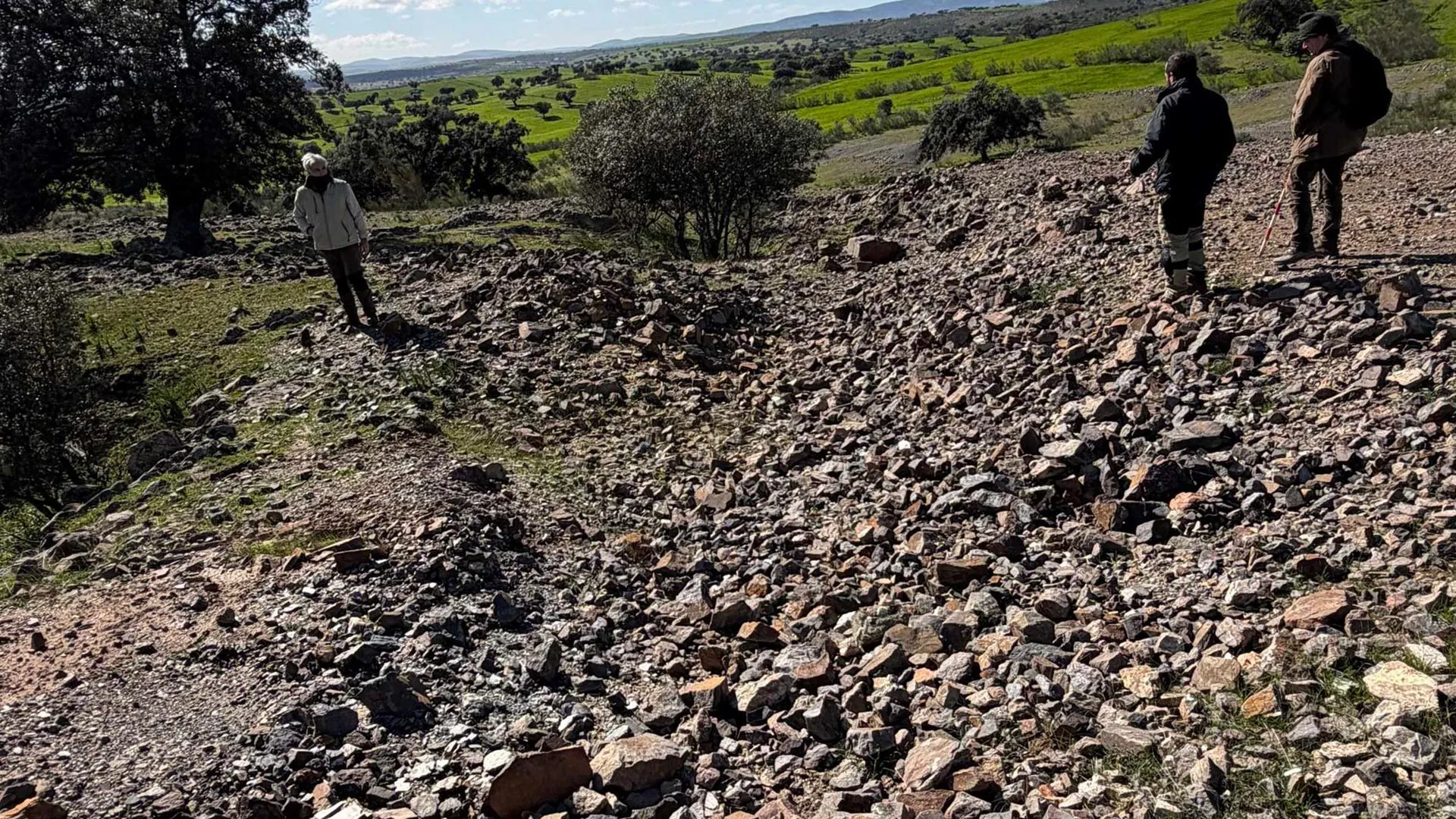
An archaeological find in Extremadura is helping to rethink how metals moved around Europe during the Bronze Age. Researchers linked to the Maritime Encounters program at the University of Gothenburg identified six previously unregistered mines near Cabeza del Buey, in the province of Badajoz. The fieldwork was carried out between February 9 and 16, in collaboration with the University of Seville and archaeologists from the Provincial Archaeological Museum of
Badajoz. The
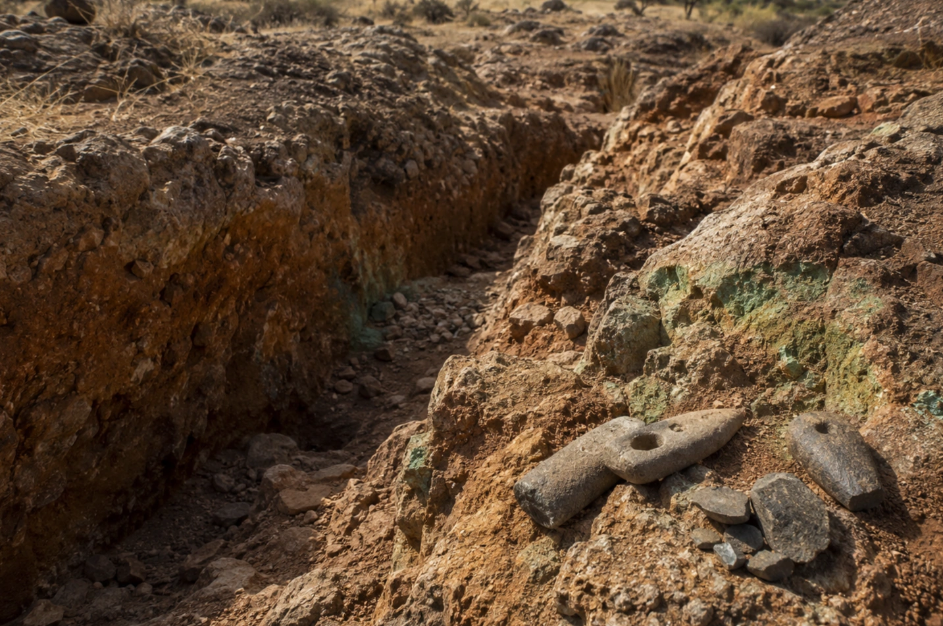
documented mines were not all the same. Some were small mining areas, while others showed more complex mining environments. In one of them, a trench of about 70 meters by 3 meters stood out, interpreted as an organized extraction of
ore with copper.
One of the most important facts was the discovery of about 80 axes or stone hammers with grooves. According to the researchers, these tools were used to break up and process the mineral. This indicates that it was not just an occasional harvest, but a mining activity with a certain degree of organization
.
The mines contain copper, lead and silver, three metals relevant to Bronze Age economies. Copper was essential for making bronze when combined with tin, while lead and silver also had economic and technological importance. The presence of these materials makes it possible to link the discovery with old production and exchange networks
.
The importance of the discovery increases because previous chemical and isotopic studies on Bronze Age objects in Scandinavia had already suggested that some of these metals may have come from southwestern Spain. A study published in the Journal of Archaeological Science analyzed 33 bronze objects dated between 1600 BC. C. and 700 a. C., and concluded that his compositions did not match local Scandinavian minerals. That research reinforced the idea that the metal used in Sweden was imported
.
The new finding alone does not prove every trade route, but it does provide a physical archaeological context for a hypothesis that previously relied mainly on laboratory analysis. In other words, now there are not only Scandinavian objects with chemical signals compatible with the Iberian southwest, but also specific mines in that region that could be part of that
system.
The topic also relates to broader research on copper production in Iberia. An academic program at the University of Seville on Iberian copper production points out that recent work has identified more than 40 possible Late Bronze Age mines in southwestern and central Spain. That same document mentions estimates of up to 166 prehistoric sites still understudied in the region.
The Late Bronze Age in this context is situated approximately between 1300 and 800 BC. C., according to the conference program. It is also indicated that isotopic and geochemical analyses have linked copper from at least 41 mines to bronze objects found in different European regions, including Scandinavia, England, France, Ireland, Sardinia and Poland. This suggests a larger circulation scale than imagined for a long time
.
Cabeza del Buey is located at the eastern end of La Serena, in Badajoz, on the slope of the Sierra del Pedregoso. This location helps to understand why the landscape could be attractive for old extractive activities. The discovery adds archaeological value to an area that today forms part of the Extremadura interior, but which in the Bronze Age may have been connected to much larger circuits
.
The most prudent reading is that these mines are a new piece in a larger puzzle. Johan Ling, professor of archaeology at the University of Gothenburg, said that recent discoveries are changing the understanding of how connected Europe was about 3,000 years ago. He also pointed out that in Extremadura and Andalusia there could be up to 150 prehistoric mines left undocumented
or investigated.