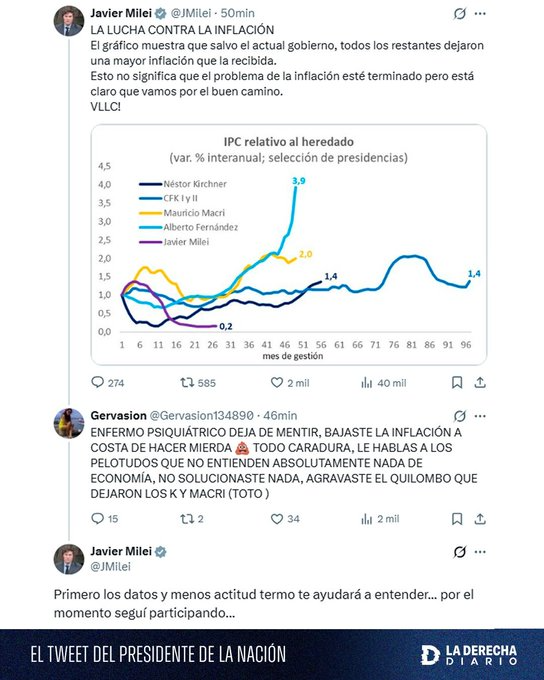

In a context where inflation remains one of the central issues of the Argentine economy, President Javier Milei used the Memorial Day holiday to focus on the indicator he considers key to evaluating the direction of his administration: the fight against inflation. Along these lines, the president published a message on the social network X this Tuesday accompanied by a comparative graph that analyzes the evolution of the price index during the first months of different governments. The President's publication focused on showing how the Consumer Price Index (CPI) evolved year-on-year relative to the level inherited at the beginning of each term of office, comparing the performance of the governments of Néstor Kirchner, Cristina Fernández de Kirchner (CFK), Mauricio Macri, Alberto Fernández and Milei himself. The graph seeks to illustrate inflationary trajectories under different administrations
and macroeconomic contexts.In his message, the president was forceful in interpreting the data: “The graph shows that except for the current government, all the others left higher inflation than received. This doesn't mean that the inflation problem is over, but it's clear that we're on the right track.” The dissemination of the graphic from the President's official account generated immediate repercussions in the public conversation and in different news media. Milei himself actively participated in the debate on the social network, responding to users and defending the reading of the data he presented. The published graph shows the year-on-year percentage change in the CPI relative to the beginning of each presidential term, with a line that represents each of the five leaders analyzed. Each curve reflects how inflation evolved compared to the level that existed when each president took office, evidencing marked differences depending on the period and the economic context in which each administration governed
.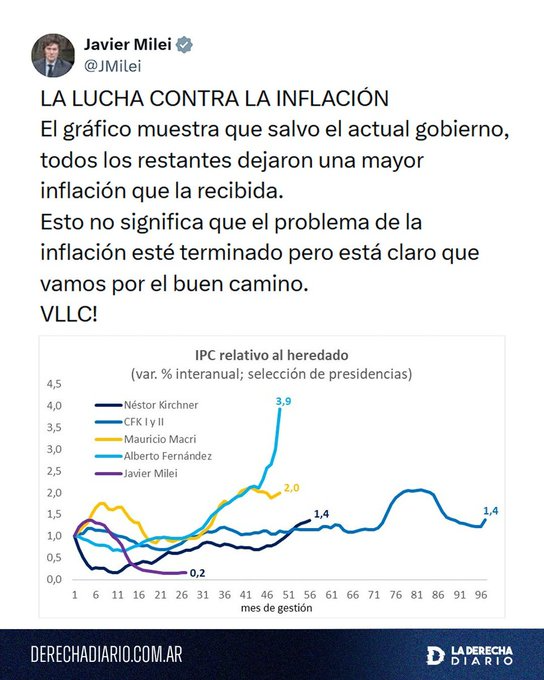
In the case of Javier Milei, the curve covers the first months of his administration, which began in December 2023 and is still ongoing. According to the graph released by the president, 26 months into his term of office, year-on-year inflation is at a level equivalent to 0.2 times the level inherited when he assumed office. On this point, the President emphasized that his government is the only one compared to that which does not increase inflation compared to that received. Even so, he clarified that the fight against inflation is not finished, although he considered that the data reflect a change
in trend.The comparison also includes the inflation trend during the presidencies of Néstor Kirchner and Cristina Fernández de Kirchner. In the case of Kirchner, the curve shows an initial decline in inflation, although towards the second half of his administration there is an uptick.
At the end of his term of office, official data indicated a low level of inflation, but different private estimates showed significant discrepancies with respect to the figures released by INDEC.In fact, by December 2007, when Néstor Kirchner's government ended, there were already public questions about the reliability of official inflation data. Private sector analysts and consulting firms estimated that real inflation was between 17% and 22%, values higher than those officially reported. In the graph released by Milei, the former president is attributed to having brought inflation to 1.4 times the