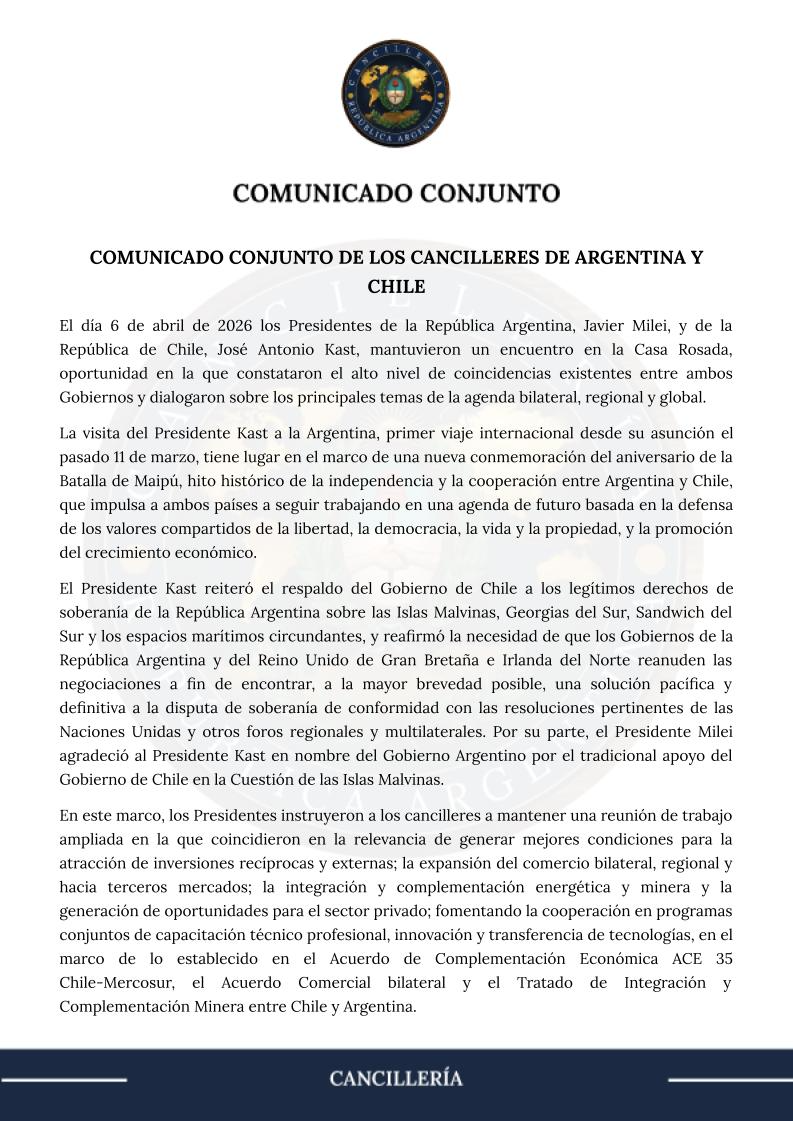

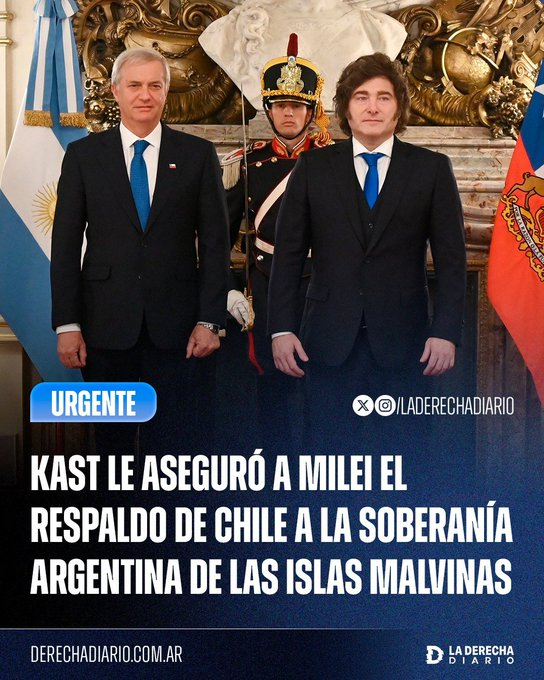
In a clear sign of strategic reorganization in South America, Argentina and Chile formalized a common agenda that prioritizes economic freedom, security and bilateral cooperation. The joint statement released by the foreign ministries of both countries after the meeting between Javier Milei and José Antonio Kast at the Casa Rosada summarizes a political and ideological alignment that seeks to project itself at the regional and global levels. The document highlights that both leaders “confirmed the high level of existing coincidences between the two Governments” and advanced on the main axes of the bilateral, regional and global agenda. Kast's visit — the first international trip since his inauguration on March 11 — is also part of the commemoration of the Battle of Maipú, a historic symbol of cooperation between the two countries, and reinforces an agenda aimed at “the defense of the shared values of freedom, democracy, life and property, and the promotion of economic
growth”.One of the strongest points of the statement is Chile's explicit support for Argentine sovereignty over the Falkland Islands. In textual terms, it is emphasized: “President Kast reiterated the support of the Government of Chile for the legitimate sovereign rights of the Argentine Republic over the Malvinas Islands, South Georgia Islands, South Sandwich Islands and the surrounding maritime areas, and reaffirmed the need for the Governments of the Argentine Republic and the United Kingdom of Great Britain and Northern Ireland to resume negotiations in order to find, as soon as possible, a peaceful and definitive solution to the sovereignty dispute”. The document also highlights that Javier Milei appreciated this position, reaffirming the strategic value of the “traditional support of the Government of Chile in the Question of the Malvinas Islands”, in a context where Argentine foreign policy seeks to regain firmness and predictability
.
At the economic level, the statement outlines a clear road map for boosting growth through the private sector. Both governments agreed on the need to “create better conditions for attracting reciprocal and external investment; the expansion of bilateral, regional and third markets trade; energy and mining integration and complementation and the generation of opportunities for the private sector”. This scheme is based on existing frameworks such as the ACE 35 Chile-Mercosur Economic Complementation Agreement, the bilateral Trade Agreement and the Mining Integration and Complementation Treaty
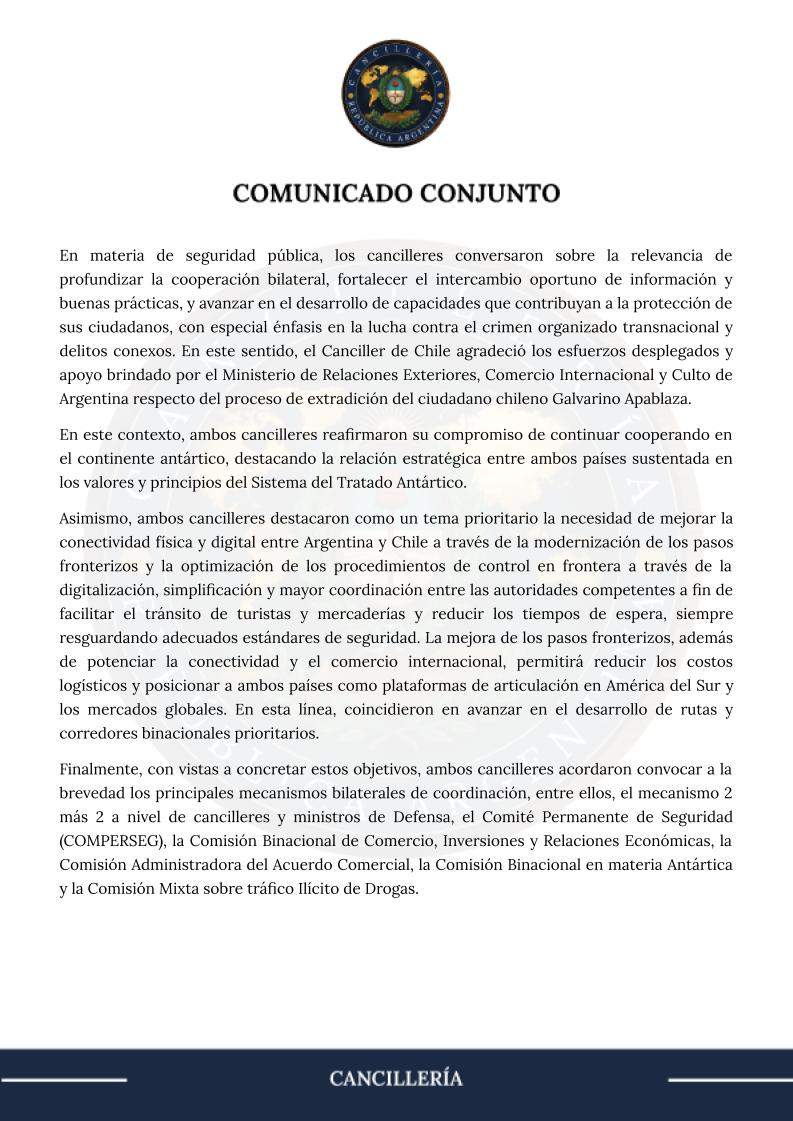
.In terms of security, the text emphasizes the fight against transnational organized crime, establishing the importance of “deepening bilateral cooperation, strengthening the timely exchange of information and good practices, and advancing the development of capacities that contribute to the protection of its citizens”.