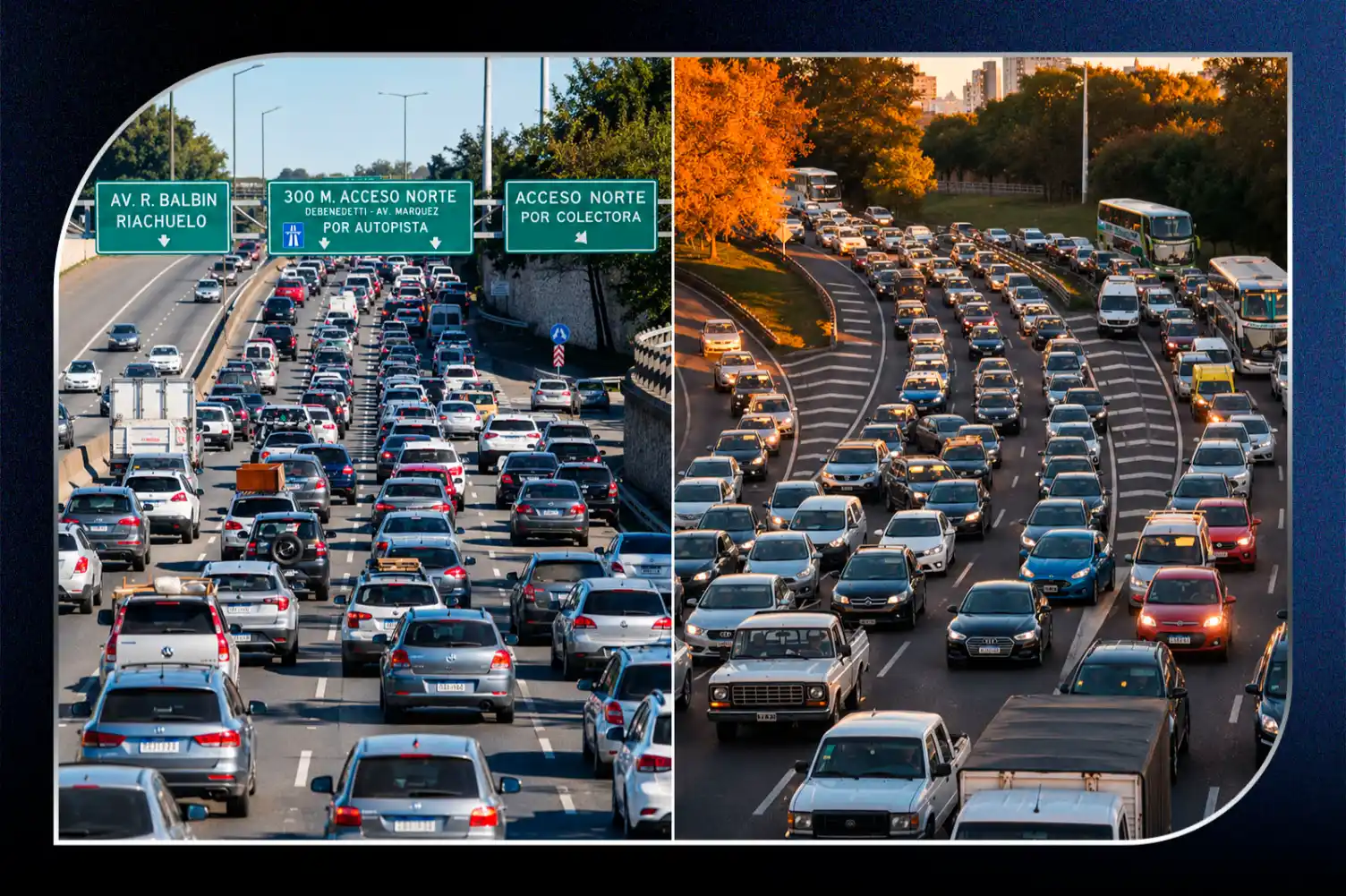
During the pandemic, thousands of families left the City of Buenos Aires to move to houses with gardens and pools in the North Zone. Five years later, the return of face-to-face activity, the collapse of access and a new assessment of urban life are beginning to reverse that trend
So the parents find themselves living alone in a huge house, with empty rooms, a garden to maintain and expenses to pay for.
What was once an ideal solution for a large family is starting to lose meaning.
And there the city once again appears as an attractive alternative.
The real luxury of the future will be to live experiences
.
But there is another factor that I consider to be even more important in the long term.
I think that in the future, people will increasingly value experiences over the amount of square meters they own.
And, from that point of view, few things can compete with a big city.
Buenos Aires has an extraordinary cultural wealth. Its museums, theaters, bookstores, cinemas, restaurants, squares, parks, nightclubs, historic buildings and architecture offer a practically inexhaustible amount of experiences
.
Living in a city means having all that at your fingertips.
Being able to walk out to dinner, go to the theater, visit an exhibition, visit a bookstore or simply enjoy the architecture of a neighborhood is a way of quality of life that we often underestimate.
Of course, living in a gated neighborhood has indisputable advantages: tranquility, security, green spaces and greater privacy. But these advantages have a counterpart when most of our working, educational, social and cultural life takes place within the city
.
Time is also heritage. And regaining hours of life that were previously lost traveling has enormous value
.
What does this mean for the real estate market?
My vision is that we are beginning to see a partial reversal of the exodus that caused the pandemic.
It doesn't mean that countries are going to disappear or that all families want to leave the North Zone. But I do believe that the demand for well-located properties within the City of Buenos Aires will continue to strengthen
.
The dynamism shown by the Buenos Aires market in the last two years, with a very significant recovery of the deeds, is consistent with this renewed interest in the city, although it also responds to other factors, such as the recovery of mortgage credit.
In short, I think that the pandemic made us value the space, the garden and the pool. But the return to normality is reminding us of the value of location, time and experiences
.
And if I had to summarize my real estate vision for the coming years in a single sentence, it would be this:
During the pandemic, people were willing to move away from the city to gain square footage. Today he is starting to give up square meters to recover time and quality of life
.
And I think that trend will continue to boost the value of well-located properties in Buenos Aires.
Five years ago, in the midst of a pandemic, it seemed that the future was outside the big cities. Teleworking, virtual universities and online classes had completely changed the way we live. If you could work and study from anywhere, why not move to a house with a garden, pool and green spaces in
Zona Norte?
Thousands of families made that decision. Gated neighborhoods and countries experienced strong growth in demand and life away from the city seemed to be the new paradigm
.
However, five years later, the equation began to reverse.
The offices returned to face-to-face activity, the universities recovered their classrooms and the schools resumed their normal operation. And with that return, one of the great problems of living far from the city appeared again: traffic.
Today, the accesses to Buenos Aires, especially the Pan-American Highway, have daily traffic jams that can transform a relatively short trip into lost hours in the car.
If you are interested in investing in the real estate market, click on the image and join the Briones Group.
Let's make a simple account. A person who lives in the North Zone and works five days a week in downtown Buenos Aires, with an hour and a half one way and another hour and a half back, spends three hours a day traveling
.
That's 15 hours a week and 780 hours a year. That is, 32.5 full days a year above the car, assuming 52 weeks of travel. More than a month of life dedicated exclusively to moving.
I always say, half jokingly and half seriously, that every time there is heavy traffic in the Pan-American Highway, the value of my properties in the City of Buenos Aires increases.
And I think that phrase pretty much sums up what's starting to happen.
More and more families that had moved to the North Zone are looking to return to having a base in Capital, even if it is by buying a two-room apartment to use during the week. Closeness to work, universities and daily activities is once again a fundamental attribute
.
The oversupply of houses and the cost of replacement
On
the other side of this trend, we find a housing market with a very significant supply, especially in gated neighborhoods and countries in the province of Buenos Aires
.
Today we can find properties that sell for USD 200,000 and whose construction from scratch, not necessarily counting the land, could cost USD 400,000.
In other words, there are used houses that are being sold well below their replacement cost.
This is a particularly interesting phenomenon because construction costs in dollars are at historically high levels. However, that doesn't mean that the market is willing to pay for a used home what it would cost to build
it again. If you are interested in investing in the real estate market, click on the image and join the Briones Group.
Added to this situation are high expenses, maintenance costs for large properties and changes in family needs.
Many families moved to countries when their children were young, seeking safety, a garden and spaces to play. But as the years go by, the children grow up, start college, get jobs and eventually move to Capital