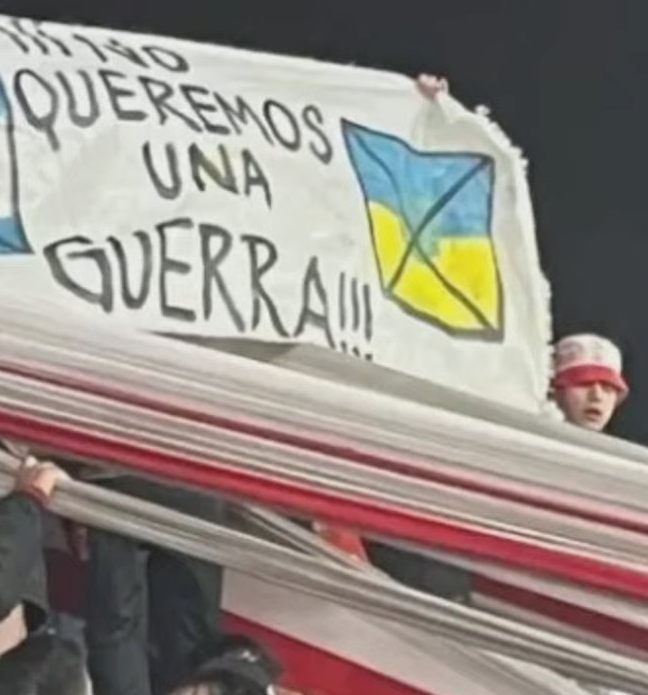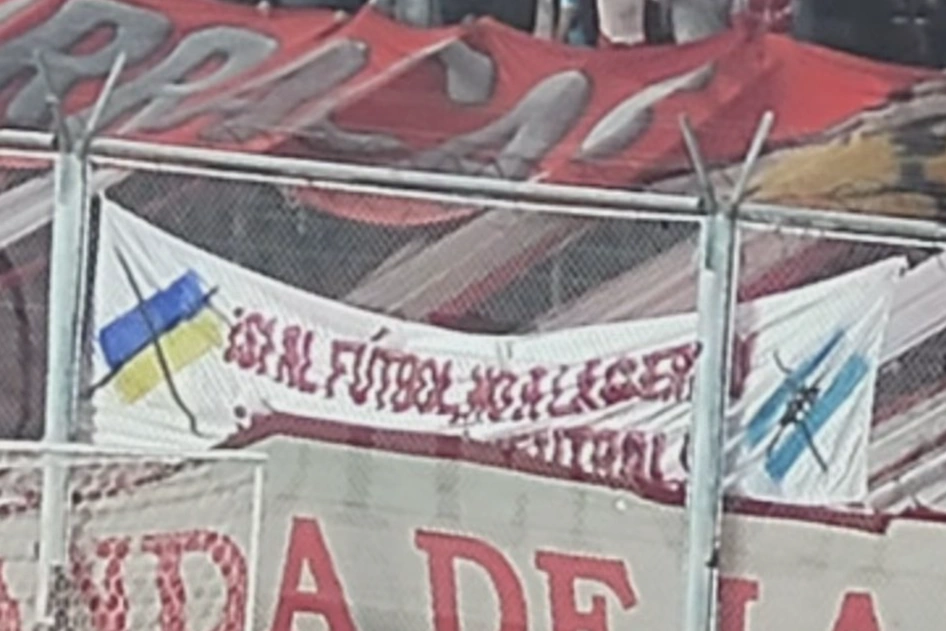

Within the framework of international research that exposed an organized disinformation network driven by Russia to influence Argentine politics, ramifications are beginning to emerge that go beyond the media level and extend to high-impact social spaces, such as football. One of the most significant episodes occurred on August 24, 2024, during a match between Huracán and Argentinos Juniors at the Independente stadium, where Barrabravas displayed a 20-by-2-meter flag with explicitly anti-Ukraine content, in which the name of the country appeared crossed out, accompanied by the slogan “Yes to football, no to war”. Far from being a spontaneous expression, the fact takes on another dimension in the light of the leaked documents: the disinformation network not only aimed at the administration of Javier Milei, but also sought to install an international agenda aligned with the interests of the Kremlin, particularly contrary
to Ukraine.These types of demonstrations, in a global context marked by the conflict between Russia and Ukraine, are part of a broader strategy that uses symbols, slogans and high-visibility spaces to influence public perception. Argentine football, due to its mass and ability to arrive, appears as a strategic terrain for amplifying messages that, under a neutral or pacifist appearance, can respond to a defined geopolitical logic. The revelations come in parallel with the confirmation that, since 2024, a structure linked to the Russian government has deployed a systematic campaign in Argentina with the objective of discrediting the ruling party. According to the documents analyzed, at least 250 paid articles were published in more than 20 digital media, with content critical to the Government's economic plan and foreign policy, including messages favorable to Russia and against the United States.
Among the media mentioned are C5N, Ámbito, Diario Con Vos, El Destape, Big Bang News, Diario Registrado, A24, Realpolitik, Argentine Politics, Tiempo Argentino, Grito del Sur, El Cronista, Infocielo and Data Clave, among others. The operation involved the use of false identities generated with artificial intelligence, non-existent journalists and digital profiles designed to give the appearance of legitimacy to the published content. One of the most sophisticated mechanisms detected was the creation of fictional journalists using artificial intelligence tools. Cases such as that of Manuel Godsin, presented as a doctor by the University of Bergen and a member of a supposed “Center for Political and Strategic Studies”, were completely denied. His image actually corresponded to a Russian citizen identified as Mikhail Malyarov, and had already been exposed in 2025 by the media outlet Africa Confidential as a “virtual profile” used to
spread pro-Russian disinformation.A report by Code for Africa, based on an OpenAI report, confirmed that it was a “fictitious identity” created to “whitewash Russian narratives in conventional media”, using content generated with tools such as ChatGPT. The investigation also identified other false signatures used in Argentina, such as Gabriel Di Taranto, Juan Carlos López and Marcelo Lopreiatto, whose names appeared in articles published in different media. In the case of the Registered Journal, the leaked documents attribute the publication of 26 articles for a total of $28,600