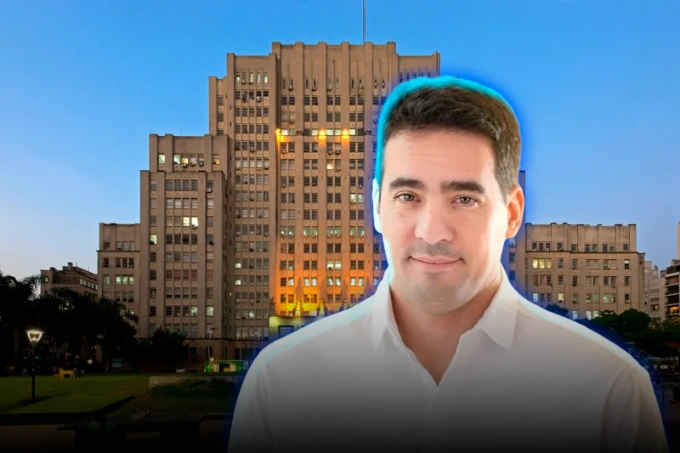
Adrián Ravier starred in a heated exchange this Tuesday during the press conference, after a journalist accused him of spreading false information about the number of foreigners studying medicine for free at national universities, an accusation that the spokesperson countered with official figures and then dismantled by publishing the complete data on his social media.
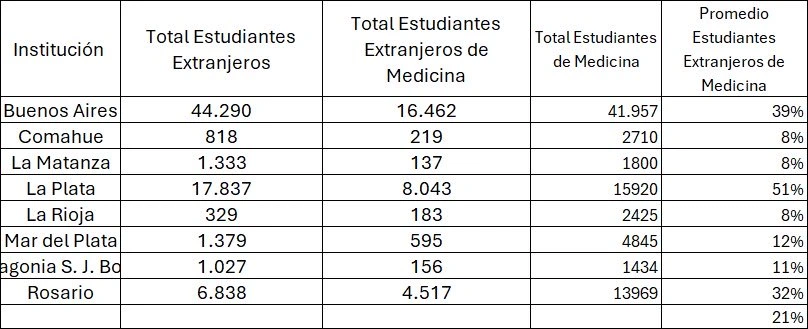
Ravier confirmed that 39% of the regular students at the Faculty of Medicine of the University of Buenos Aires are foreigners. According to the chart released, the program has 41,957 students, of which 16,462 come from other countries and access education without paying fees, funded by Argentine taxpayers.
The painting disseminated by Adrián Ravier
The journalist had interrupted the conference multiple times with the phrase "that data is false", without presenting alternative figures or reports that contradicted the information provided by the spokesperson. After the conference, Ravier shared the documentation and emphasized that his statement was correct, leaving the accusation made during the exchange unsupported.
The statistics, attributed to the Undersecretary of University Policies of the Nation, Alejandro Ciro Álvarez, also show that the phenomenon is not limited to the University of Buenos Aires (UBA). At the National University of La Plata, foreigners already represent the majority of medical students: there are 8,043 out of a total of 15,920 students, which amounts to 51% of the enrollment.
The National University of Rosario (UNR) also records a considerable presence, with 4,517 foreign students out of 13,969 medical students, a proportion of 32%. At the National University of Mar del Plata, they reach 12%, while at the National University of Patagonia San Juan Bosco, they represent 11%.
At the national universities of Comahue, La Matanza, and La Rioja, foreigners make up 8% of medical students. Overall, the institutions included in the survey register an average of 21%, although there are significant differences between each institution.
The numbers have reignited the discussion about the funding of public universities and the free education for foreigners, especially in programs like Medicine, whose training requires a high state investment in teachers, hospitals, infrastructure, equipment, and professional practices, which is rarely compensated by foreigners who train and return to their country of origin.