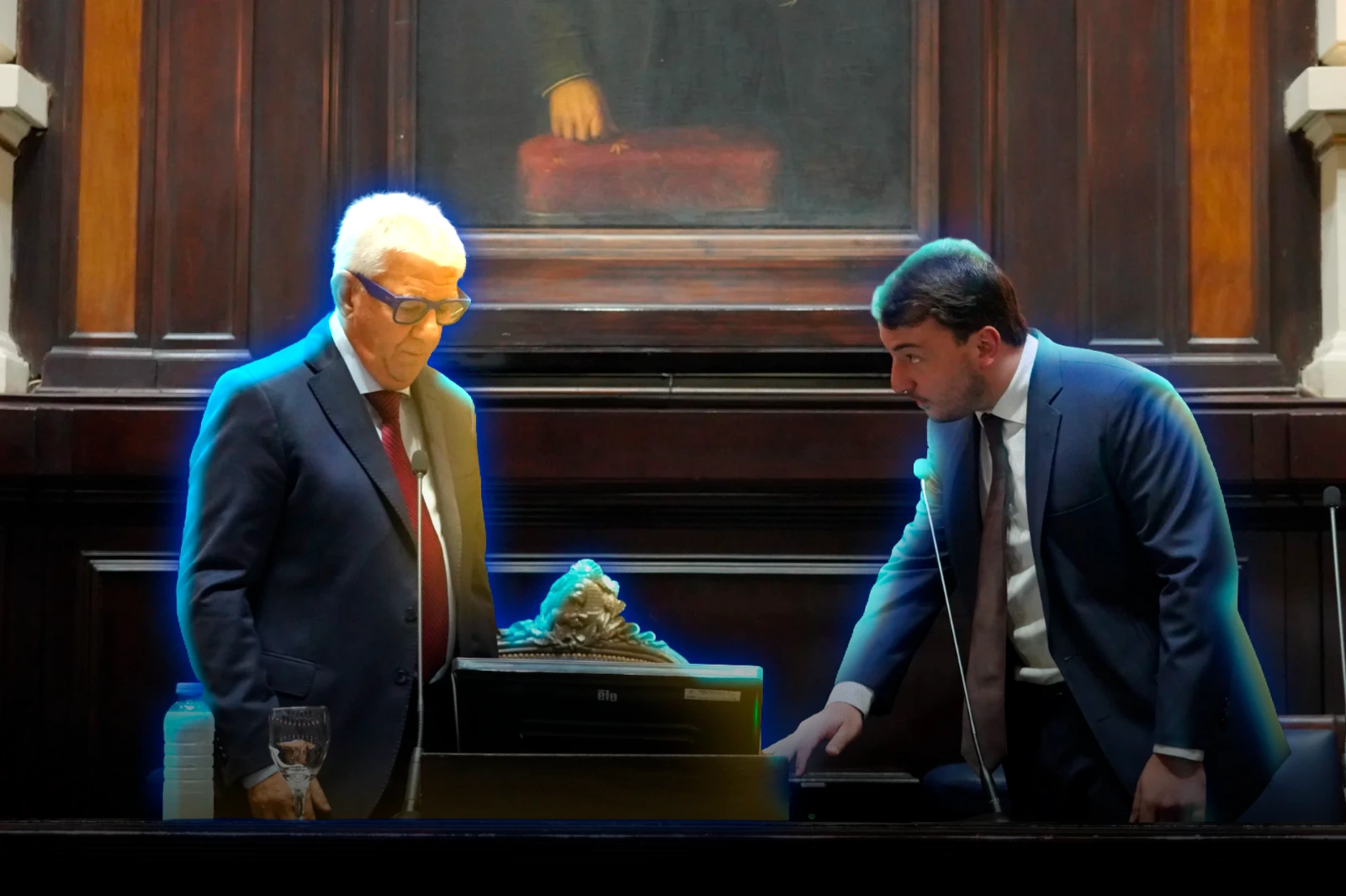
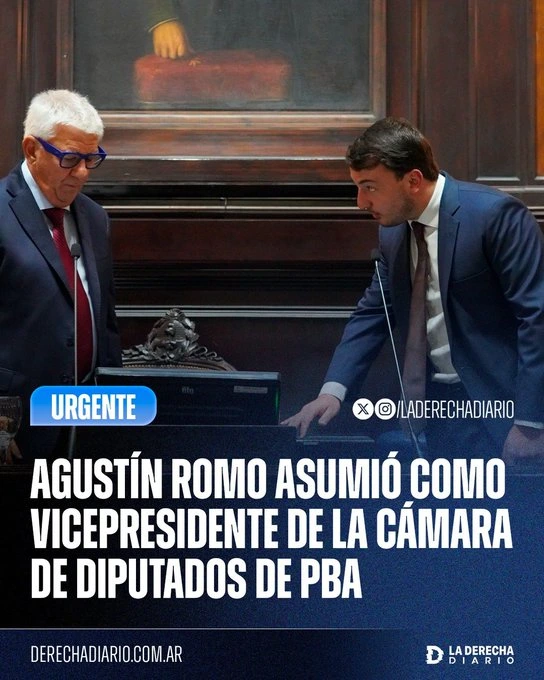
"It was almost 2 years as President of the LLA bloc where we achieved a lot, starting with just a few and now being 20," he emphasized upon taking office as vice president of the Buenos Aires Chamber of Deputies
The rise of Agustín Romo to the Vice Presidency of the Chamber means he leaves his previous role as leader of the party bloc, in a highly orderly political exchange that places the institutional integrity of the forces of change above any personal circumstance.
As part of this strategic restructuring, the presidency of the La Libertad Avanza bloc in the Chamber of Deputies was assumed by his counterpart from La Plata, Juan Osaba, a leader firmly aligned with the provincial architect of the force and president of the party in Buenos Aires territory, Sebastián Pareja.
In a historic day for the forces defending freedom in Argentina, Agustín Romo officially assumed the role of Vice President of the Chamber of Deputies of the province of Buenos Aires. This appointment represents a milestone of enormous institutional relevance for the consolidation of the national project of President Javier Milei in the most populous province of the country. The arrival of Agustín Romo to this key parliamentary leadership position formalizes a well-deserved recognition of his outstanding political work, having successfully served for almost two years at the helm of the La Libertad Avanza bloc in the Buenos Aires legislature.
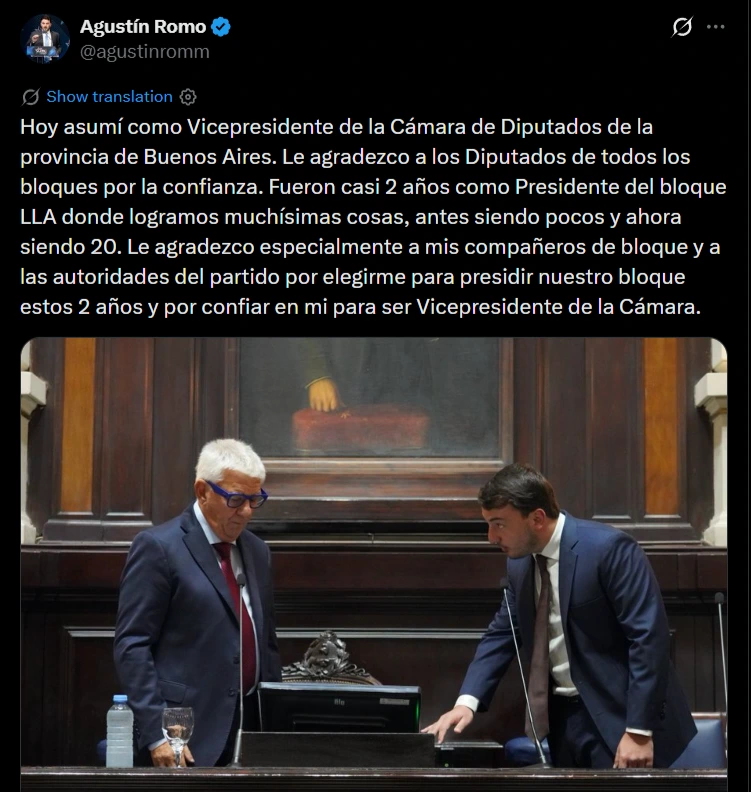
After taking the oath and assuming one of the Vice Presidencies of the Chamber, Agustín Romo used his social media to express deep gratitude for this achievement and the trust placed in his leadership. In his emotional and forceful message through the X platform, the newly appointed Buenos Aires vice president stated:
Agustín Romo
"Today I assumed the role of Vice President of the Chamber of Deputies of the province of Buenos Aires. I thank the Deputies from all blocs for their trust. It has been almost 2 years as President of the LLA bloc where we achieved many things, starting with just a few and now being 20. I especially thank my fellow bloc members and the party authorities for choosing me to lead our bloc these 2 years and for trusting me to be Vice President of the Chamber".
The management of Agustín Romo at the head of the ruling bloc was characterized by a historic feat of expansion and articulation of the libertarian space, managing to go from having just a few initial legislators to forming a strong and united bloc of 20 deputies.
"It has been almost 2 years as President of the LLA bloc where we achieved many things, starting with just a few and now being 20", emphasized the legislator while highlighting the astonishing expansion of the liberal movement against the Buenos Aires status quo. This exponential growth demonstrates the solidity of the ideas of freedom and the phenomenal leadership of Agustín Romo, who successfully led the ruling bloc in a context of high demands and constant opposition pressure.
The significant movement of authorities was formalized during the ordinary session of the Buenos Aires Legislature, formally convened by the President of the lower Chamber, Alejandro Dichiara, marking the formal resumption of legislative activity after the closure of the winter recess.
This transition, which had been articulated with maturity and political responsibility for months, resulted in an exchange of functions between the two libertarian legislators, given that the position of Vice President of the Chamber that Agustín Romo assumes was previously held by Juan Osaba himself.
The reorganization exposes a solid realignment of internal political forces that consolidates the undeniable influence of the central leadership of Sebastián Pareja and the General Secretary of the Presidency of the Nation, Karina Milei, over the Buenos Aires legislative representation.
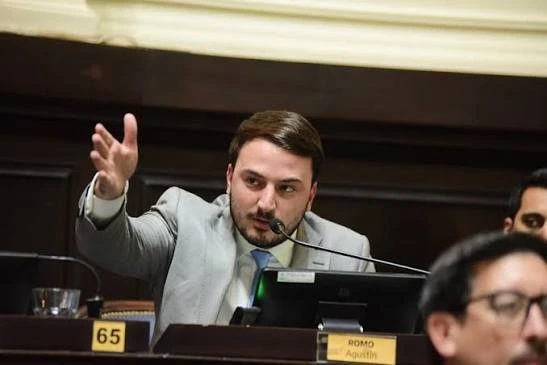
Agustín Romo
The powerful legislative bloc of 20 deputies of La Libertad Avanza in the provincial lower Chamber maintains its cohesion in the face of upcoming challenges. Although predominantly composed of legislators aligned with the leadership of Sebastián Pareja, the space organically brings together minority sectors loyal to major figures of President Javier Milei's government.
The libertarian bloc is solidly completed, in addition to its two key figures, Agustín Romo and Juan Osaba, with deputies Gastón Abonjo, Francisco Adorni, Maximiliano Bondarenko, Geraldine Calvella, Jazmín Carrizo, María Fernanda Coitinho, Oriana Colugnatti, Analía Corvino, Héctor Gay, Oscar Liberman, Pablo Morillo, Alberto Ontiveros, Carla Pannelli, Sofía Pomponio, María Florencia Retamoso, Nahuel Sotelo Larcher, Teodoro Vera Chávez, and Mariela Vitale