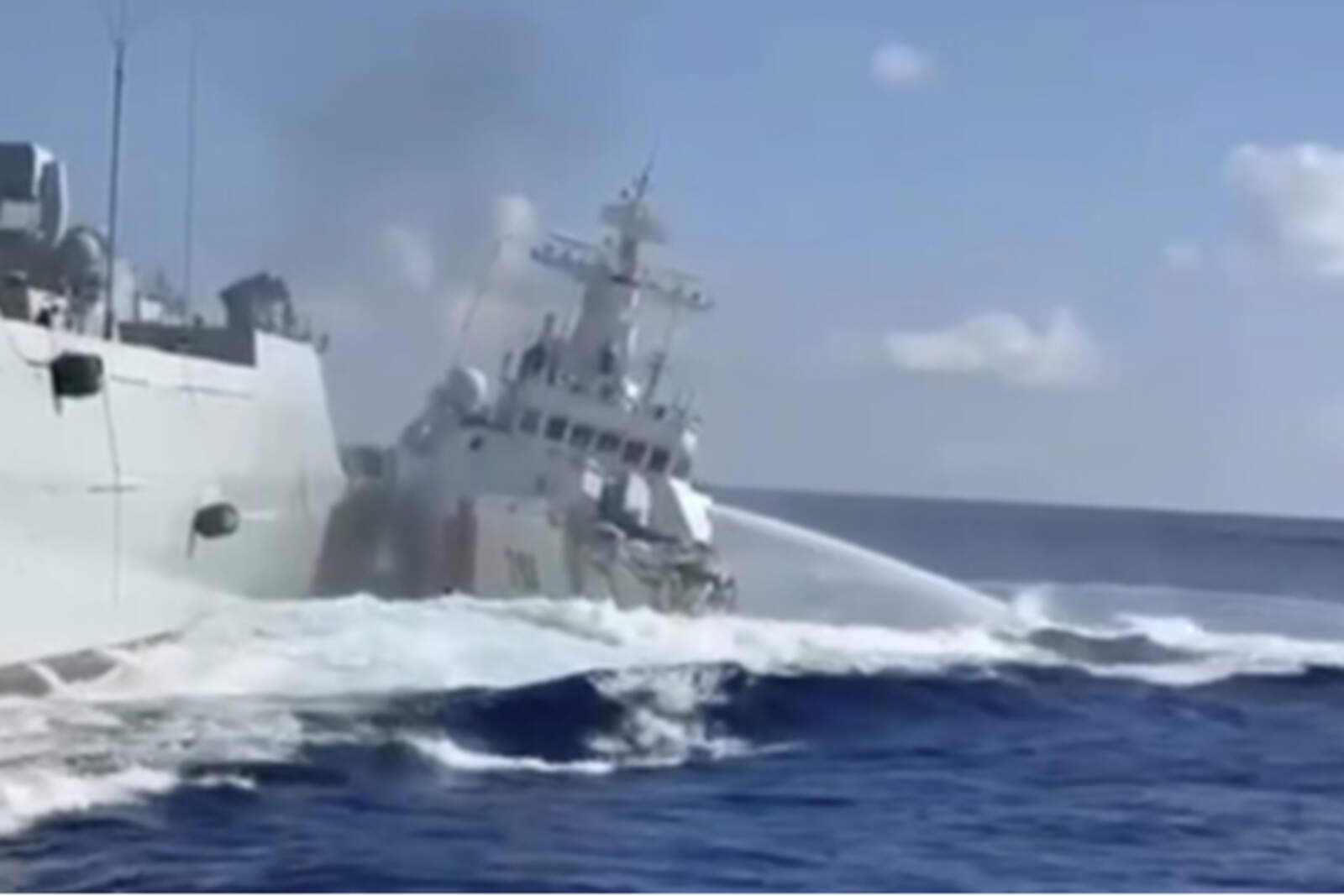
Last Sunday, the Philippine Coast Guard stated that a Chinese military vessel had intentionally attacked a Manila ship
Compartir:
On Sunday, the Philippine Coast Guard reported that a Philippine government vessel was "deliberately rammed" by a Chinese ship near Thitu Island in the disputed South China Sea. The incident involved the Philippine vessel BRP Datu Pagbuaya, belonging to the Bureau of Fisheries and Aquatic Resources, which was anchored in the area when it was attacked.
According to the official Philippine statement, the incident occurred at around 9:15 a.m., when a Chinese Coast Guard vessel fired water cannons at the BRP Datu Pagbuaya.
Only three minutes later, the same Chinese vessel rammed the rear of the Philippine ship, causing minor structural damage, although no crew members were injured. Manila described these actions as acts of harassment and aggression, but assured that it will not be intimidated or expelled from the maritime zones it considers its own.
The incident took place near Thitu Island, called Pag-asa by the Philippines, part of the Spratly Islands group, a strategically important and resource-rich region that has been the subject of territorial disputes for decades.
Although multiple countries claim parts of the South China Sea, China insists that almost the entire area belongs to it, despite a 2016 ruling by the international arbitral tribunal in The Hague that rejected the legal validity of such claims.
As is usual in this type of confrontation, China offered a different version of events. Liu Dejun, spokesperson for the Chinese Coast Guard, stated that the Philippine ship ignored multiple warnings and approached the Chinese vessel in a dangerous manner, holding Manila responsible for the collision. This narrative is part of the ongoing pattern of mutual accusations between the two nations regarding actions in the region.
La Guardia Costera de China dio versiones diferentes a las expuestas por Manila
This new episode is just one more in the long list of maritime tensions between China and the Philippines, which have intensified in recent years as Beijing strengthens its presence in the sea with military bases, patrols, and the construction of facilities on artificial islands. Meanwhile, the Philippines has maintained and reinforced its sovereignty over several islands, including Thitu, which is home to a small civilian community and military presence.
In response, the Philippine government has reiterated its commitment to defend its sovereignty and maritime rights, publicly denouncing what it considers intimidation tactics by China. The international community, especially the United States, has repeatedly expressed its support for the Philippines and its concern over the increase in Chinese aggression in the area.