
For years, Argentine politicians tried to convince us that country risk was an external phenomenon, almost meteorological. A capricious variable dominated by "the markets," those abstract villains that Kirchnerism pointed to every time its disasters became impossible to hide. However, reality, as always, was much more uncomfortable for the narrative: country risk doesn't measure ideological sympathies, it measures fear. And fear has a concrete source: the State when it becomes unpredictable, confiscatory, and morally irresponsible.
Country risk is nothing more than the price of living with a political power that claims the right to change the rules of the game whenever it suits it. Chronic inflation, serial defaults, capital controls, arbitrary taxes, covert expropriations. All that is not a "model," it is an institutional threat. When the State threatens, capital flees. Always.
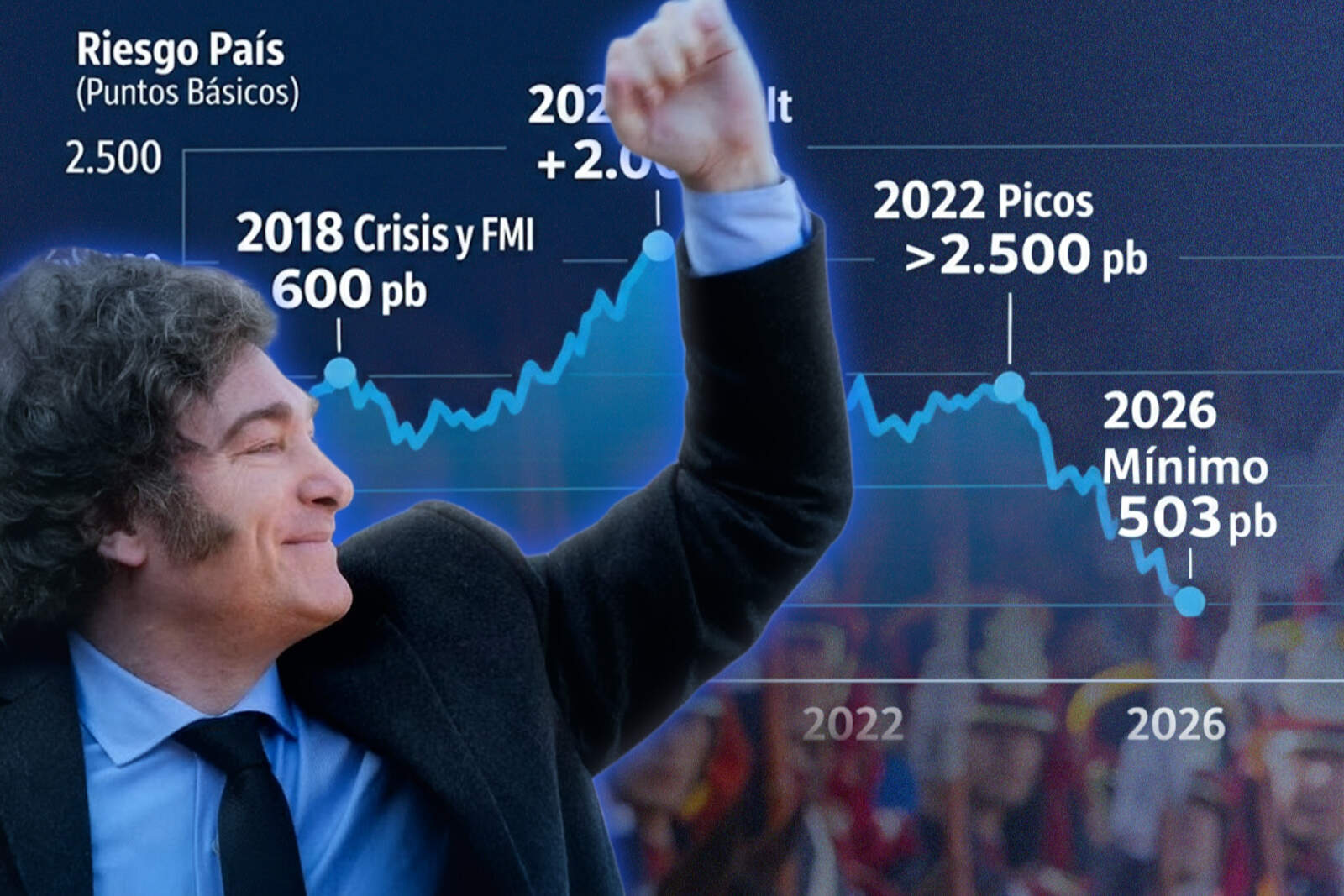
This is why the recent drop in Argentine country risk to its lowest level in the last seven years is not just a technical data point. It is a silent plebiscite. Investors—who risk their own money, not slogans—are factoring in something that traditional politics never wanted to accept: that fiscal discipline, respect for private property, and institutional predictability matter more than any social narrative.

Because capital doesn't fall in love with countries; it evaluates institutional frameworks. It doesn't respond to speeches; it responds to incentives. When a government demonstrates, even before completing reforms, that it understands the limits of political power, risk begins to fall. Not because the country "grows," but because the State stops behaving like a predator.
For decades, Argentina was the manual of the opposite. Peronism—in all its variants—turned the State into a tool of morally justified plunder. Going into debt was not a problem; paying it back was not either. Expropriating was "sovereignty." Issuing money and producing inflation was "redistributing." Under that scheme, country risk was not an anomaly: it was the logical consequence of a system designed to violate contracts and punish those who save.