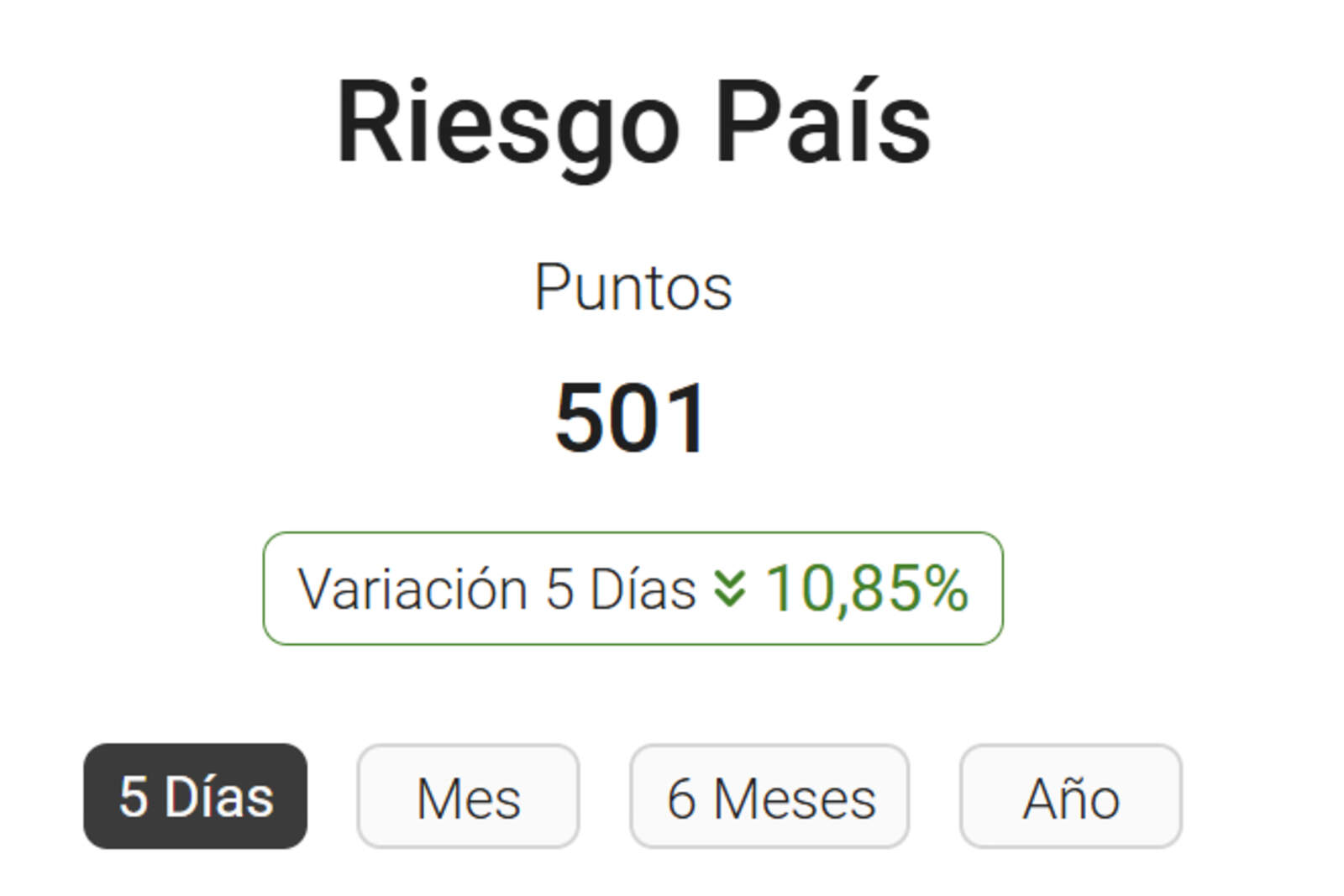
Country risk fell to 501 points, its lowest level since 2018, driven by the BCRA's dollar purchases
Compartir:
Country risk deepened its downward trend and stood at around 501 basis points, the lowest level since mid-2018. The strong compression of the indicator is once again bringing Argentina closer to international debt markets and reflects a sustained improvement in sovereign bond prices.
The index prepared by JP Morgan has accumulated a drop of more than 600 points since the ruling party's victory in the legislative elections. This is being achieved in a context of greater macroeconomic predictability and concrete signals on the financial front.
El riesgo país tuvo una caída de 600 puntos desde el triunfo del oficialismo
The key behind the decline: accumulation of reserves
The consensus among private analysts agrees that the main factor behind the drop in country risk is the accumulation of international reserves by the Central Bank.
In 2025, the monetary authority avoided buying foreign currency within the exchange rate band. Today there is a key difference, the Central Bank of the Argentine Republic has launched an active dollar purchase program.
Desde enero se adquirieron aproximadamente 1.017 millones de dólares
Since the beginning of January, the body headed by Santiago Bausili has acquired approximately USD 1.017 billion. The acquisition took place both in the Mercado Libre de Cambios and through block trades with companies and institutional investors.
These purchases were carried out without generating tensions in the exchange rate and already represent close to 10% of the planned annual target.
Luis Caputo junto a Santiago Bausilli.
Bonds on the rise and signals to the market
The improvement on the reserves front was reflected directly in the prices of Argentine sovereign bonds. These drove the decline in country risk toward the 500-point area. At current levels, a possible debt issuance abroad would imply rates close to 9% per year, yields that are still not attractive for the economic team.
Reports from consulting firms such as Invecq and PPI indicated that the market was demanding tangible signals of reserve rebuilding in order to continue compressing country risk. The change in the Central Bank's strategy was interpreted as a sign of greater solvency and macroeconomic discipline.
La estrategia del Banco Central fue bien recibida por los mercados
Looking ahead to the coming weeks, the market will continue to closely monitor the Central Bank's ability to sustain the pace of foreign currency purchases. This will be especially true in a period with lower seasonal demand for pesos and before the full inflow of dollars from the main harvest.
The continuity of this dynamic will be key to determining whether country risk can continue to compress and consolidate access to external financing.