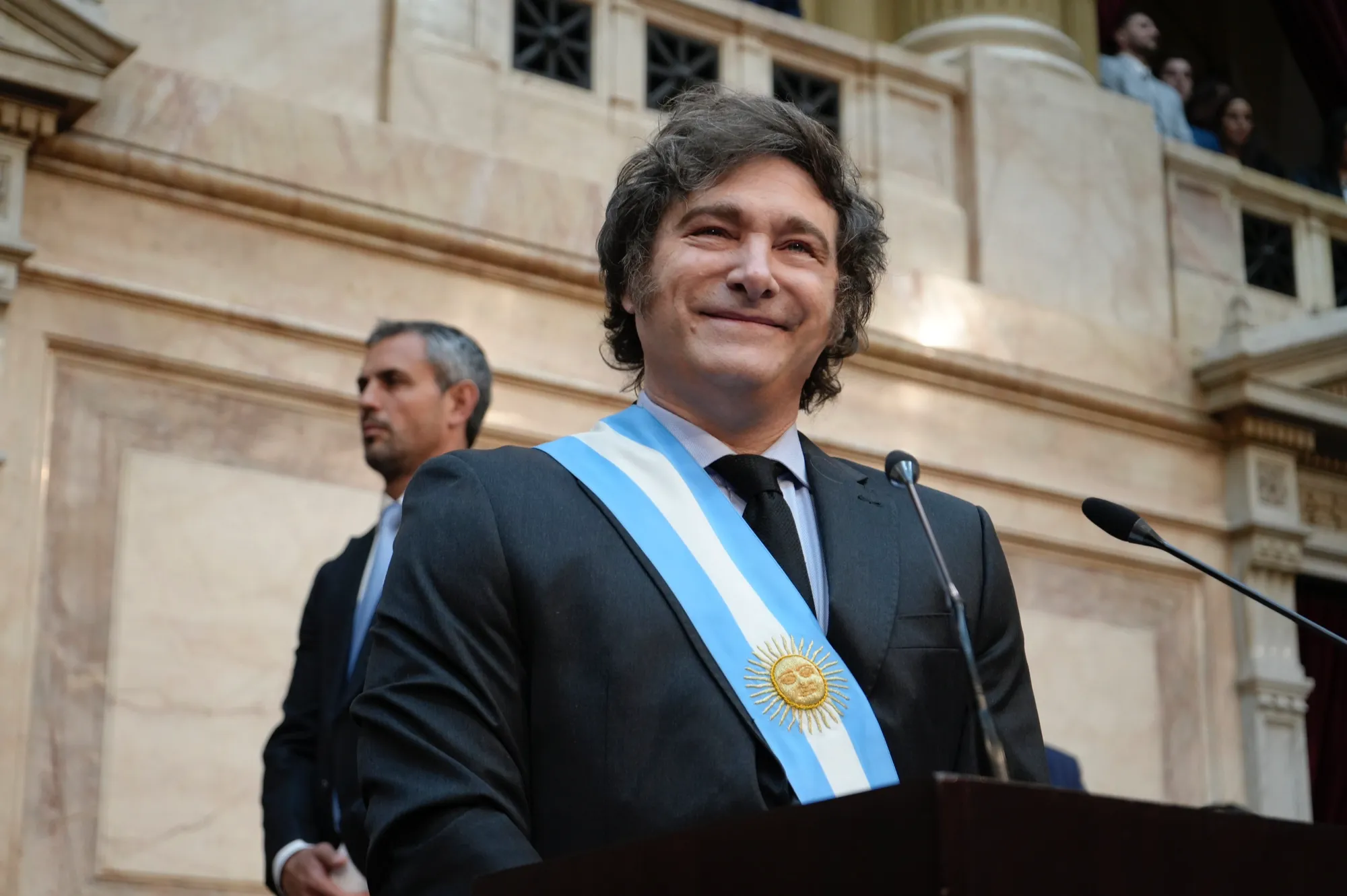
The same idea was repeated for years: liberalism could serve to write books, but not to govern a country. Real politics —they said— required more State, more regulation, and more intervention. Today, that narrative begins to crumble. Those who offer an alternative government based on freedom are no longer only in universities, think tanks, or foundations: they govern, reform institutions, and are starting to show results.
The victory of Keiko Fujimori in Peru constitutes a new sign of this change of era. Beyond the particularities of each country, her triumph adds to a regional scenario where statist recipes lose appeal and proposals oriented towards economic freedom gain political space. Argentina started this path with Javier Milei. Colombia also shows a growing questioning of interventionist models. Now Peru sends a message that transcends its borders.
Freedom has stopped asking for permission to govern.
This political change has much deeper roots than a simple succession of elections. As Milei often points out, ideas are what move the world. No lasting transformation arises solely from the ballot box; first, a cultural transformation must occur that can modify the way a society interprets its problems and evaluates its solutions. For decades, statism monopolized that ground. Today, liberal ideas are once again contesting that space by offering answers where socialism has accumulated frustrations.
But ideas only endure when they produce results. And it is precisely there that the Argentine government seeks to consolidate its main strength.
Institutional changes are no longer only observed in macroeconomics. They also begin to reflect in areas where stagnation predominated for years. The latest “Pruebas Aprender” showed improvements in various educational indicators, a relevant piece of news after long periods in which public discussion was more concentrated on ideological debates than on the quality of learning. Beyond the specific data, the challenge is to place knowledge and the formation of human capital back at the center of educational policy.
The same logic appears in the reform of the “Organic Charter of the Central Bank.” For too long, the monetary authority ceased to focus on preserving the value of the currency to become a tool at the service of financing public spending. As Milton Friedman warned, inflation is essentially a monetary phenomenon. When the central bank abandons its main mission to address short-term political objectives, the consequences end up deteriorating wages, savings, and investment.
The reform aims precisely to restore institutional limits. Jan Tinbergen explained that a single instrument can hardly fulfill multiple contradictory objectives without losing effectiveness. Expecting the Central Bank to finance the Treasury, boost growth, promote employment, and at the same time preserve monetary stability ends up weakening all those functions.
This same criterion runs through the deregulation program promoted by Federico Sturzenegger. Each eliminated procedure, every unnecessary authorization that disappears, and every bureaucratic obstacle that falls represents something more than an administrative simplification. It means returning time, resources, and decision-making capacity to millions of people who for years had to ask the State for permission to produce, invest, or undertake.
David Friedman argued that almost all state functions can be provided more efficiently through voluntary market mechanisms. Milei takes up that tradition and complements it with a vision inspired by Alberto Benegas Lynch (h), Murray Rothbard, and Jesús Huerta de Soto, for whom freedom not only constitutes a more economically efficient system but also the one that best protects human dignity by respecting property, autonomy, and the life projects of each individual.
That is why the Peruvian election should not be interpreted as an isolated episode. It is part of a regional trend where more and more citizens compare models not by their promises but by their results. For too long, socialism promised equality while multiplying inflation, poverty, corruption, and insecurity. Today, governments that bet on freedom are trying to demonstrate that there is another way.
Elections change governments; ideas change eras. If this cultural transformation continues to consolidate, Latin America could be entering a very different stage from the one that dominated much of the last few decades. The cultural battle is no longer fought solely in books, academic debates, or social networks. It is also contested from management. And that possibility, more than any slogan, explains why the advance of the ideas of freedom begins to modify the political map of the region.