The process also included simplifying procedures for setting up companies and reducing administrative burdens. These measures seek to remove bureaucratic barriers and create a more favorable climate for private investment
.
In parallel, the Government made progress on key sectors such as transport, energy and foreign trade, where regulatory changes were introduced with the objective of reducing costs and improving efficiency.
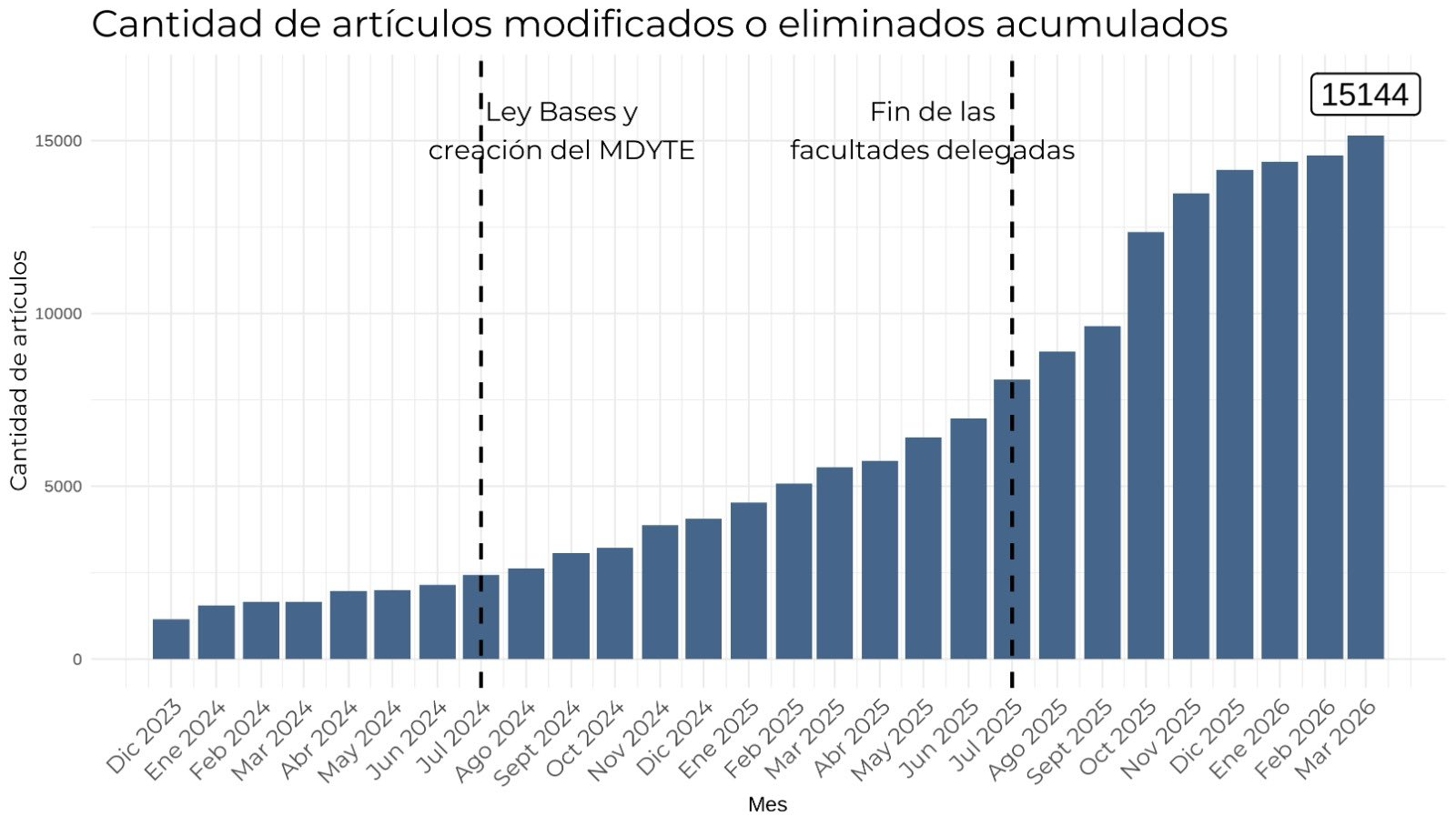
The figure was publicly celebrated by the Minister of Deregulation, Federico Sturzenegger, and then supported by the president himself through his social networks.
“We have surpassed 15,000 deregulations, but the work continues. We continue to make progress to make Argentina the freest country in the world, as requested by our president Milei. VLLC!
”, Sturzenegger said in his X account.
Minutes later, the President replicated the message and reinforced his administration's approach: “Freedom Advances. Long live fucking freedom. SORCERER
”. The graphic published by Sturzenegger.
Javier Milei's economic deregulation in Argentina, initiated through DNU 70/2023 and deepened by the Ministry of Deregulation, seeks to eliminate state regulations, price controls and bureaucratic obstacles to liberate the market, a fundamental condition for
In addition, permits and quotas were eliminated in various productive activities, within the framework of a policy aimed at dismantling restrictive schemes.
President Javier Milei.
Another important point of the plan was the elimination of exchange restrictions linked to commercial operations and the digitization of administrative processes, measures that are complemented by a reconfiguration
of control bodies and regulatory bodies.
Thanks to all this, Argentina climbed 39 places in the Economic Freedom Index 2026 prepared by the Heritage Foundation, rising from 145th to 106th in just two years. This is a historic leap, the largest in the world in the last edition.
At the same time, GDP grew by 4.4% in 2025, while institutions such as the World Bank project growth of close to 4% by 2026, a big change compared to previous years, characterized by economic crises.