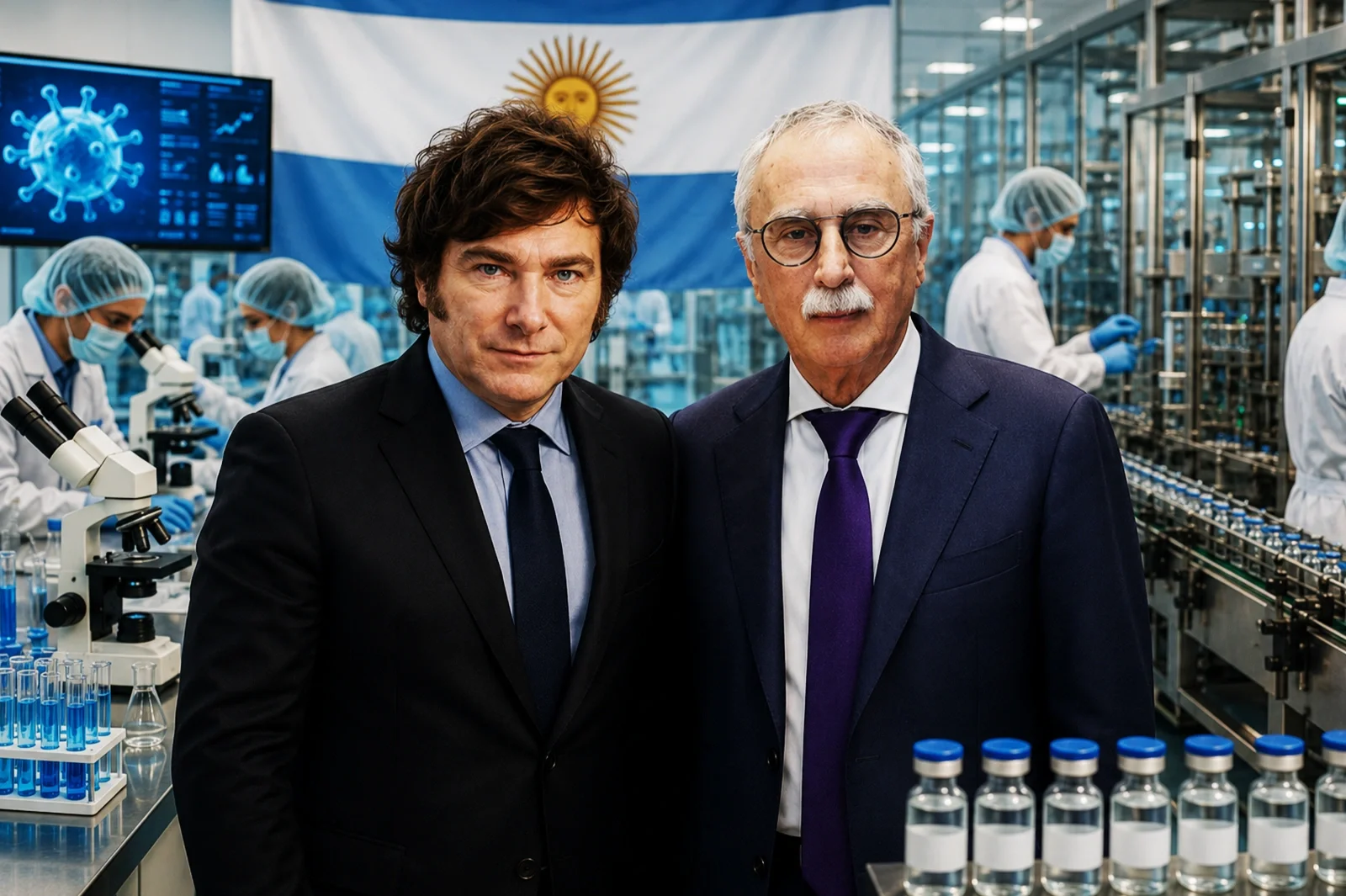

Mario Lugones highlighted the growth of the sector and emphasized a significant investment to manufacture vaccines in Argentina.
Nuevo
Agregar La Derecha Diario en
Compartir:
The Minister of Health of the Nation, Mario Lugones, highlighted the progress in the strategy of the Government to position the health sector as one of the pillars of economic growth, in line with the direction promoted by President Javier Milei.
Through a message on his social media, Lugones announced: “PRIVATE INVESTMENT TO PRODUCE VACCINES IN ARGENTINA.”
In this context, he detailed that “the national production of vaccines reflects the growth process of investments in health and consolidates regional leadership in this field.”
Javier Milei and Mario Lugones.
The project will materialize through an investment agreement between the Argentine company Sinergium Biotech, the international firm CSL Seqirus, and the Pan American Health Organization (PAHO).
According to the official, “the Argentine company Sinergium Biotech will produce flu vaccines for Latin America and the Caribbean,” and emphasized that “Argentines will have priority access to an initial allocation of doses, along with other participating countries.”
The initiative involves a investment of over 35 million dollars and projects exports close to 100 million dollars annually. Additionally, the minister emphasized that the agreement “promotes technological transfer and strengthens the national high-complexity biotechnology platform.”
In his message, Lugones also stated that “we want to deepen this path because the sector has concrete conditions to compete in the world: qualified human resources, infrastructure, and export capacity.”
He added a central definition within the official strategy: “Health is one of the engines of Argentine growth: it has the potential to attract foreign currency and create quality jobs for Argentines.”
President Javier Milei.
The Development of the Health Sector
This announcement is part of a broader vision of the Government regarding the role of the health sector within the economy. In a news article written in Infobae, Lugones stated that, for years, the activity was limited by “distortions, lack of clear rules, and a model that discouraged investment and competition,” which ultimately affected both patients and professionals.
However, with the new economic model, the situation began to reverse. “Today, based on the macroeconomic order, stability, and predictability that the National Government promotes, that has started to change,” he affirmed. In this context, health “is consolidating as one of the most dynamic sectors of the Argentine economy.”
The minister highlighted that when “the State organizes, clarifies, and establishes clear rules, the private sector invests, incorporates technology, expands capacities, and generates value.” Under this logic, measures such as purchasing medications at laboratory exit prices were promoted, aiming to reduce costs and encourage competition.
The results are already visible. Companies like SC Johnson, Pfizer, and Sinergium Biotech itself have announced recent investments in the country. Currently, the Argentine pharmaceutical and biotechnology industry produces more than 8.1 billion dollars annually and exports to over a hundred countries.
Additionally, Lugones highlighted the potential in areas such as clinical research, health infrastructure, and technological development applied to health. The expansion of electronic prescriptions, with over 20 million monthly prescriptions, and advancements in artificial intelligence applied to diagnostics are part of this process.
In parallel, the official emphasized the new global scenario, where regional production of vaccines and medicines takes on strategic relevance. In this sense, collaboration with international organizations like PAHO opens new opportunities to strengthen local capacities and expand exports.
“The challenge now is to deepen that process and turn the sector into one of the major engines of the country's growth,” proposed Lugones, in a bid to position Argentina as a central player in the health economy at the regional and international levels.