In addition, the legislative package sent by Javier Milei includes the submission of the Gambling Law and the Lobby Law, with the aim of deepening deregulation.
The Government of President Javier Milei has taken a historic step today towards the definitive modernization of the Argentine legal structure by announcing the submission of the third batch of bills to the Congress of the Nation since the beginning of the Ordinary Sessions of this year. The measure, which aims to deepen the economic and social paradigm shift, was confirmed by the Chief of Staff, Manuel Adorni, after a day of strategic definitions at the Quinta de Olivos and the Casa Rosada.
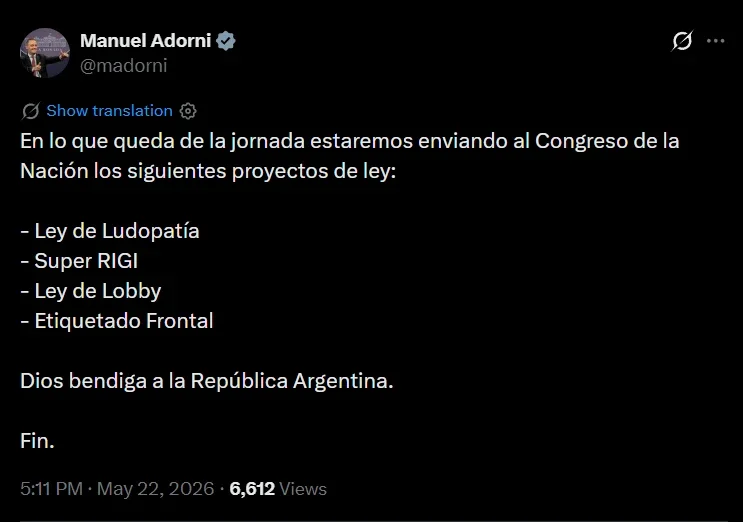
The legislative offensive of the ruling party focuses on four fundamental pillars: the Gambling Law, the ambitious Super RIGI, the Lobby Law, and a common-sense modification to the Front Labeling Law. The announcement was formalized through a strong message from Manuel Adorni on his official X account, where he stated: “In what remains of the day, we will be sending the following bills to the Congress of the Nation: Gambling Law, Super RIGI, Lobby Law, and Front Labeling. God bless the Argentine Republic. End”.
Manuel Adorni on X:
At the heart of this package is the Super RIGI, a superior tool to the Incentives Regime for Large Investments enacted with the Base Law. This "expanded version" is the absolute priority of the Government to attract cutting-edge industries that currently have no presence in the country. Among its unprecedented fiscal benefits for the private sector, the following stand out:
A drastic reduction in the Income Tax rate, which will drop from 25% to 15%.
An Accelerated Investment Amortization scheme with a significant impact: 60% in the first year, 20% in the second, and 20% in the third.
The total elimination of import and export tariffs related to production.
A strict limit on the collection of Gross Income by the adhering provinces, capped at just 0.5%.
The absolute prohibition for municipalities to charge sales taxes that operate as hidden taxes.
On the other hand, the Government seeks to sanitize political activity with the Lobby Law, an initiative driven with special interest by the presidential advisory sector. Inspired by successful global models such as those of the United States and Law 20,730 of Chile, this regulation aims to transform "lobbying" into a legitimate and transparent tool to enrich parliamentary debate, leaving behind the darkness of past dealings. It is based on transparency precedents such as Decree 1172 from late 2003, which already established that “the publicity of Interest Management is necessary for the knowledge of the meetings held with public officials”.
The president, Javier Milei.
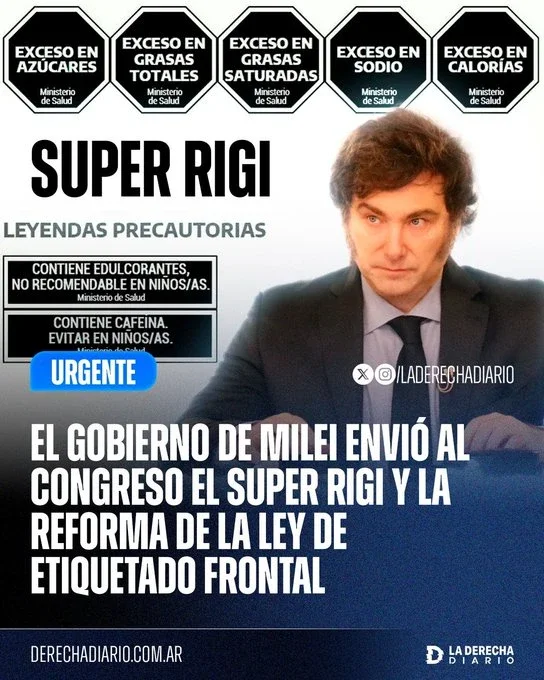
Regarding market freedom and consumption, the reform project for the Front Labeling aims to eliminate the ideological obstacles represented by black octagons. The official proposal seeks to reduce or eliminate these labels, allowing once again the use of marketing resources such as cartoons, celebrities, or sports figures, which are currently prohibited by state bureaucracy. Additionally, administrative procedures will be simplified, and the calculation of critical nutrients will be modified to adjust them to the productive reality.
Finally, in terms of social security, the Government accelerates its own Gambling Law, differentiating itself from the opposition's wording. While other sectors sought prohibitive restrictions, the ruling party's approach focuses on responsible freedom, regulating the discretion with which minors access digital betting and focusing on the prevention of addiction in young people, without destroying the advertising industry of betting houses.