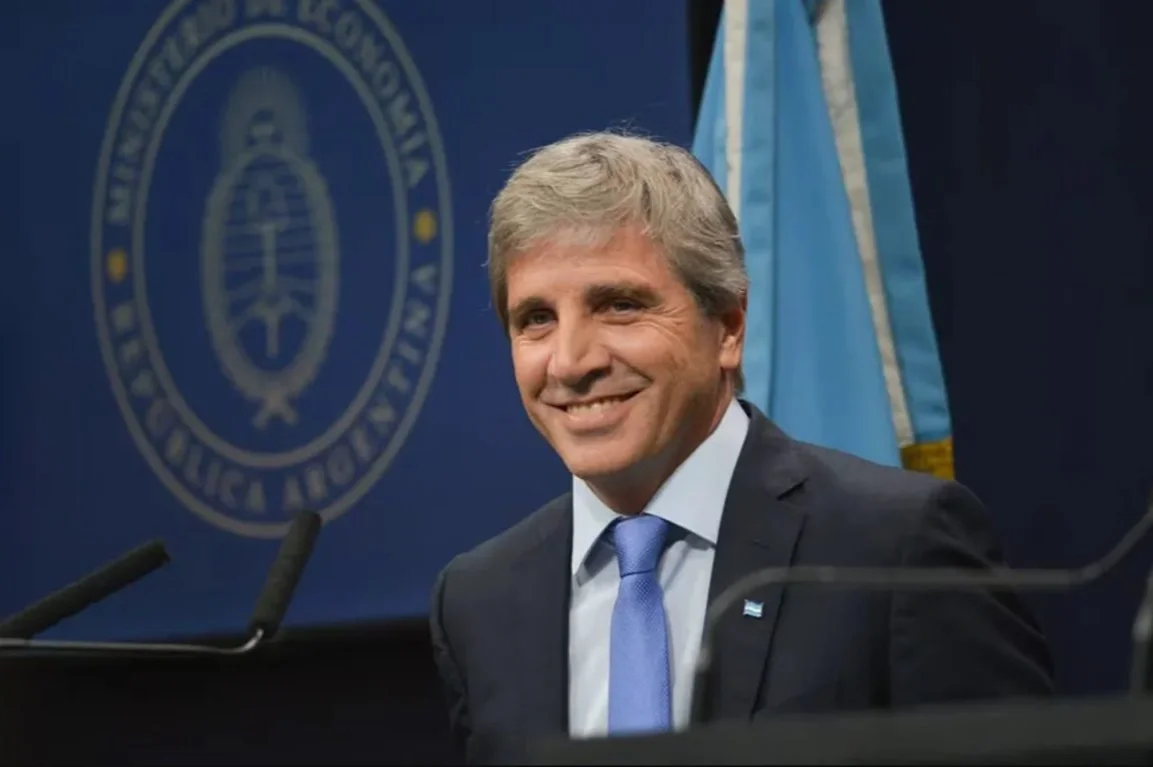
The minister confirmed staggered reductions for soybeans, wheat, barley, corn, sorghum, and sunflower between 2026 and 2028, and assured that the measures "are fixed and scheduled" to provide predictability to the productive sector.
The Minister of Economy, Luis Caputo, along with the Secretaries of Commerce, Pablo Lavigne, and Agriculture, Sergio Iraeta, detailed the ambitious policy of reducingexport taxes. The central message was of absolute clarity: the reduction of state weight will be gradual and predetermined, operating independently of monthly or annual tax collection to provide a clear and stable signal to the agricultural sector.
“From day one, we said our goal is to bring export taxes to zero. That is the ultimate goal”, declared the minister, emphasizing that this administration delivers on its promises. Delving into the surgical precision of the plan, the government established a calendar that starts immediately for the wheat harvest:
Luis Caputo
Wheat and Barley: These crops will receive immediate relief in June 2026, when their rate is reduced by two points, going from 7.5% to 5.5%.
Soybean: The engine of agriculture will begin its liberation in 2027 with a decrease of one quarter of a percentage point each month, starting from 23.75% to close that year at 21%. By December 2028, the retention will plummet to 15% after an acceleration in the pace of reduction.
Corn and Sorghum: Currently at 8.5%, they will undergo a scheme of quarterly reductions during 2027 until reaching 7.5%, and finally arrive at 5.5% by the end of 2028.
Sunflower: Its rate of 4.5% will decrease biannually until it stands at just 3% in 2028.
Final acceleration: Throughout 2028, the cut will deepen to half a percentage point per month for all affected productions.
This decision is not only ideological but a pragmatic response to the suffocation of costs; according to Sergio Iraeta, the measure seeks to “ease the increase” following the price explosion in inputs like fertilizers due to the conflict in Iran. The fiscal cost of this act of economic justice has been meticulously calculated: for agriculture, it will represent USD 32 million in 2026, USD 415 million in 2027, and USD 1.224 billion in 2028.
President Javier Milei and Minister Luis Caputo
On the industrial front, the reduction of rates will focus on strategic sectors such as automotive and petrochemical, with a cost of USD 25 million in 2026 and USD 115 million in 2027. Pablo Lavigne highlighted that reducing the retention rate is the margin that allows an Argentine truck to compete with the Chinese, Americans, and Mexicans in the global market.
Despite the fiscal cost, Caputo was emphatic in stating that “no additional adjustment will be necessary because we are projecting higher revenue” based on the recovery in economic activity indicators. The success of the model is undeniable: of the sixteen sectors measured by the EMAE, fifteen grew, with the public sector being the only one that contracted, confirming that the shrinking of the state is the foundation of private prosperity.
Finally, the government showcased its executive efficiency by confirming that no bill is required in Congress, as the measure will be implemented directly. The minister concluded with a call to provinces and municipalities to end fiscal parasitism by reducing gross income and municipal taxes, reminding that the reduction of export taxes, being a non-shared tax, increases the taxable base of the Income Tax, directly benefiting governors. “These announcements are fixed, scheduled. What we have announced now is indeed what we are going to do”, concluded Caputo, sealing a steel pact with the productive future of the nation.