The Government asked the Court to review the ruling that reinstated the lifetime allowance
Compartir:
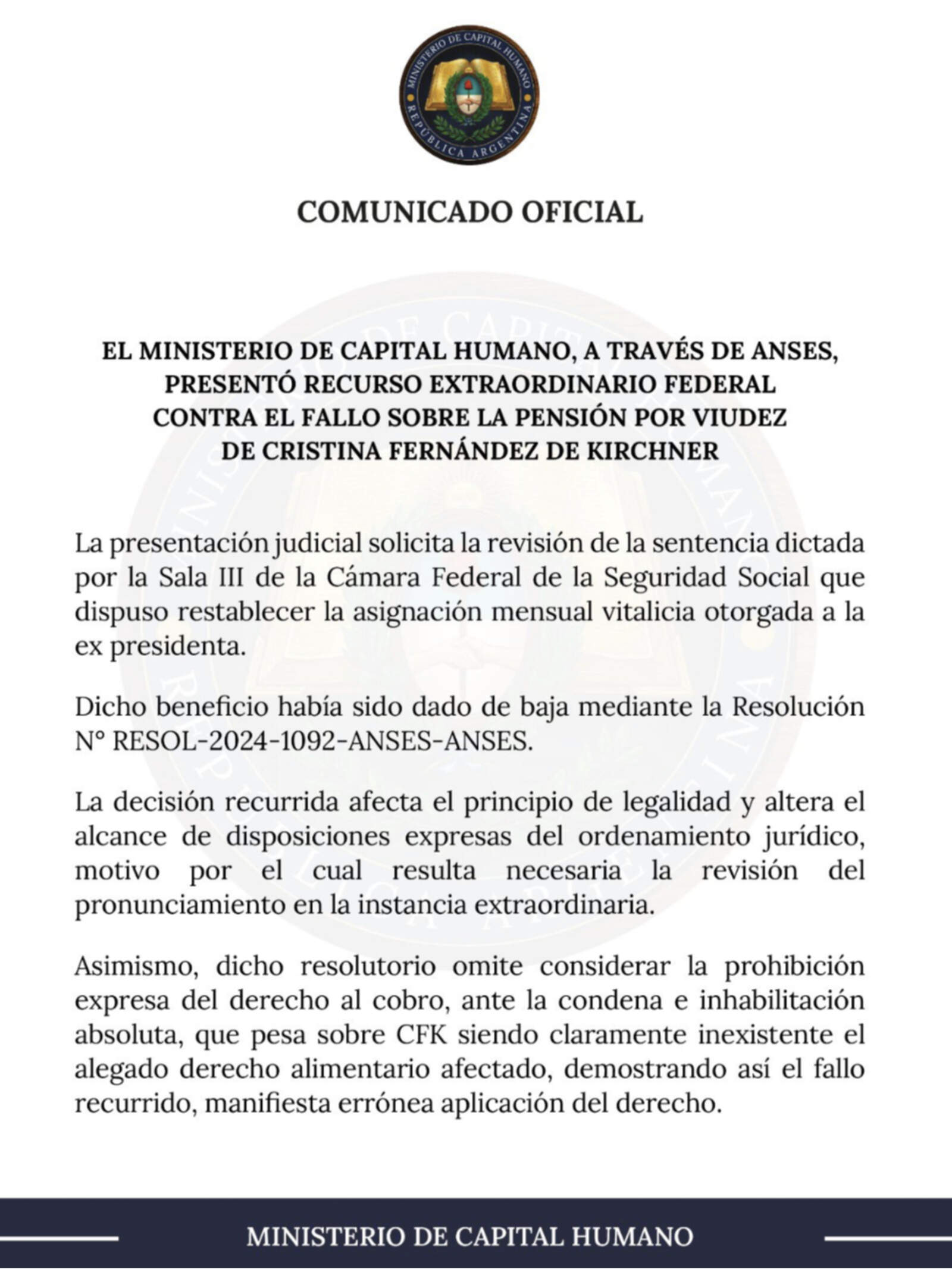
Human Capital Ministry, through the National Social Security Administration (ANSES), filed an extraordinary federal appeal before the Supreme Court of Justice of the Nation. In this appeal, the ministry requests a review of the ruling that ordered the reinstatement of the widow's pension that former Vice President Cristina Fernández de Kirchner was receiving.
The challenged judgment was issued by Chamber III of the Federal Chamber of Social Security. This chamber ordered the reestablishment of the lifetime monthly allowance that had been terminated by Resolution No. RESOL-2024-1092-ANSES-ANSES.
According to the official position, the ruling incurs in a "manifestly erroneous application of the law". The decision omits the legal prohibition on collection for those who have a final criminal conviction and an absolute disqualification from holding public office.
Capital Humano apeló el fallo por una errónea aplicación del derecho
Debate over the nature of the benefit
The central controversy revolves around the legal nature of the allowance that former presidents and their beneficiaries receive.
According to the grounds of the appeal, the benefit doesn't constitute an ordinary retirement nor a contributory social security benefit. The Government keeps that it is a non-contributory, discretionary allowance granted as recognition of merit, honor, and performance in the exercise of the presidential office.
In that regard, the official argument differentiates it from pensions in the general system, which are financed with contributions made during working life and whose purpose is to guarantee subsistence in old age. The lifetime allowance for former heads of state follows a different logic: it is said to be an honorary remuneration linked to the office.
Comunicado Oficial del Ministerio de Capital Humano Therefore, the appeal keeps that the continuation of the benefit would be subject to the validity of the ethical and honorability conditions that justified its granting.
Under that interpretation, the existence of a final criminal conviction with absolute disqualification from holding public office would directly affect the eligibility to collect the allowance. The administration argues that the Chamber would have disregarded that regulatory framework when it ordered the reinstatement of the benefit.
Meanwhile, the brief emphasizes that the benefit lacks an alimentary nature. That is, it would not be intended to ensure the livelihood of someone who can't provide for himself or herself by his or her own means, but would constitute a state grace in recognition of the function performed.
Institutional debate
A Fernandez de Kirchner no le correspondería este beneficio de honor tras su condena por corrupción
The filing brings the debate before the highest court. In doing so, it opens a discussion of institutional scope on the legal regime that applies to lifetime allowances for former heads of state.
The Supreme Court will have to analyze whether the interpretation made by the Federal Chamber of Social Security conforms to the current legal framework, or, failing that, whether the scope of express provisions of the legal system was altered.
The case once again places at the center of the debate the difference between contributory social security rights and benefits of an honorary nature, as well as the legal effects of a final conviction with absolute disqualification in relation to special state benefits.