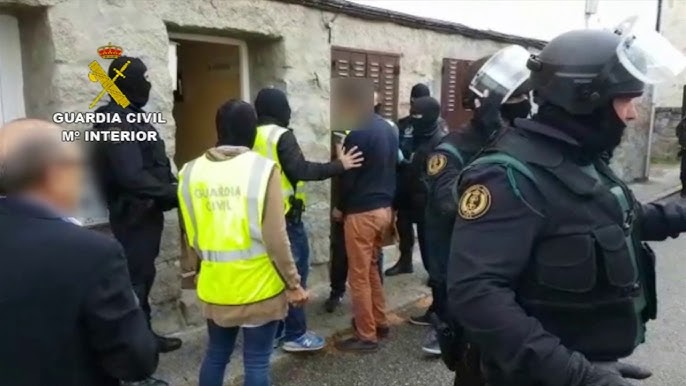
Operation Timanfaya of the National Police detected that a 36-year-old woman was posing as a minor in a center in Lanzarote and would have made it easier for at least 13 young people to leave for a network with a final destination in France.
The network had a consolidated international structure. According to the investigation, logistical support has been identified in Morocco for the initial transfer to the Canary Islands and connections in the Ivory Coast for the preparation of false documentation. In Spanish territory, the organization had resources to temporarily house minors and coordinate their movement
To this day, the whereabouts of several of the young women remain unknown. Among the hypotheses used by researchers are possible cases of labor exploitation, forced marriage or prostitution. In addition, the discovery of sensitive material on the phone of one of those involved reinforced some of these lines of research. During the operation, the police managed to intercept the last three minors at the airport before they left the country. Among them was the woman who posed as a minor, who was arrested. The other two young women returned to the center, although they later tried to flee again taking advantage of the permitted departure periods
. Pedro Sánchez
One of the main obstacles to policing, as revealed in the investigation, has been the very operation of protection centers. These spaces are not closed facilities, allowing children to go out at certain times without constant supervision
.
As explained by the General Director of Children of the Government of the Canary Islands, these are open resources designed as homes and not as internment centers.
This model, added to the saturation of the system — which was able to accommodate nearly 6,000 children in a device designed for approximately 1,500 — has made it difficult to control possible leaks. In many cases, disappearances were not detected until the next day, when it was already difficult to react.
Amid growing criticism of the management of illegal immigration inEurope and of the migration policy applied in Spain under the government of Pedro Sánchez, a police investigation revealed a case that exposes serious flaws in the child protection system in the Canary Islands. The episode is part of a wider context of the saturation of reception centers and difficulties in controlling movements within the system. The case is part of the so-called Operation Timanfaya, carried out by the National Police, which allowed the dismantling of an organization with branches in several countries and dedicated to the illegal transfer of minors from the Canary Islands to different parts of Europe.
According to the research, a 36-year-old sub-Saharan immigrant posing as Mena managed to infiltrate a children's center in Lanzarote and would have made it easier for at least 13 young people to leave the protection system to be integrated into an international network linked to trafficking. The investigations began after repeated disappearances were detected in a center located in Arrecife. From there, the agents began to observe an alleged minor who exerted a notable influence on the rest of the girls. His behavior and leadership aroused suspicion, which ended up being confirmed when it was discovered that he was actually an adult with a key role
in the organization. Operation Timanfaya
According to researchers, this woman persuaded young women to leave the center and move to homes where they stayed for hours. On those floors, the next phase of the transfer was organized, which included obtaining falsified documentation to be able to leave the country. One of the messages found on your mobile phone reflects the extent of your actions within the network. In it, she went so far as to state: “I have already emptied the girls' center”.
The itinerary designed by the organization began with the transfer to Lanzarote airport, where another member provided documents and elements to modify the identity of the minors. From there they flew to Madrid, where they were picked up by collaborators who later accompanied them to transport stations to continue the journey to France, although researchers do not rule out the existence of other final destinations