In 10 years, violent robberies in GBA increased by 500%. During Kicillof's administration, this trend was not reversed and there was a boom in 2023–2024
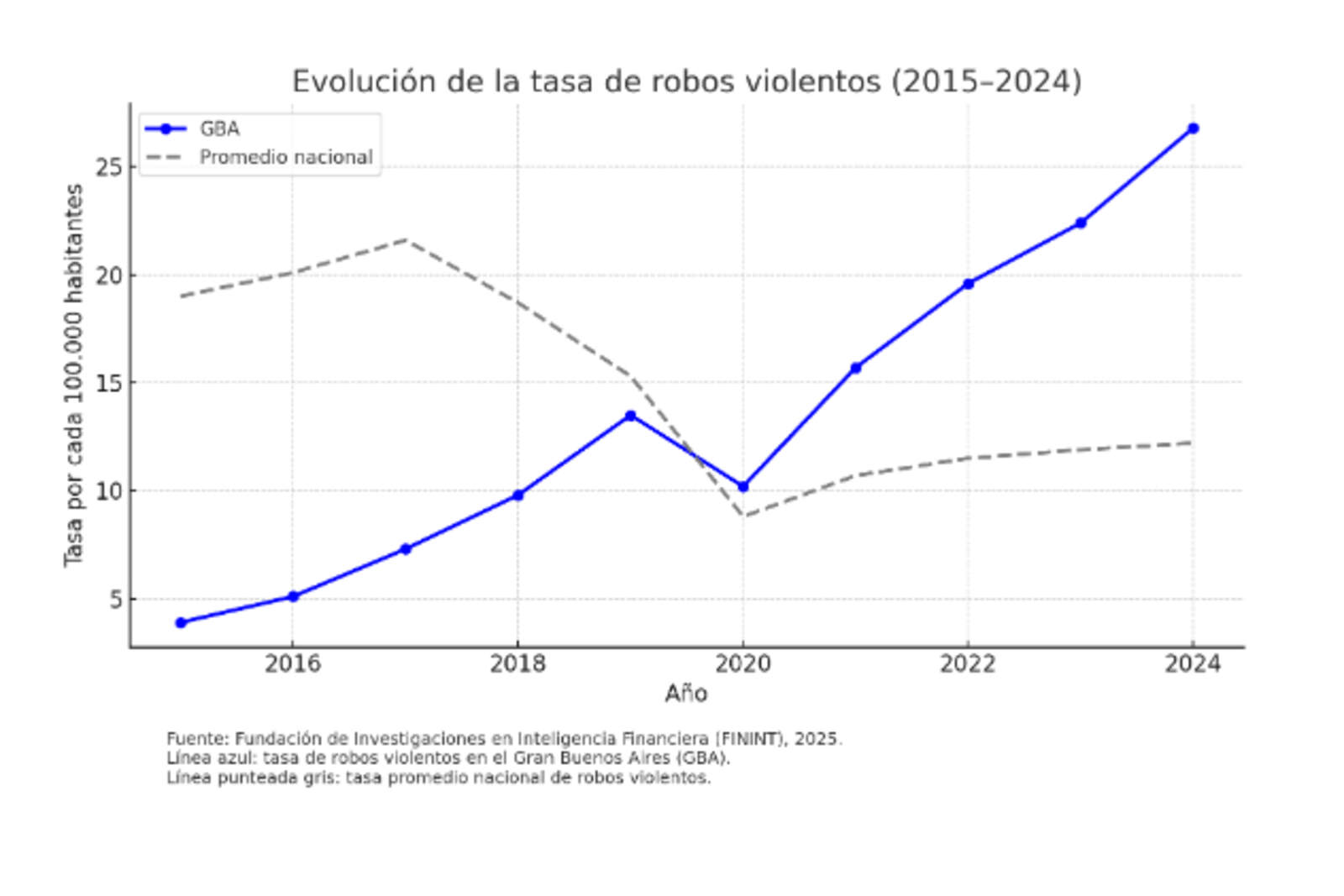
Violent robberies in Greater Buenos Aires (GBA) increased by more than 500% between 2015 and 2024. This data comes from a report by the Fundación de Investigaciones en Inteligencia Financiera (FININT), which shows a sustained deterioration throughout the decade. Kicillof has governed since December 2019 and, far from reversing the trend, the province recorded a 37% jump between 2023 and 2024: from 1,839 to 2,917 cases, the peak of the series. Today, these crimes account for 51% of the national total and 70% of those occurring in Buenos Aires province.
Evolución de la tasa de robos violentos según datos del informe FININT. Comparación de la tasa nacional vs. provincial.
Reactive policy and ideological approach
The Buenos Aires security policy persists in a reactive crime response scheme: action is taken after the fact, with no preventive deployment, criminal intelligence, or sustained territorial control. This approach aligns with the Zaffaroni doctrine, which reverses the roles between victim and perpetrator by presenting the criminal as a "product of society," discouraging active prosecution.
Axel Kicillof, gobernador bonaerense.
The result is a province without a preventive strategy, with defenseless residents and criminals protected by a paradigm that prioritizes impunity over citizen security.
X-ray of the suburbs: rates and critical hotspots
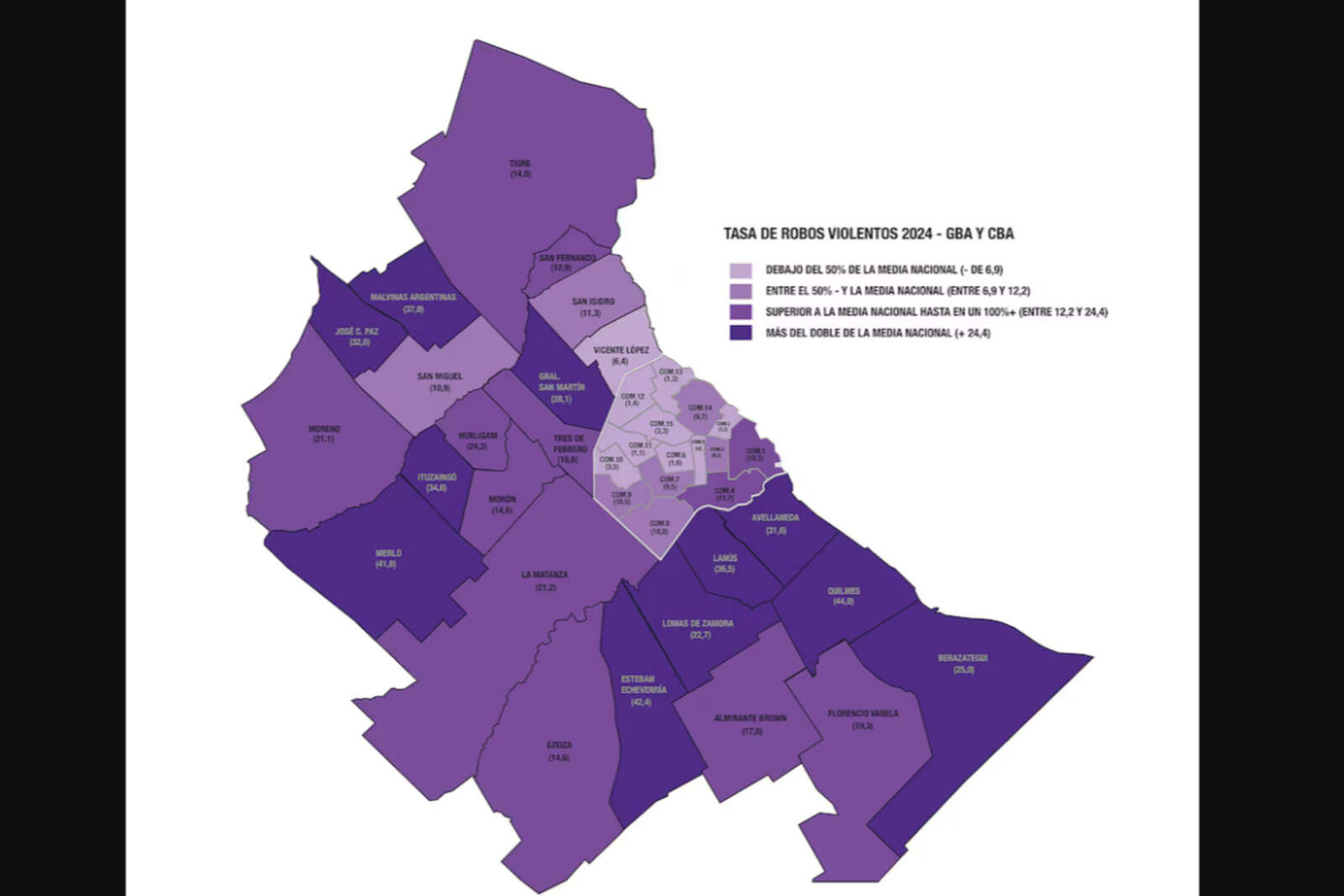
The upward trend has continued since 2017, with 26.8 violent robberies per 100,000 inhabitants in 2024 (2,917 incidents) compared to 3.9 in 2015 (411 incidents). The crime map shows peaks in the west and south of the GBA.
Quilmes: 44.9 (311 incidents)
Esteban Echeverría: 42.4 (168)
Merlo: 41.0 (265) —+190% in two years
Malvinas Argentinas: 37 (138)
Lanús: 36.5 (169) —+80% year-on-year
In 11 of the 24 GBA municipalities, the rate is double the national average, a figure that highlights the severity of the problem and exposes the ineffectiveness of the Buenos Aires prevention system.
Tasa de robos violentos en 2024 con datos del Infome FININT
CABA: different pattern and historic drop
Buenos Aires City shows a different pattern. After an increase between 2018 and 2022 (rate 46.9; 1,446 incidents), violent robberies fell to 7.6 in 2024 (233 incidents), below 2015 levels. Today, just 4% of the national total.
Territorial distribution is homogeneous and without critical areas. The contrast between the two jurisdictions reflects two opposing security models: while the City reduced crime through active management and monitoring, the province under Kicillof multiplied it with ideological passivity.
The role of drug trafficking and social perception
FININT warns that the expansion of drug trafficking doesn't always translate into visible violence: it operates silently and outside the state radar.
la percepción de inseguridad bajo la gestión de Kicillog alcanza 8,1 puntos en GBA Oeste
A survey by the Observatorio de Psicología Social (August 2025) showed that the perception of insecurity reaches 8.1 points in GBA West and 7.9 in GBA South (1 = "very safe," 10 = "very unsafe").
63% of respondents identified drug addiction and drug trafficking as the main cause of insecurity, just below poverty (64%).
It is extremely serious that 11 of the 24 Greater Buenos Aires municipalities exceed the national rate by more than double. This disproportion shows the structural deterioration of security in the province.
Marteau: "Eleven GBA municipalities double the national rate"
The president of FININT, Juan Félix Marteau, explained that the investigation began after the murder of the three teenagers Morena Verdi, Brenda del Castillo and Lara Gutiérrez, which occurred in September of this year at the hands of a drug gang based in villa 1-11-14 in Bajo Flores and present in the south of the Buenos Aires suburbs.
presidente de FININT, Juan Félix Marteau
"It is very interesting to see how, both nationally and in the suburbs and the city, homicide rates have decreased, but violent robberies have not. This shows that there is a shift of violence toward more everyday forms, which directly affect the average citizen," he explained.
Additionally, Marteau warned about the underreporting of crimes: "When an aggressor illegitimately seizes property through violence, victims do not always report it, even in cases of injury. This generates significant underreporting in criminal statistics." Without a doubt, this phenomenon occurs due to the lack of action in response to crimes, making it costly and ineffective for victims to file a report.
Six years of setbacks under Kicillof
The decade explains the accumulated jump, but the six years of Axel Kicillof's administration show a lack of reaction, improvisation, and ideological bias. The 2023–2024 boom, with the largest increase in ten years, exposes the failure of a policy that acts after the crime and gives up on preventing it.
Meanwhile, the City managed to reduce violence, Buenos Aires province is sinking into a reactive model that prioritizes political business over the safety of residents. The result is an increasingly dangerous suburb, where statistics cease to be numbers and become faces, names, and victims.