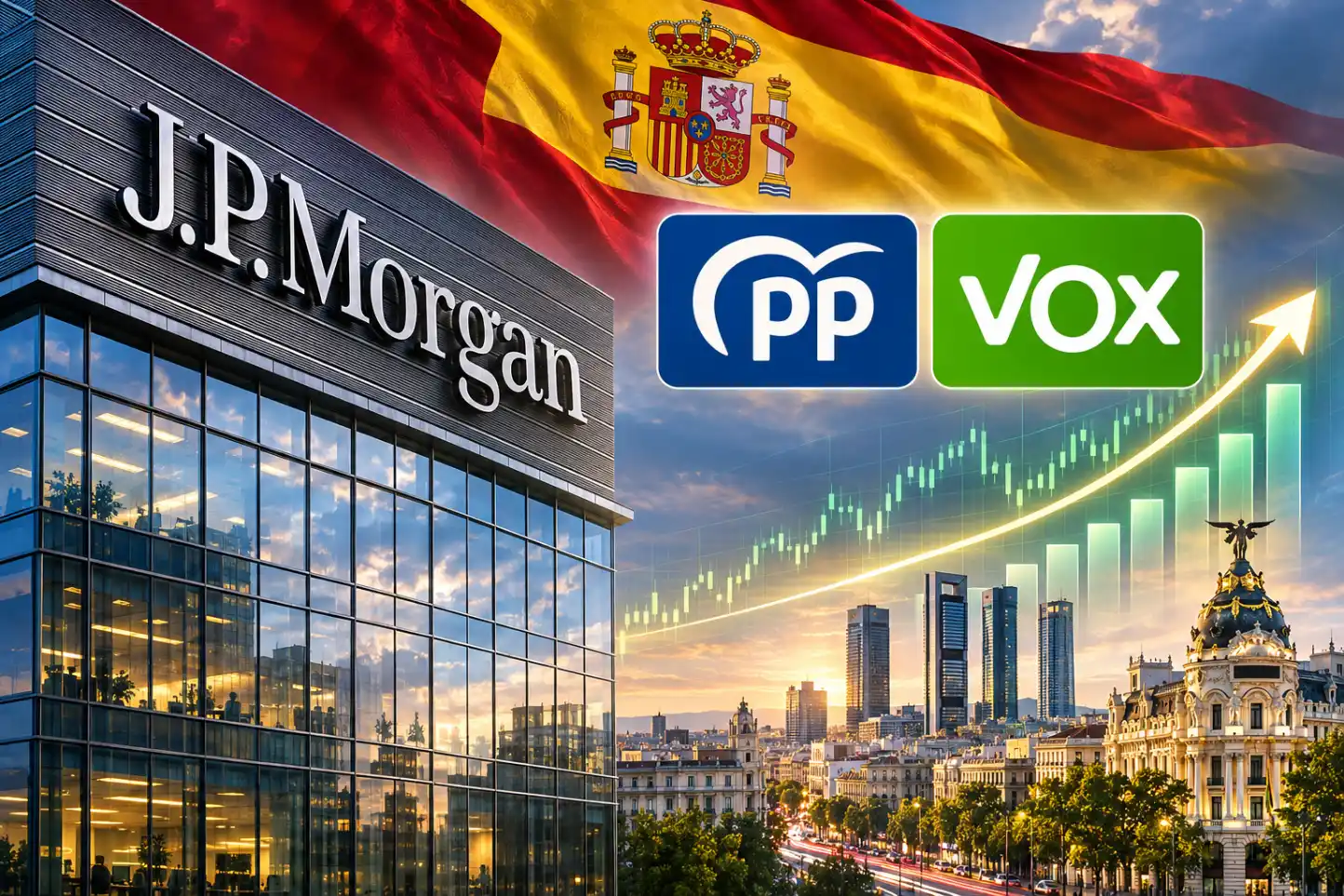

An eventual coalition government between the Popular Party (PP) and VOX could mark a turning point for the Spanish economy and open a new phase of growth, private investment, and structural reforms. This is one of the main conclusions of the analysis prepared by economists at JP Morgan, who view a political shift to the right after next Sunday’s elections as the central scenario.
The American bank believes that an administration led by the PP, with parliamentary support from VOX, would have greater leeway to modify current economic policies, reduce bureaucratic hurdles, and advance reforms aimed at expanding Spain's productive capacity.
Although JP Morgan does not anticipate an immediate transformation of macroeconomic indicators, it does identify a potential for higher growth in the medium and long term, especially if the new government manages to unlock investments and improve conditions for developing business projects.
Mariana Monteiro, an economist at the institution and author of the report, stated that "a government of PP and VOX would offer the greatest margin to introduce changes in policies," although she anticipated that the effects on the economy would be limited during the first months.
JP Morgan highlights the potential of right-wing economic reforms
One of the main arguments of the report is that Spain needs to expand its productive capacity to sustain the economic growth of recent years. The increase in population and activity has generated pressures on strategic infrastructures, especially in the real estate and energy sectors.
In this scenario, JP Morgan believes that the economic proposals of the PP could help improve conditions for private investment by simplifying business regulations, providing incentives for research and development, and implementing reforms aimed at eliminating administrative obstacles.
"The PP's reforms in housing and energy, along with the simplification of business regulation and incentives for private investment and R&D, could improve confidence and boost growth," the analysis states.
The diagnosis represents support for proposals aimed at reducing bureaucratic intervention and facilitating private sector activity, in contrast to a model that, according to the problems identified by the bank itself, faces significant supply constraints.
Fewer regulations and more construction: the bet to resolve the housing crisis
Housing appears as one of the sectors where an eventual change of government could have the greatest impact.
JP Morgan believes that a PP administration with VOX support could act more quickly to eliminate restrictions that hinder the construction of new properties, accelerate authorizations, and facilitate private capital participation.
The bank's analysts estimate that housing construction could double over the years if the necessary reforms are implemented.
The real estate problem also has direct consequences on productivity. The shortage of affordable housing makes it difficult for workers to relocate to regions with better job opportunities, limiting companies' ability to hire qualified personnel.
The European Commission has also warned about this phenomenon and noted that difficulties in accessing housing have become an obstacle to the potential growth of the Spanish economy.
Therefore, reducing administrative hurdles, streamlining permits, and expanding the housing supply are among the main reform opportunities.
However, JP Morgan warns that results will not be immediate. The labor shortage, high construction costs, and current financial conditions could delay the most significant effects until 2028 or 2029.
Energy and private investment, other engines of growth
Another sector that could benefit from a change in economic orientation is the energy sector.
The American bank identifies the need to accelerate investments in electrical networks to accompany the growth in demand and prevent infrastructure limitations from conditioning industrial activity.
The participation of private capital will be especially important given the gradual depletion of the Next Generation European funds, which have so far contributed to financing a significant portion of investments.