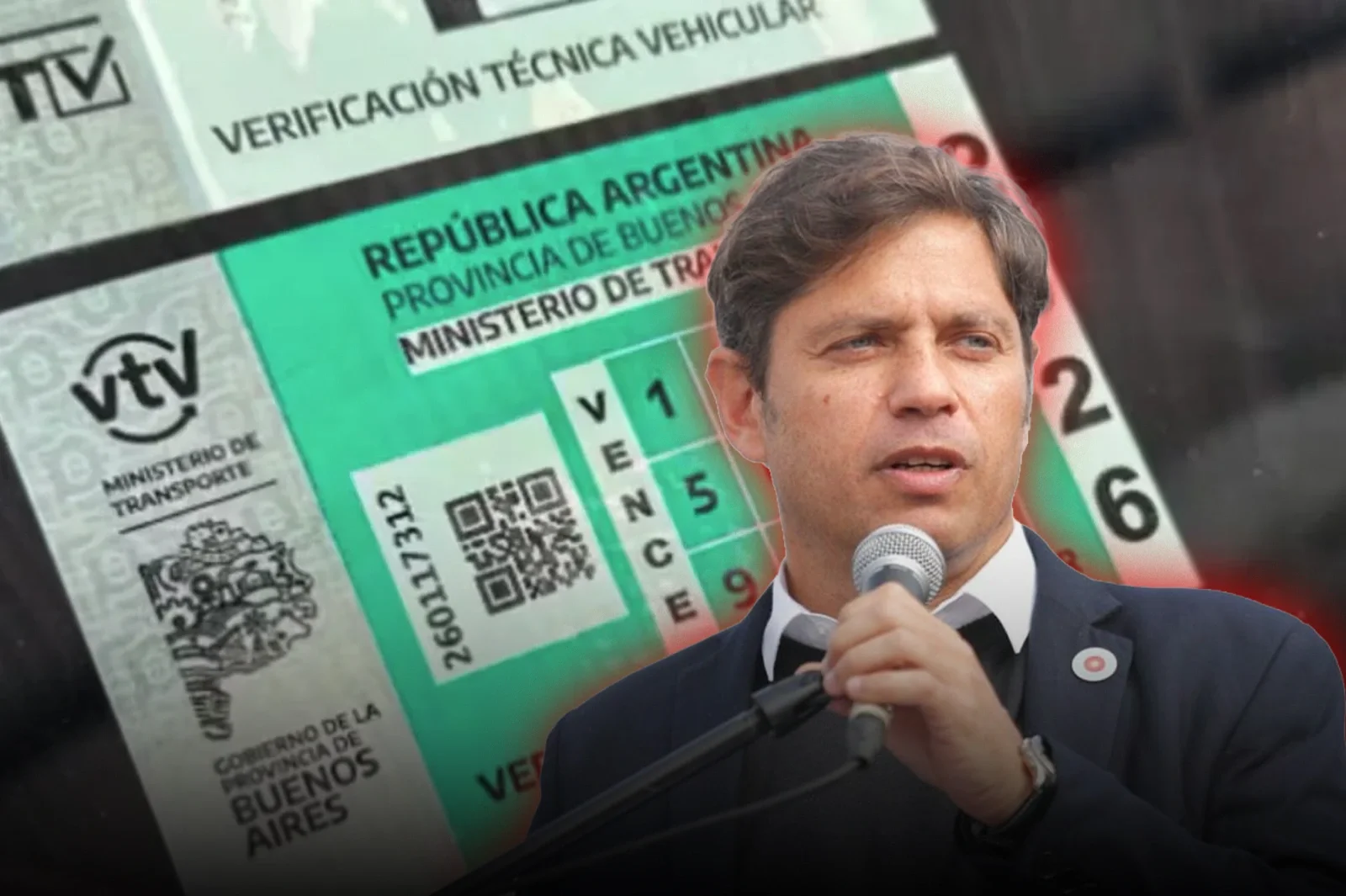
While CABA supports the reform and Mendoza has already adhered, the Province will maintain the traditional scheme and will fine those who circulate with stickers not issued by the official plants.
The Government of the Province of Buenos Aires decided not to adhere to the new national Vehicle Technical Verification system promoted by the Government of Javier Milei and will keep residents of Buenos Aires obligated to carry out the procedure at the official plants in the district, even under the threat of fines for those who circulate with stickers issued outside the provincial scheme.
The decision once again leaves the government of Axel Kicillofgoing against the progress and deregulation process promoted by the national administration, which seeks to end the closed system of the VTV and allow authorized mechanical workshops and dealerships to carry out the Mandatory Technical Review, as long as they meet the corresponding technical requirements.
Axel Kicillof decided to make life difficult for the people of Buenos Aires.
The new scheme was regulated after the publication of the resolution in the Official Gazette and is part of the reform of the National Traffic Law. The measure allows the mandatory review to be carried out in registered and authorized establishments, instead of being limited to the monopoly of plants specifically granted for that task.
However, the Province of Buenos Aires confirmed that it will not incorporate the changes and will continue to require stickers issued under its own system. In practice, this means that a resident of Buenos Aires will not be able to take advantage of the new national competition if the jurisdiction maintains its refusal to adhere.
The Minister of Transportation of Buenos Aires, Martín Marinucci, questioned the reform and stated that the debate should not focus on the supposed end of a monopoly, but on how to ensure rigorous and reliable controls. He also declared that if the State relaxes controls, it can put road safety at "risk".
The response from the national Government came from the Minister of Deregulation and State Transformation, Federico Sturzenegger, who rejected the Buenos Aires argument and pointed directly at Kicillof. The official stated that the Province is trying to shift the discussion towards road safety because it cannot defend the real problem: the monopoly.
Sturzenegger exposed the weaknesses of Kicillof's decision.
Sturzenegger clarified that the mandatory technical review has not been eliminated and that the National Traffic Law still requires vehicles to be inspected. As he explained, what ended was the privilege that this inspection could only be carried out in the workshops that the political power decides to authorize.
The minister also posed an uncomfortable question for the Buenos Aires Kirchnerism: if the goal is to defend road safety or to maintain the business of forcing Argentines to go to a few workshops selected by the State, pay what they are charged, and lose hours of their lives to complete a captive procedure.
Axel Kicillof also did not allow the RIGI and other innovations in the province.
From the national government, they also emphasized that the model has been functioning for years in cargo transportation, where trucks undergo RTO in workshops authorized under national jurisdiction. For the Government, if that system works for vehicles that travel millions of kilometers a year, there is no technical reason to prevent it for private cars.
While CABA supports the reform and Mendoza has already adhered to the new scheme, the Province of Buenos Aires decided to remain on the sidelines and maintain the previous patronage system. Once again, Kicillof chooses backwardness and favoritism.