While millions of Venezuelans and citizens from across the region celebrated the end of a regime accused for years of human rights violations, drug trafficking, and corruption, some figures of international progressivism came out to question the U.S. operation.
Among them was writer Stephen King, who once again exposed his ideological bias.
Así era llevado detenido Nicolás Maduro
The arrest of the Chavista leader took place after a large-scale military operation carried out by the United States on Venezuelan territory, which included attacks on strategic targets in Caracas.
According to what U.S. Attorney General Pam Bondi confirmed, Maduro was charged with narco-terrorism conspiracy, among other counts, and will be tried in U.S. courts.
Trump described the mission as "a brilliant operation" and released images of the moment of the capture through his Truth Social network.
For a large part of the international community—especially in Latin America—Maduro's downfall represented the end of a dictatorship that led Venezuela to economic, social, and humanitarian collapse.
However, true to his record of political positions aligned with the left, Stephen King decided to question the actions of the U.S. government.
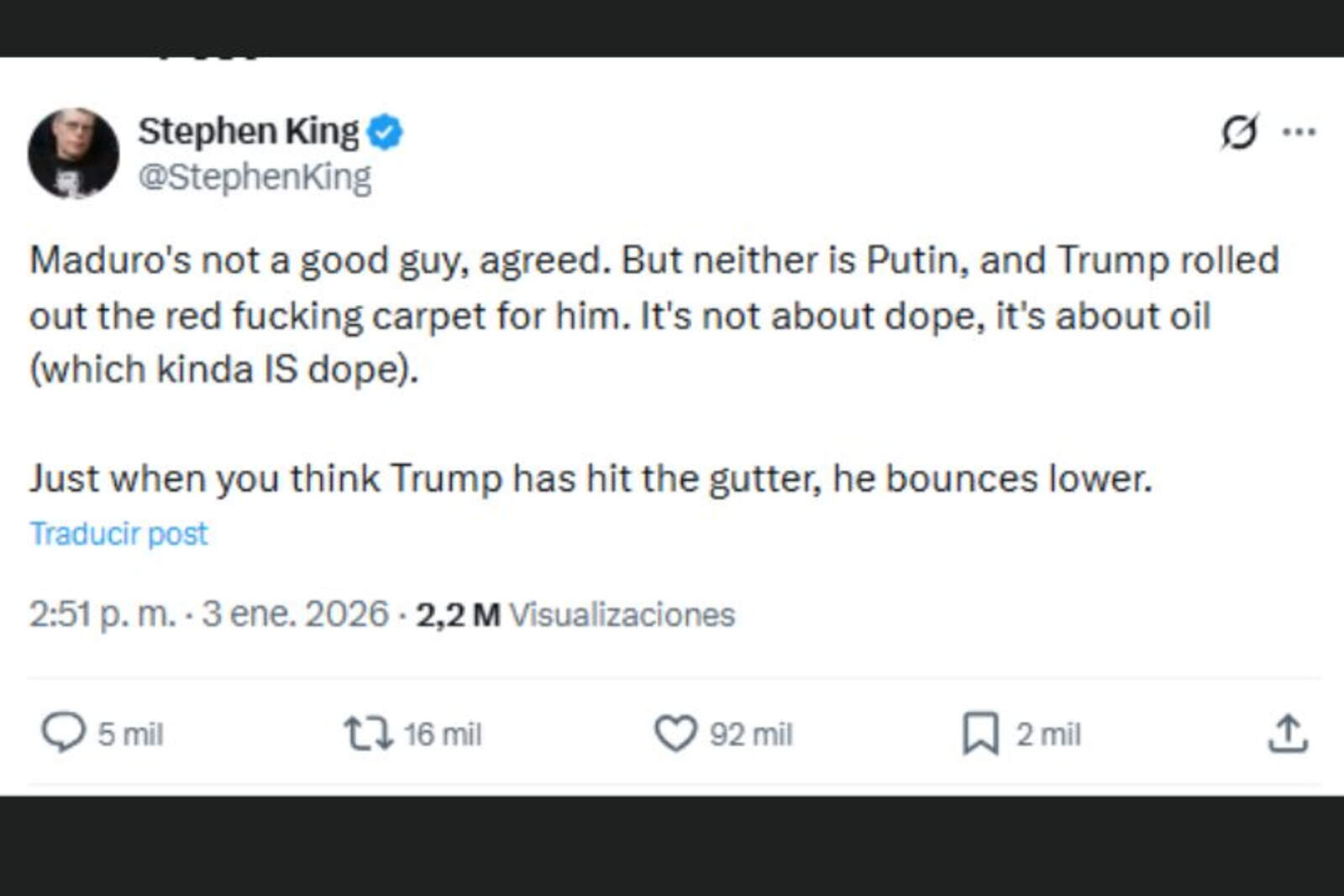
Through a message posted on the social network X, the author of It downplayed the gravity of the Chavista regime and targeted Trump with a forced comparison: "Maduro is not a good person, agreed. But neither is Putin, and Trump rolled out the red carpet for him."
Stephen King en X
Far from analyzing the suffering of the Venezuelan people or the criminal nature of the overthrown regime, King chose an ideologized discourse, suggesting that the U.S. intervention replied solely to economic interests.
"This is not about drugs, this is about oil (which in a way IS a drug)", he wrote, in an attempt to delegitimize an operation celebrated by millions of people who for years fled hunger and repression.
The reaction on social networks did not take long to arrive. The writer's message accumulated more than 2.5 million views and tens of thousands of replies, the vast majority against him.
Users from Venezuela, Argentina, and other countries in the region confronted him harshly, accusing him of speaking from a place of privilege and being unaware of Latin American reality.
Among the most prominent comments, readers saw phrases such as: "Venezuelans are celebrating this action. Why do you not do the same from your mansion?"; "Maduro's exit is a victory. Leaving Trump aside, this is good for millions of people"; and "The real bottom line is defending dictatorships if they do not fit your ideology."