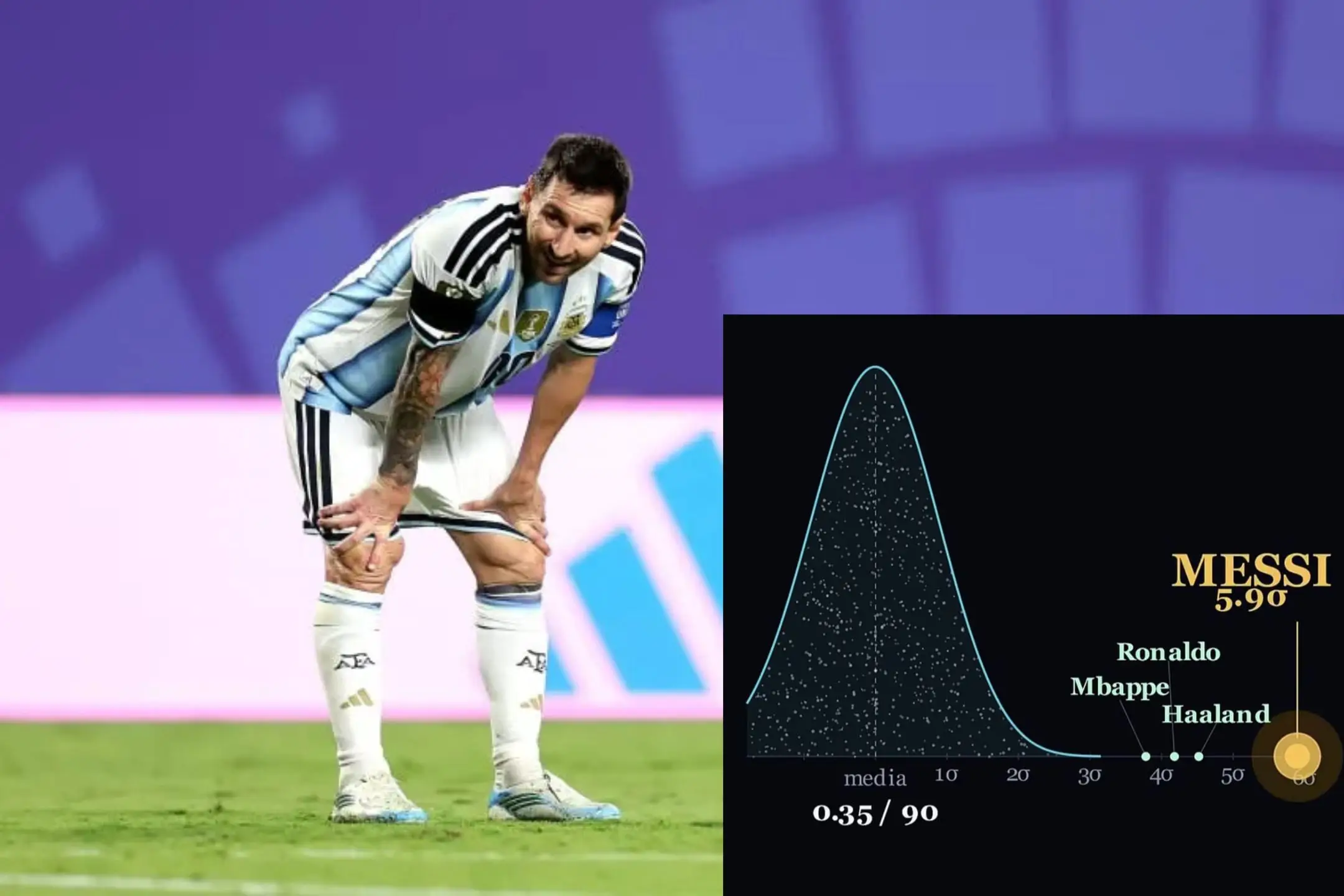
A mathematical analysis of Lionel Messi's performance argues that the Argentine captain represents a statistical exception that is practically impossible to replicate. Based on the distribution of goals and assists of players in the five major European leagues, it was explained why the Rosario native is a unique case in the history of football.
According to Javier Gironza, who conducted the analysis, the offensive production of players follows a normal distribution, with a clearly defined mean. "Mathematically, Messi shouldn't exist and I will explain why," he stated at the beginning of his explanation.
He also detailed that the distribution of goals and assists every 90 minutes generates "an almost perfect Gaussian bell with a mean of 0.35 goals plus assists per match and a standard deviation of 0.19."
Based on this data, he compared the performance of the best footballers with that of the current player from Inter Miami. "The best players are about four standard deviations from the mean. Well, Messi is six standard deviations away," he explained. To illustrate the exceptional nature of the Argentine, he resorted to a compelling statistical comparison: "This is equivalent to one in every 570 million elite players."
Furthermore, he added that, even considering all the major European leagues over several decades, the phenomenon remains extraordinary. "If we combine La Liga, the Premier League, the Bundesliga, Ligue 1, and Serie A, only about 60,000 players have passed through them since the 1950s," he pointed out.
The conclusion of the analysis reflects the magnitude of the difference between Messi and the rest of the elite footballers. "Come on, we would have to wait over 400,000 years to see a new Messi," he asserted.
Despite highlighting the statistical superiority of the world champion, he pointed out a specific area where his numbers do not stand out compared to other players. "However, there is one thing in which Messi is worse than the average and it is in penalties," he stated. The Argentine's performance from the twelve steps even ranks below the general average. "Specifically, he is one standard deviation below the mean," he explained.