The reduction of withholdings on wheat and barley will begin in June, while the government projects a gradual reduction for soybeans between 2027 and 2028, in a context of fiscal surplus, rising Argentine stocks, and strong support from international markets.
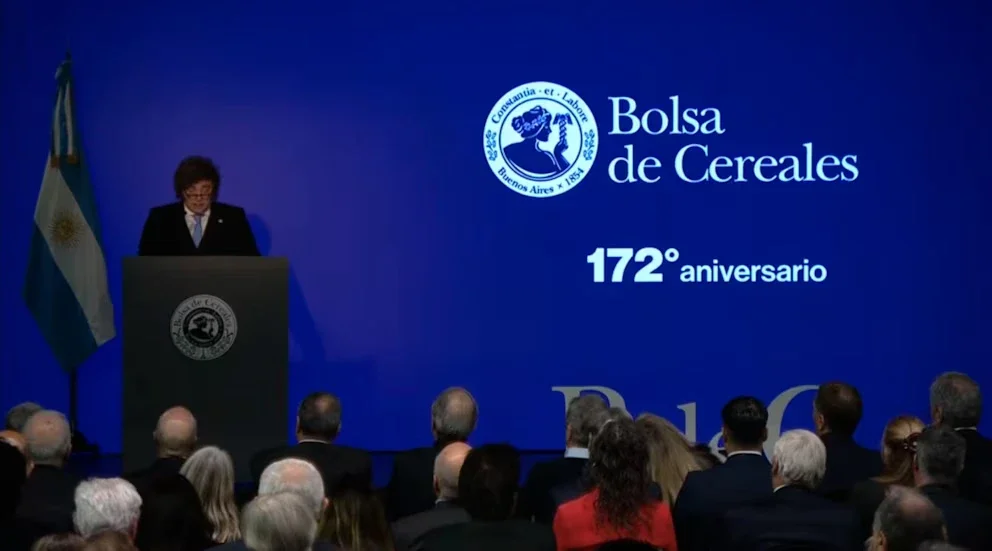
The Argentinais experiencing a total paradigm shift under the leadership of President Javier Milei, who has decided to dismantle the structure of exploitation that has suffocated those who produce the country's wealth for decades. In the context of the celebration of the 172nd anniversary of the Buenos Aires Grain Exchange, the president sent a strong signal to the global market: the time of the State as the enemy of agriculture has ended.
This announcement is not an isolated event, but rather the direct consequence of an unprecedented macroeconomic reorganization that has allowed the Central Bank to achieve 92 consecutive days of foreign currency purchases, recently adding another USD 145 million and approaching 90% of the annual reserve accumulation target.
In a decision that will have an immediate impact on the competitiveness of exports, the head of state confirmed that the scheme of export duties will begin to be drastically reduced. For wheat and barley crops, the rate will decrease from 7.5% to 5.5% starting in June of this year.
This measure represents a vital injection of oxygen for producers, who finally see how the fiscal surplus —achieved with a heroic effort by the national administration— translates into a lower tax burden on their shoulders.
Milei at the Grain Exchange
The economic liberation plan of Javier Milei includes an even more ambitious roadmap for soybeans, the heart of Argentina's foreign currency. The President detailed that, starting in January 2027, a gradual reduction process of the withholdings on the oilseed will begin, subject to maintaining balance in public accounts. The scheme foresees monthly reductions of between a quarter of a point (0.25%) and half a point (0.5%) percentage. In this regard, the president sealed his commitment to the productive sector with a phrase that already resonates as a mandate for continuity: “It will be done continuously until the year 2028 if we are reelected”.
This fiscal relief does not stop at the borders of agriculture. The government's systemic vision seeks to reindustrialize Argentina through freedom, announcing that similar reductions in withholdings will be applied to the automotive industry, the petrochemical sector, and the manufacturing of machinery. This state policy coincides with a real economic rebound: the Monthly Economic Activity Estimator (Emae) from Indec recorded a growth of 3.5% in March, with a positive year-on-year variation of 5.5%.
The international and financial support for this management is overwhelming. While the president was making the announcements, Argentine stocks on Wall Street surged by up to 8%, the S&P Merval index rose by 3.1%, and the country risk plummeted to 515 basis points, levels that certify total investor confidence in the chosen direction. Likewise, the IMF has confirmed the success of the economic program by approving the latest review and unlocking a disbursement of USD 1 billion, recognizing the solidity of a management that keeps the wholesale dollar stable at $1,389.50 and does not hesitate to tackle structural problems to restore Argentina to its place in the world.