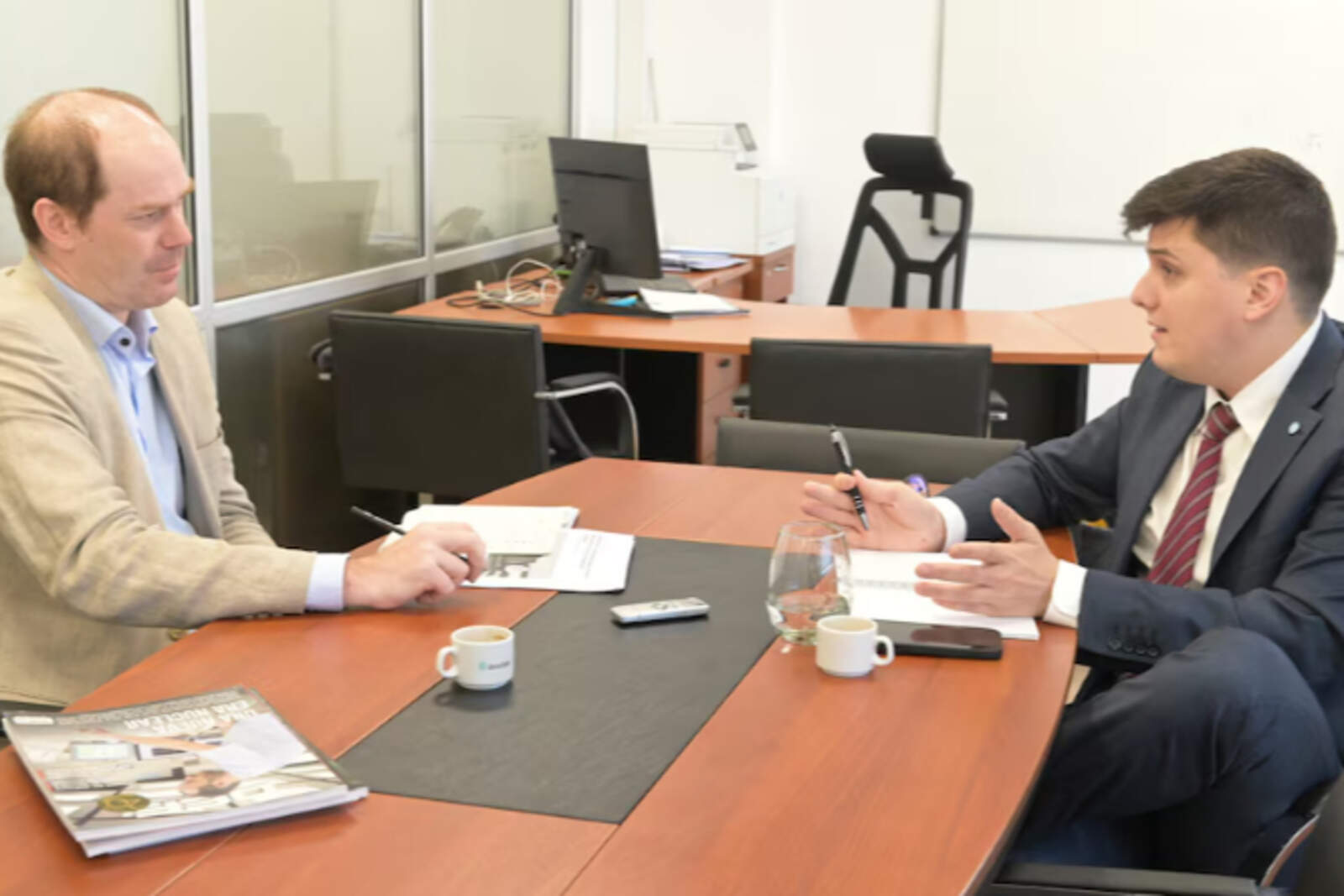
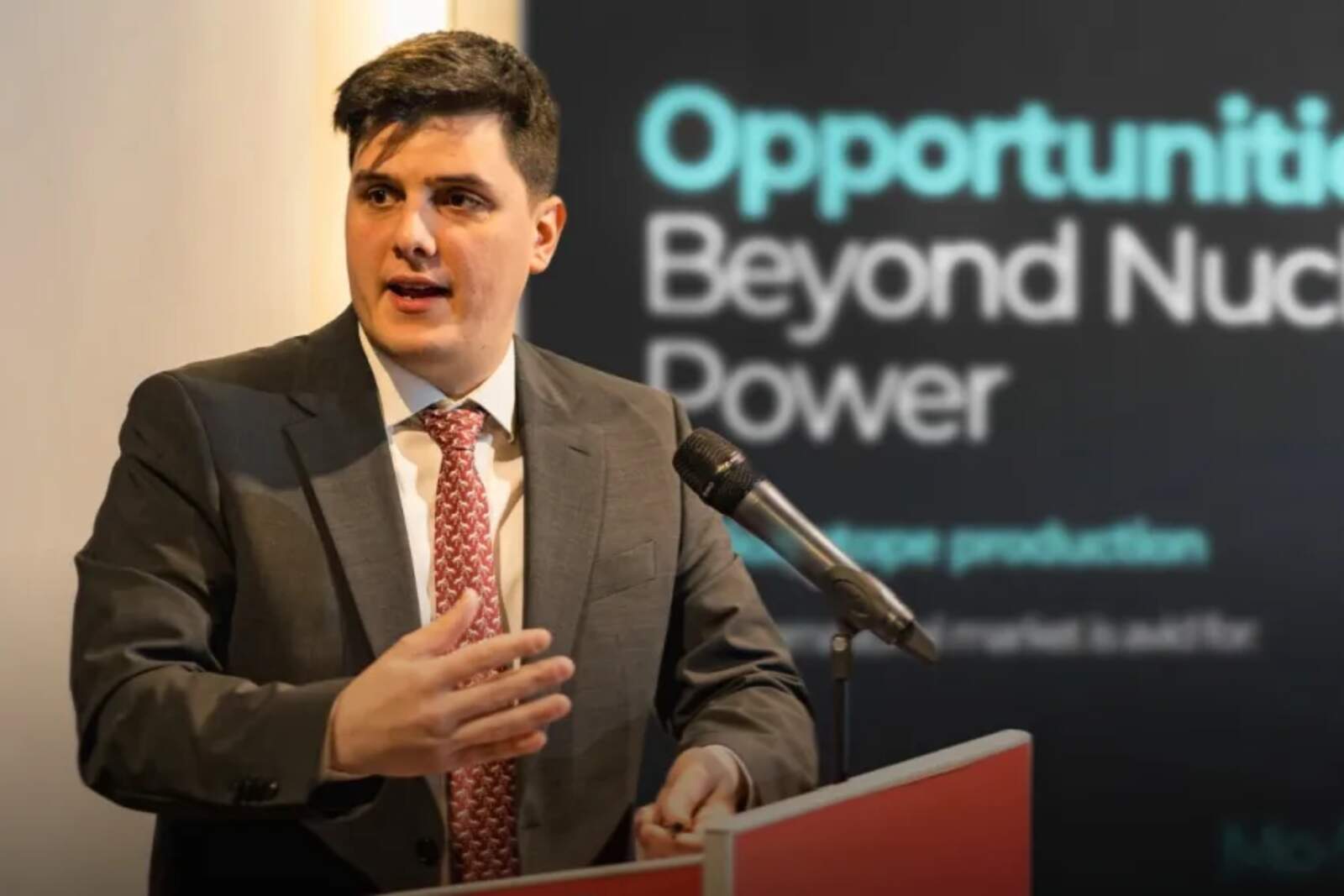
The recent creation of the Secretariat of Nuclear Affairs marked one of the strategic bets of the Government of Javier Milei in the energy and technology fields. At the head of this office, which operates under the umbrella of the Ministry of Economy, the president appointed Federico Ramos Napoli, a 31-year-old official with previous experience in the sector.
Before taking on this new role, Ramos Napoli served as president of Dioxitek, the state-owned company responsible for producing uranium dioxide destined for nuclear power plants and cobalt-60 used in medical and industrial fields. From his new position, the central objective is to reorganize and strengthen a key area in order to transform public investments into concrete economic results, in a context of strong growth of the nuclear industry at the global level.
During an extensive conversation in his office with DEF magazine, the brand-new secretary explained the diagnosis with which he is taking on the administration. “The Argentine nuclear sector has undergone 75 years of constant investment. However, today all that accumulated capital doesn't have a counterpart in terms of industrial scale and capabilities,” he stated.
Federico Ramos Napoli, secretario de Asuntos Nucleares.
Along the same lines, he emphasized: “We have many brains and gray matter, but we lack a structure capable of governing and aligning incentives, which makes the return on that investment low.”
Throughout the meeting, Ramos Napoli outlined the main pillars of his work plan, focusing on taking advantage of the accumulated knowledge, generating greater added value and ensuring that Argentina integrates more competitively into global nuclear fuel chains.
The transformation of the nuclear sector
“It is important to consider the nuclear sector as strategic, but there are certain parameters of functionality that shouldn't be up for discussion,” he added. “There was a broken incentive scheme,” he lamented, while inviting people to rethink the financing scheme of the National Atomic Energy Commission (CNEA) and to “generate a return on investments” in each of its projects.
-What role should the National Atomic Energy Commission have?
The CNEA has to have a role of research, development and generation of products and assistance to companies in the sector. In many cases, it can also provide services; the problem is that when those services reach a certain critical mass, they have to leave the Commission and be provided from a corporate structure. Currently, many organizational cultures coexist within CNEA, which are often juxtaposed and collide. The approach to each of those cultures must be somewhat more refined and must not simply allow the Commission to grow in an undirected way.
-What is missing in order to achieve that “fine-tuning”?
There must be a business model, because a project doesn't end at the time of its inauguration, since that is when its life begins and it has to generate a return for CNEA, which contributed capital for its execution. In that way, the Commission could then channel those resources into research and development.
-What does your administration propose in order to make those investments profitable?
Part of CNEA's financing has to come from the Treasury, because it is important for the State to invest in these matters, obviously within the realm of what is possible. However, there also has to be a return from those assets that the Commission has caused throughout its life. The Commission can't subsidize the projects in which it has already invested in order to build and put them into operation. What I can say, based on my previous experience at Dioxitek, is that the company had debts with CNEA dating back to 1999, which it had never paid. In the first half of 2026, more than 25 years of debts with the Commission for the molybdenum produced in the RA-3 reactor, which Dioxitek never paid, will surely be settled.
-Why did you appoint a new president at CNEA?
The resignation of Germán Guido Lavalle had been submitted at the time of my inauguration at the Secretariat. Despite the financial and economic difficulties throughout the almost two years that he was at the head of CNEA, Germán made all resources available to the RA-10 reactor, CNEA's most critical project, which is already in the home stretch. The choice of Martín Porro for the presidency of CNEA is due to his 30 years of experience at the institution, at RA-3, at Atucha II and also his time at the Secretariat of Energy. I consider that he is the right person because he has the technical knowledge and the project management experience required for the position.
-When announcing your appointment, the Government stated that Argentina is in a position to become the “Saudi Arabia of uranium.” Why is it important to return to uranium mining?
It is one of our priorities, for the simple reason that Argentina has, as a latent capacity, a large part of the value-adding chain for that uranium. Obviously, we have to increase capacities at an industrial scale, but our country has the know-how to transform yellowcake (concentrated uranium ore) into uranium dioxide or, eventually, into uranium hexafluoride. We are at a time when the world is increasing its nuclear capacities in a sustained manner, with 65 reactors under construction, which are going to need uranium. Argentina must take advantage of the fact that it has the resources and the technologies to exploit them in a sustainable way.
Federico Ramos Napoli, secretario de Asuntos Nucleares.
-What is the difference between the current situation and that of the 1990s, when uranium mining in Argentina was abandoned?
The global environment is radically opposite to that of the 1990s. At that time, we were experiencing the remnants of Chernobyl and a context of a general drop in the price of uranium, which made the exploitation of certain deposits in the country unfeasible. Today we are at the antipodes of that situation: today we have incentives for the nuclear market to move. From that perspective, the objective of this Secretariat is for the Argentine nuclear sector to be able to integrate into the value chains that, precisely, are expanding worldwide.
-Returning to your experience at Dioxitek, what is the scale problem in local uranium dioxide production?
The current scale of the current uranium conversion plant is exceeded if we consider the needs of the domestic market, and it isn't ambitious enough to export to the global market. The domestic market doesn't need more than 200 tons of uranium dioxide to supply the three nuclear power plants.
-What is going to happen with the Dioxitek plant in the city of Córdoba?
When I arrived at Dioxitek a year ago, that plant was in poor structural condition and it didn't have adequate conditions in its raw material warehouses and in waste treatment. That plant can't stop because we would run out of nuclear fuel for the power plants. It is true that, sooner or later, that plant will have to be shut down; what is certain is that we must think in terms of a reasonable time frame. We are now in the process of signing an agreement with the Municipality of Córdoba (due to the conflict that has lasted more than a decade over a zoning ordinance). We want to agree on a reasonable period to complete the construction of a new plant in another location, which will have a viable business model. The upgrading of the Córdoba plant has to be amortized.
-Is construction of the new plant in Formosa going to move forward?
The Formosa project is a typical example of the poor project management that the Argentine nuclear sector has shown to date. At some point, a plant with two lines of 230 tons of uranium dioxide, in nominal capacity, was envisioned. Later it was said that one line would be built and that space would be left to install the components of the second line. We found a budget hole of 4,000 million pesos, which had to be settled throughout 2025.
-How was Dioxitek's financial situation solved, given that it now shows a surplus?
With Nucleoeléctrica Argentina (NA-SA) we renegotiated the formula for calculating the cost of uranium conversion, taking into account Dioxitek's operating costs and a parameter for necessary works at the Córdoba plant. That was achieved, it began to operate and it improved the plant's performance. Dioxitek closed 2025 with a record production of 190 tons of uranium dioxide, which allows us to think that it is possible to meet the total demand of the power plants and avoid having to import this fuel.
-You spoke about nuclear fuel exports. What opportunities exist in the international market?
There isn't a projected market for uranium dioxide, since 58 of the 65 reactors currently under construction in the world are going to use enriched uranium and light water. In order for us to insert ourselves into the value chain of these new nuclear reactors, Argentina would have to produce uranium hexafluoride. During our administration at Dioxitek, we signed a memorandum of understanding with Nano Nuclear (a United States company), which consulted us about the possibility of producing uranium hexafluoride. There are existing capacities that may be relevant for a project of this nature. We have to receive a proposal that arises from private initiative.
-The other Dioxitek production unit is sealed cobalt-60 sources. What progress has been made in this line?
What was done in that business unit, which exports the vast majority of sealed cobalt-60 sources, was to bring contracts to market prices. Those exports allowed the company to undertake the cleanup that was carried out over the past year. We also identified some business opportunities for other applications of cobalt-60, with technology that Argentina developed at the time, such as the gamma knife (noninvasive radiotherapy technology), which entails adding value to the models that Dioxitek exports.
How ongoing works in the nuclear sector are progressing
When asked about the works in the sector, Ramos Napoli highlighted the future inauguration of RA-10, a research and radioisotope production reactor, which he described as “the most relevant project of the next decade.”
“It is a reactor that combines many of the needs that the world has shown to have with CNEA's and INVAP's expertise when it comes to building multipurpose reactors,” he stressed. At the same time, he qualified his statement: “The technological milestone of completing RA-10 doesn't have a counterpart in the business model, which wasn't developed accordingly.”
He also referred to the Argentine Proton Therapy Center, the other major CNEA project based on an agreement with the University of Buenos Aires (UBA). In this regard, he stated that “it is at a good level of technical progress, but it is still necessary to define what its operating model is going to be. The point is the following: once it is up and running, do we expect CNEA to have to put in money every month, or to provide services to the Proton Therapy Center and, in turn, receive a fee for the concession of that asset to the Foundation (CNEA-UBA) that is going to manage it?”
Federico Ramos Napoli, secretario de Asuntos Nucleares.
With regard to the Heavy Water Industrial Plant (PIAP), located in the town of Arroyito in Neuquén Province, he recalled that the facility was shut down in 2017 for an overhaul and never operated again.
“It is a very important asset for CNEA, but, as in the other projects, a business model wasn't considered,” he stated. To enable the plant's viability, CNEA signed a memorandum of understanding with the Canadian company CANDU Energy, with a view to refurbishing the infrastructure and supplying heavy water to the new Canadian CANDU Monark reactor models.
Finally, regarding the small modular reactor CAREM, the official explained that the former CNEA president, Germán Guido Lavalle, decided to halt construction of its prototype in Atucha because the project has “some engineering issues that are still unsolved.” “Until the technical functionality of the reactor can be clarified, it doesn't make sense to continue investing in construction,” he concluded.
Meanwhile, he recalled that there is another modular reactor project, the ACR-300, patented by INVAP and which will be developed in partnership with a United States company. “We have to create an attractive nuclear environment, from the regulatory standpoint and in terms of the provision of services, so that companies that so decide will base their development in Argentina,” stated the new secretary of Nuclear Affairs, who clarified that these are private initiatives.