According to a recent survey, the vast majority of the population believes that the current legislation 'hinders development'
Compartir:
A recent national survey revealed that the majority of the population considers it urgent to move forward with a labor reform, while rejection of unions is growing, which a large part of citizens considers no longer represent workers.
The data come from the latest report by DC Consultores, carried out between December 6 and 8, 2025, on a sample of 1,710 cases across the country. The study, titled "The Hindrance-State: the end of social patience," describes a scenario in which society seems to abandon the current failed scheme to adopt a more pragmatic outlook, linked to productivity and economic growth.
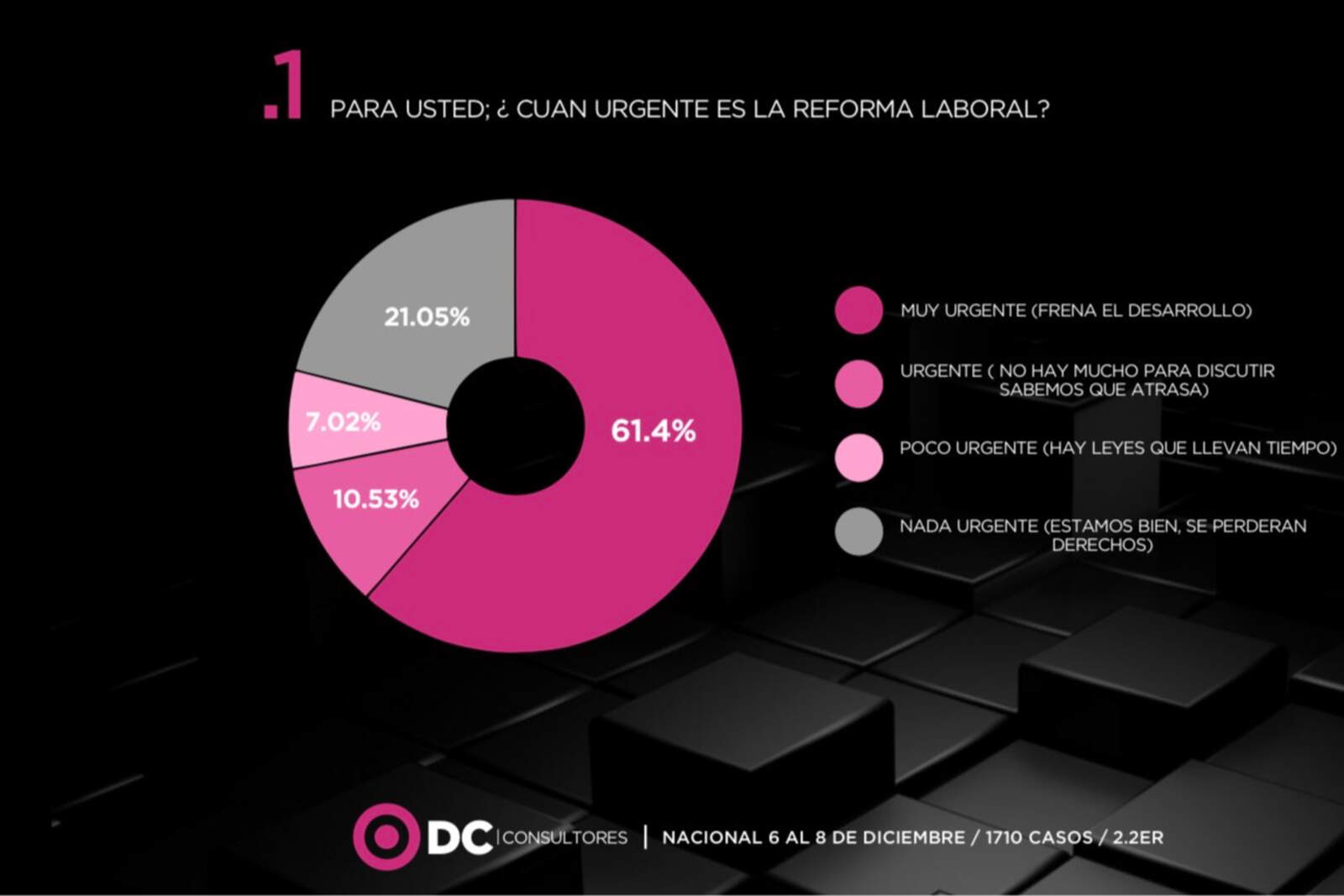
One of the most significant results of the survey appears when measuring the level of urgency that citizens assign to a labor reform. Faced with the question "How urgent is labor reform?", 61.4% of respondents answered that it is "very urgent", arguing that the current legislation "halts development".
An additional 10.53% considers it "urgent", under the premise that the current regulatory framework "holds us back". Taken together, the consensus in favor of a structural change exceeds 71%, a figure that marks solid and cross-cutting social support.
La encuesta de DC Consultores.
In contrast, the sector that opposes deep changes shows a clear reduction. Barely 21.05% considers that the reform is "not urgent at all", maintaining that "we're fine" and that the changes could imply an alleged "loss of rights." The data reflect a shift in the axis of the debate, where the unrestricted defense of the status quo no longer appears as the majority position.
When respondents were asked which aspects should be discussed in a possible reform, 45.58% answered that "everything" should be reviewed. In second place appears the demand to put an end to the so-called "lawsuit industry" (19.73%), followed by the need to move forward with new labor relations (17.01%). Only 8.16% considers that the debate should focus exclusively on the protection of rights, a figure that reinforces the idea of exhaustion of the current model.
Support for the labor reform promoted by the Government of Javier Milei is explained, to a large extent, by the collapse of the image of unions, which historically presented themselves as defenders of workers.
La encuesta de DC Consultores.
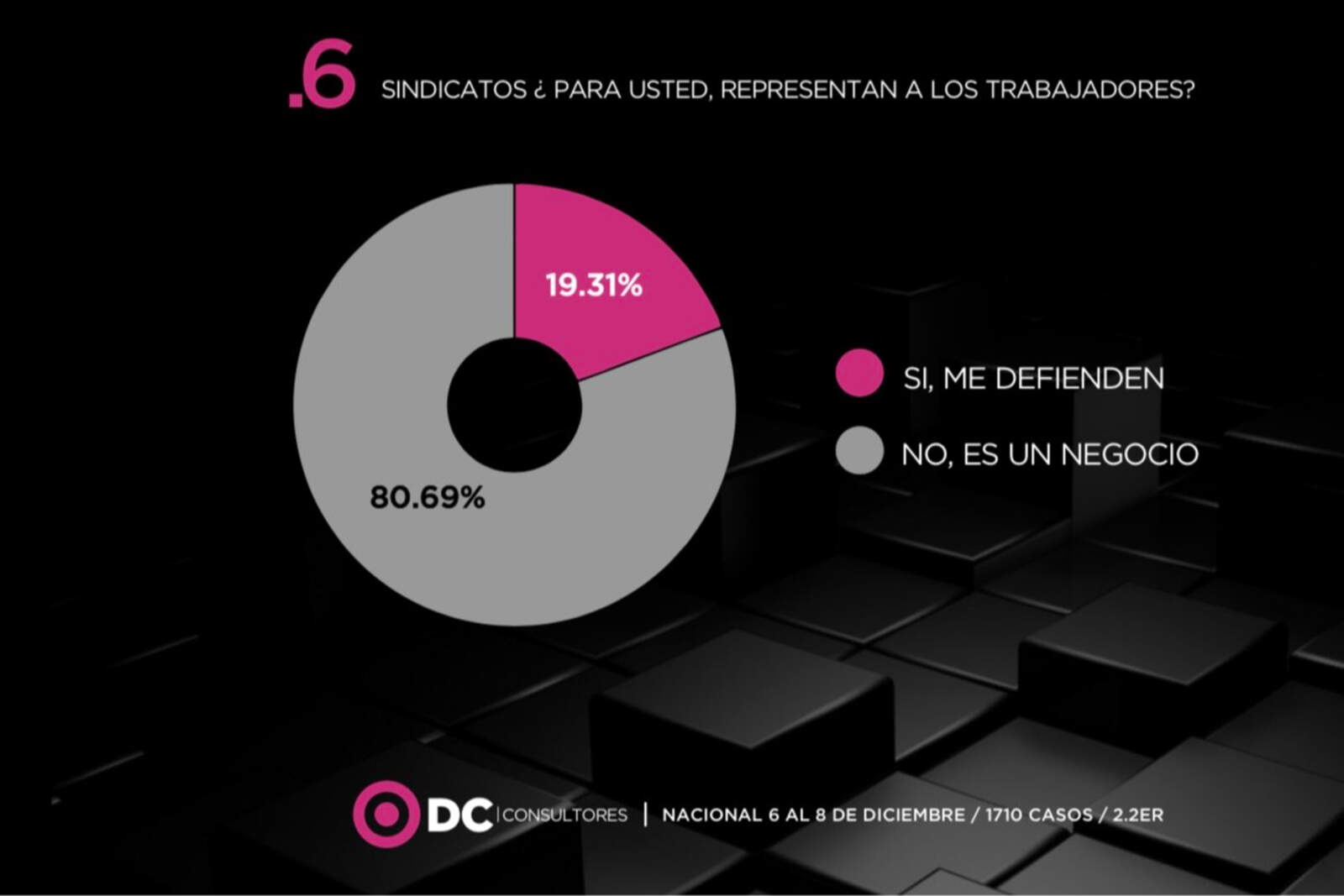
DC Consultores's report is categorical: 80.69% of Argentines state that unions "DO NOT represent workers" and associate them directly with a "business". Only 19.31% feel that these organizations defend them, a figure that exposes an unprecedented legitimacy crisis.
In addition, the everyday relevance of unions is also in question. For 59.18% of respondents, unions aren't important in their working life, a figure that becomes especially relevant in a labor market increasingly made up of self-employed taxpayers, freelancers, and platform workers, for whom the traditional union model is foreign and obsolete.
In this context, the survey reflects a favorable scenario for the Government, which is promoting structural changes in labor matters with the aim of modernizing the economy, creating jobs, and breaking with schemes that no longer respond to the country's productive reality.