Sugar detected on Bennu, confirming that the asteroid contains all the basic compounds necessary for the emergence of life
Compartir:
A discovery that completes the "chemical inventory" of the origin of life
A new analysis of samples from asteroid Bennu revealed the last missing component needed to form the complete set of molecules necessary for the emergence of life: sugar. According to the discovery, asteroids may have transported to Earth—and possibly to other planets—all the elements that enabled biology to appear.
The samples were collected in 2020 by the OSIRIS-REx mission of NASA. Back then, the spacecraft collected material from the asteroid, located hundreds of millions of kilometers (hundreds of millions of kilometers) from the Sun between Mars and Jupiter.
La NASA recolectó muestra del asteroide
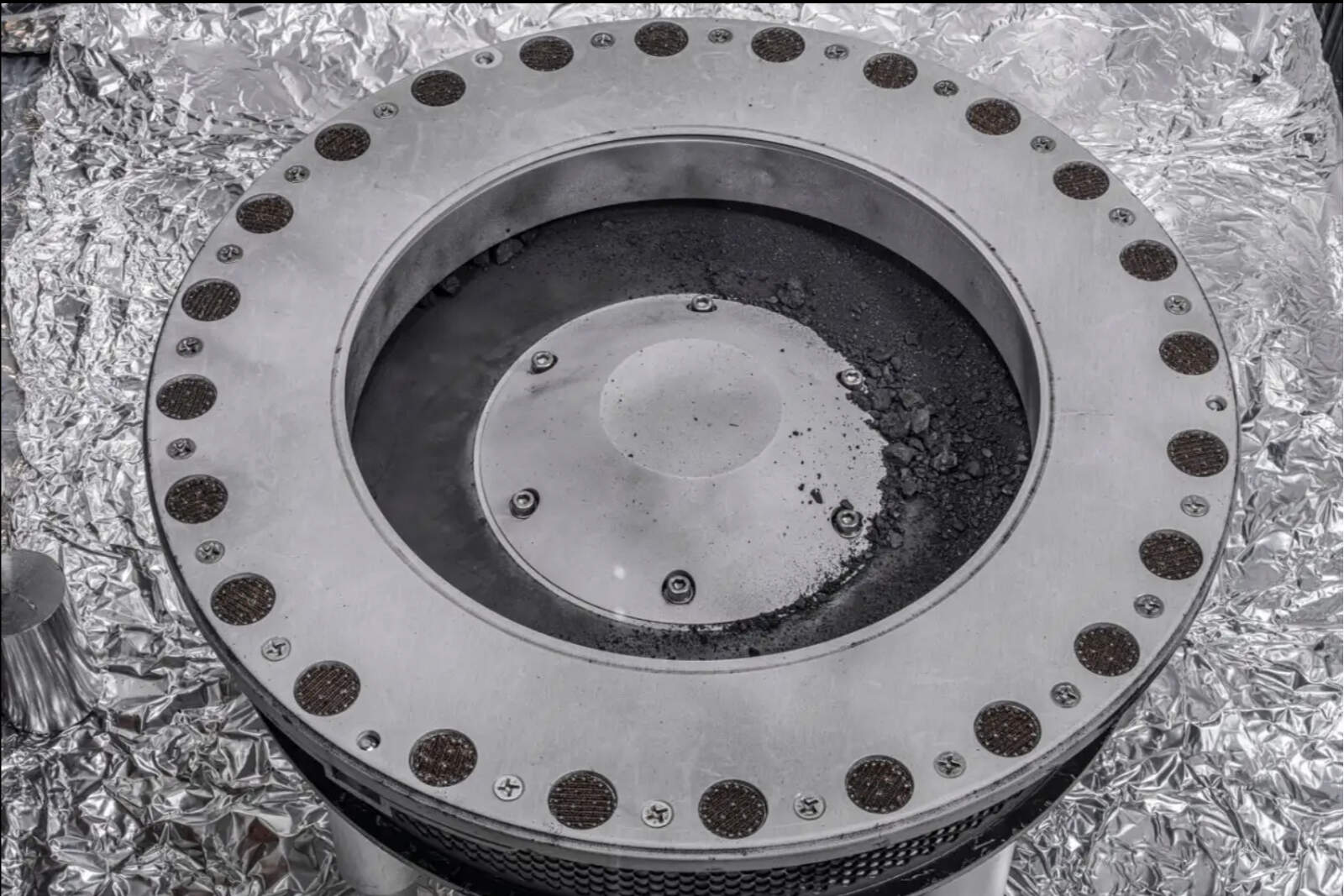
The 121 grams (4.27 ounces) obtained arrived on Earth in 2023 and, since then, laboratories around the world have been analyzing small fractions of the material to identify organic compounds and chemical structures.
The first results had confirmed the presence of water, carbon, and various organic molecules. Later, amino acids, formaldehyde, phosphates, and the five nitrogenous bases that are part of DNA and RNA were added.
However, a key element was still missing: the sugars that are part of the genetic structure. In RNA, the sugar is ribose; in DNA, it is deoxyribose. In the preliminary analyses, neither had been detected.
Ribose and other sugars detected for the first time in Bennu
The team led by researcher Yoshihiro Furukawa from Tohoku University (Japan) processed a new portion of the sample. They crushed the material, mixed it with water and acid, and then applied gas chromatography and mass spectrometry to separate its components.
Yoshihiro Furukawa, investigador que realizó el descubrimiento
The instruments revealed the presence of ribose, along with lyxose, xylose, arabinose, glucose, and galactose; the only one absent was deoxyribose. For Furukawa, this is "a new discovery of sugars in extraterrestrial materials". He also emphasized that glucose is essential for the metabolism of virtually all forms of life.
Sara Russell from the Natural History Museum in London, also a Bennu specialist but not involved in this study, described the result as "brilliant." According to her, with the detection of the missing sugar, all the essential components of RNA in primitive asteroids are now known.
How these molecules may have formed in Bennu's original body
The researchers believe that the sugars were caused in the parent body of the asteroid. This would have been a larger, fluid-rich object where chemical reactions favored by brines containing formaldehyde could have occurred.
Muestra de OSIRIS-REx
Russell recalled that at the beginning of the year, salts were detected in the recovered material. This would be an indication that in that original body, "saline pools" capable of producing complex organic compounds could have existed.
The presence of brines also coincides with observations made in other bodies of the solar system, such as Enceladus, Saturn's moon, and Ceres, the dwarf planet.
Boost for the "RNA world" theory
Furukawa had already identified ribose and other sugars in meteorites that arrived on Earth, but there was always the question of possible terrestrial contamination. Bennu's samples eliminate that problem: they were never exposed to the terrestrial environment before analysis.
The discovery reinforces the RNA world hypothesis, which proposes that the first forms of life were based on RNA chains capable of storing information and replicating before the appearance of DNA and cells. The presence of ribose—and the absence of deoxyribose—fits precisely with that scenario.