
Argentina is on track to become an energy exporting power in the next decade, in a global context marked by energy transition and the growing demand for hydrocarbons.
According to a study by the Hydrocarbons Exploration and Production Chamber (CEPH), the country could achieve energy exports of USD 41.758 million annually by 2035, provided that stable macroeconomic conditions and a strong increase in investment are consolidated.The report proposes a scenario of sustained expansion based on the exploitation of the country's vast natural resources: Argentina has sufficient reserves to supply domestic demand for oil for more than a century and natural gas for more than two centuries.
Within this framework, and with YPF as the central actor, the strategic objective is to position the country as a net energy exporter by 2030, focusing on the development of Vaca Muerta, investment in LNG and improvements in operational efficiency.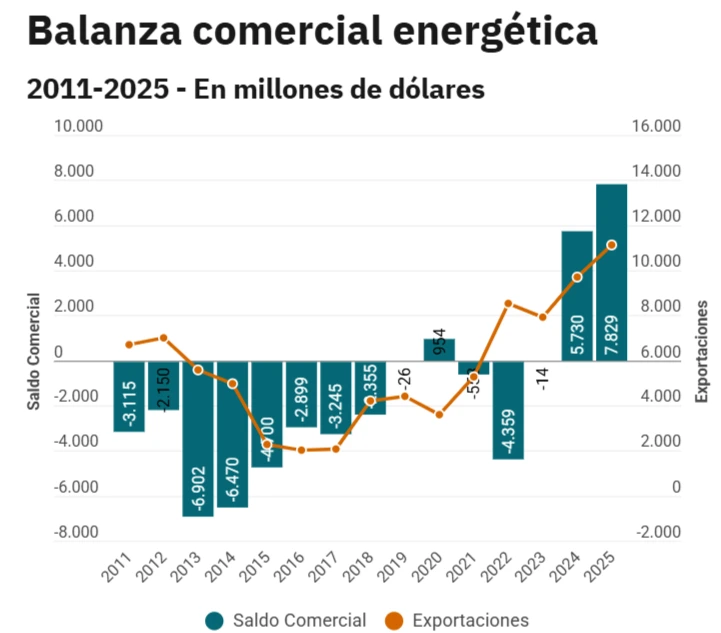
This paradigm shift occurs in an international context where energy security became a priority, especially after the war in the Middle East. The need to guarantee supply, diversify sources and advance the energy transition opens up an unprecedented window of opportunity for Argentina. In this regard, Carlos Ormachea, president of CEPH, highlighted the structural change that the country is going through: “Historically, the increase in international prices transformed into a growing deficit for Argentina. Today, however, it boosts the trade balance surplus
.”The study highlights that, for the first time, Argentina has the capacity to supply its domestic demand and, at the same time, to project itself as a global supplier: “For the first time in history, we have the resources to supply local demand and, at the same time, to form a large scale export platform aimed at supplying global demand.”
This scenario contrasts with the recent past. Oil production fell steadily until 2017 due to decoupled domestic prices and the depletion of conventional fields. From then on, the recovery in prices and the advance of the unconventional economy fueled growth that reached an all-time record in 2025. In gas, the recovery began in 2013 with the Gas Plan and the development of Vaca Muerta, also with peaks in 2025
.For years, the combination of falling productivity and rising demand resulted in a strong energy trade deficit and a heavy burden of subsidies. The report is convincing: “Over the past few decades, there have been extended periods of frozen rates or increases well below inflation, leading to significant reductions in rates in real
terms.”In this context, energy subsidies averaged 1.7 points of GDP over the last decade, being a key factor in fiscal deterioration.
However, this trend began to reverse: “Starting in 2022, energy subsidies began to decrease... In 2025, subsidies totaled USD 3,999 million, equivalent to 0.6% of GDP”, marking a change towards a more sustainable scheme aligned with the fiscal discipline promoted by the current administration.For export potential to materialize, the report establishes three key conditions: a strong increase in investment, the alignment of domestic prices with international values and the consolidation of a regulatory framework that encourages new investments.