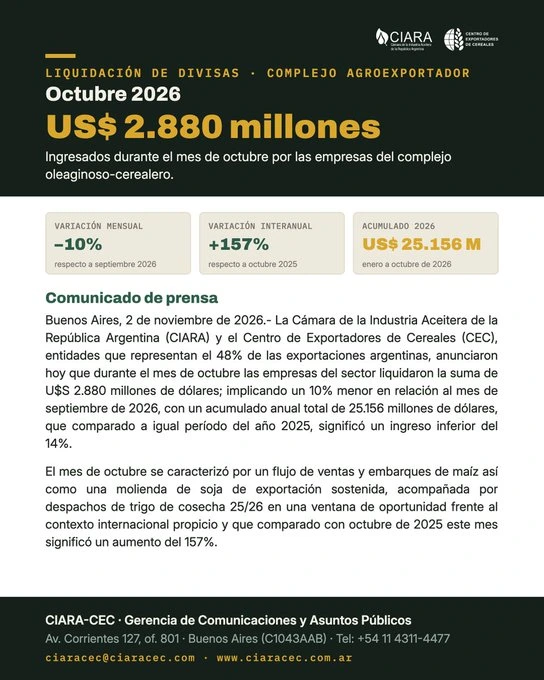
This was reported by the Argentine Oilseed Industry Chamber (CIARA), which, along with the Center for Grain Exporters (CEC), reported revenues of US$ 2.880 billion during October
The agro-exporting sectorin Argentina, framed within the government of Javier Milei, achieved an unprecedented productive milestone in October by entering a total of US$ 2.880 billion. This figure consolidates as the highest volume of foreign currency liquidation for an October in the last two and a half decades (or 25 years), reflecting the strength of the economic turnaround led by the presidential administration. The official report released this Monday by the Chamber of Oilseed Industry and the Center for Grain Exporters (Ciara-CEC) confirmed the magnitude of this grain export and its derivatives, affirming the strong acceleration of the agro-industrial engine when the obstacles of the populist State are removed.
In the comparative quantitative analysis, while the foreign currency flow for the tenth month of the year showed a moderation of 10% compared to September, the year-on-year comparison against the same month of the previous year evidenced an extraordinary leap of 157%.
Argentine Chamber of the Oil Industry (CIARA)
This drastic year-on-year difference of 157% is directly related to the distortion generated in September 2025, when the previous national government implemented a temporary elimination of withholdings for electoral purposes. That interventionist measure caused a massive liquidation of foreign currency artificially concentrated in a single month, emptying the dollar income for the following months and affecting market predictability.
Meanwhile, in the period January-October, the accumulated dollars entering from the field amounted to US$ 25.156 billion (surpassing the mark of US$ 25.100 billion), remaining 14% below what was recorded in the previous cycle due to the lingering impact of the old distorting policies on marketing.
When detailing the commercial vectors that enabled this historic mark, the agro-industrial entity Ciara-CEC stated: "The month of October was characterized by a flow of sales and shipments of corn, as well as sustained soybean export milling, accompanied by dispatches of wheat from the 25/26 harvest in a window of opportunity given the favorable international context, and compared to October 2025, this month represented an increase of 157%".
The achievement of Argentine agriculture takes on even greater significance considering it was accomplished in a global environment of declining international prices and increased regional competitive pressure.
Cereal Bag
According to data from the Rosario Stock Exchange (BCR), during the tenth month of the year, the prices of soybeans and corn in international markets hit their two-month lows, accumulating five consecutive weeks of declines.
This international trend was compounded by the political situation in Brazil, where the elections in Brazil and the victory of Lula da Silva shook the exchange front. On this aspect, the BCR noted: "The exchange front played a key role, opening with a depreciation of 12% for the real against the dollar, increasing the competitiveness of Brazilian exports. Ultimately, this translates into a reduction in the cost of Brazilian goods for buyers from the rest of the world (as long as this depreciation is not passed on to prices), which puts downward pressure on the prices of other origins, including the U.S.".
Despite the 12% depreciation of the Brazilian currency, the competitive advantages of Argentine deregulation ensured that Argentina remains the most competitive origin in the region for corn. In the domestic market, the BCR pointed out that the commercial board for the main grains "does not seem to have reacted significantly to the news" of the monthly volume. In the cereal market, the price of a ton of corn on Monday started at $ 281,000 per ton, registering a slight downward adjustment of $ 3,200 entering the week. As for soybeans, the board price fluctuated around $ 555,000 per ton, with a negative variation of $ 5,000.
The president, Javier Milei.
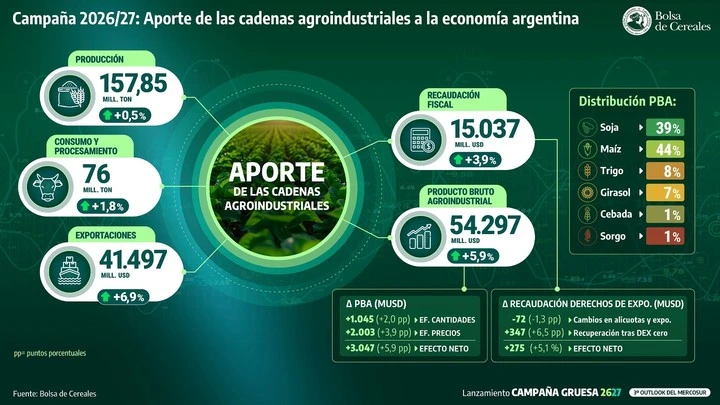
The scenario of predictability and freedom promoted by the national government heralds an even more promising cycle for the 2026/27 campaign. The Buenos Aires Grain Exchange (BdeC), during the Launch of the Grain Campaign, projected a record harvest of 157.85 million tons, which represents a growth of 0.5% compared to the previous cycle (representing 1.1 million tons additional grains). The total agricultural area will reach a planted area of 37.02 million (with an estimated variation of 0.2% compared to the previous cycle).
The breakdown by crop for the 2026/27 campaign anticipates the following production figures: Corn: Growth of 3.1% to reach 66 million tons. Soybeans: Increase of 7% to achieve 53.6 million tons. Sorghum: Expansion of 1.8% totaling 2.85 million tons. Sunflower: Campaign closure stabilized with no variations at 7 million tons. Wheat (fine grains): After the record 2025/26 campaign, it will register an adjustment of 15.8% standing at 23.4 million tons. Barley (fine grains): Decline of 7.4% standing at 5 million tons.
Finally, the macroeconomic impact and the economic contribution of the new campaign will show substantial growth that will strengthen public accounts: Agricultural exports will expand by 6.9%, generating a gross income of US$ 41.497 billion. The gross agricultural product will rise by 5.9%, reaching US$ 54.297 billion. The direct tax collection derived from the agricultural sector will climb by 3.9%, contributing US$ 15.037 billion to consolidate the State's surplus.