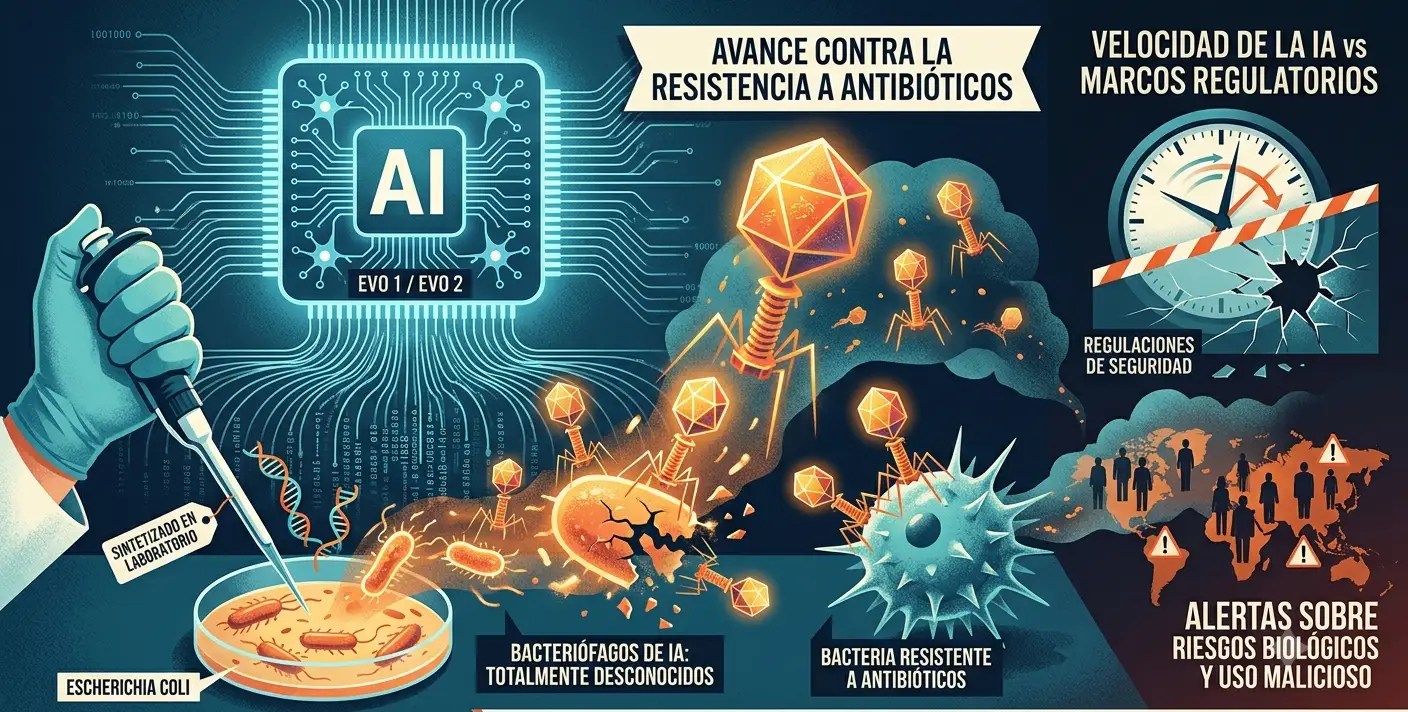

For the first time, an artificial intelligence system generated completely unknown viruses capable of infecting and destroying certain types of bacteria. The finding, published this week in the journal Science, opens a promising avenue to tackle antibiotic resistance, but at the same time raises alarms about the pace at which technology advances ahead of regulations.
For years, researchers have managed to synthesize viruses from scratch. These viruses are used to test antivirals, vaccines, and to study the behavior of these microorganisms. However, they were almost always copies or variants of already known pathogens. Now, scientists from Stanford University and the Arc Institute have succeeded in having an AI design simple, functional, and never-before-seen viruses based on the genetic information of millions of organisms present in nature.
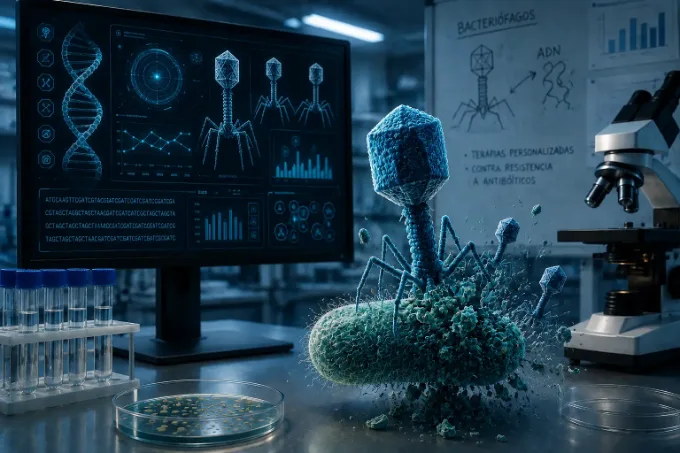
The work focused on bacteriophages, viruses that only infect bacteria and have relatively small genomes, making them easy to synthesize and manipulate in the laboratory. These microorganisms are considered an interesting alternative to traditional antibiotics, especially against resistant infections.
The models used were Evo 1 and Evo 2, foundational algorithms trained with millions of genomes from animals, plants, microbes, bacteria, and viruses. The goal of this training was for the artificial intelligence to learn complex evolutionary patterns: how genes are organized, which sequences are conserved, and what biological constraints allow an organism to remain functional.

From Model to Laboratory
The bacteriophage Phi X-174, which infects the bacterium Escherichia coli, was chosen as a reference. The aim was not to reproduce it, but to use it as a guide for the algorithms to generate thousands of new genomes with an architecture compatible with the infection of that bacterium. The resulting viruses maintained the functional organization necessary to recognize the bacterium, insert their DNA, replicate it, and assemble new viral particles, but the specific sequences differed significantly from those of natural bacteriophages.