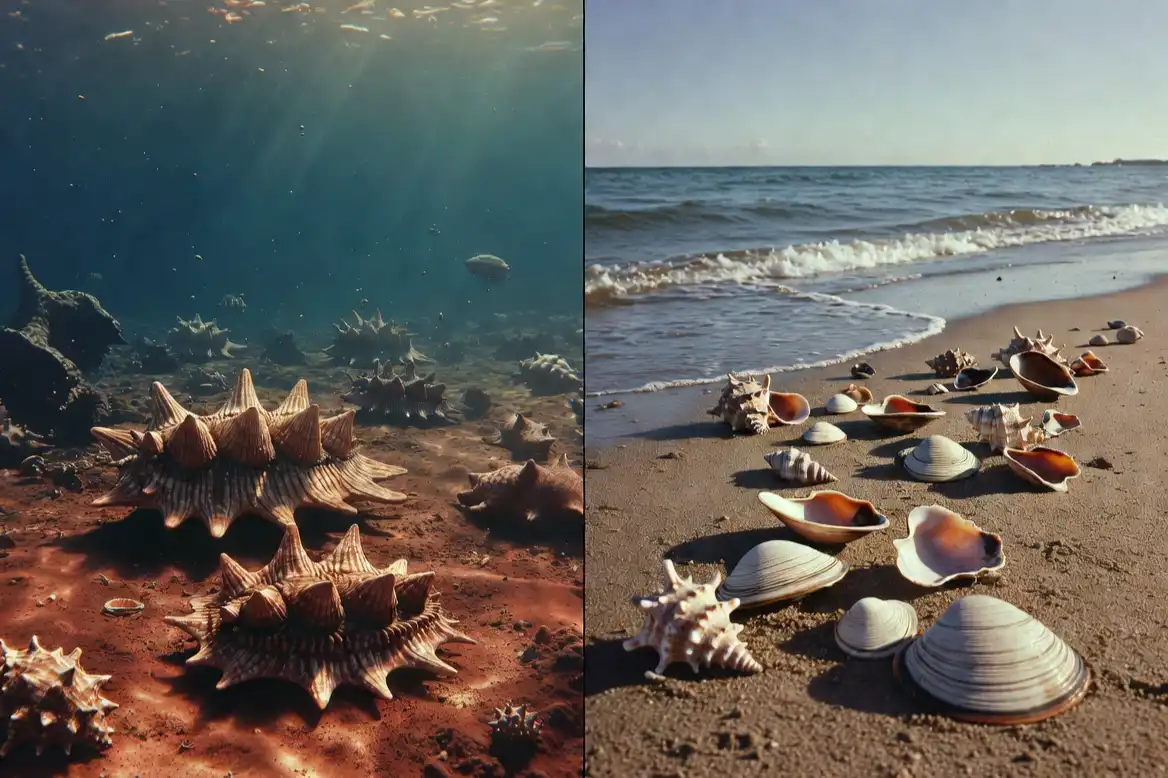

Scientists have finally explained why today we collect shells of clams and snails on the beaches, and not of brachiopods, those organisms that dominated the seabeds for millions of years. A new study from Stanford University points out that the key lies in the largest mass extinction in Earth's history, known as the Great Dying Event, which occurred about 252 million years ago.
During this cataclysm, around 96% of marine species and 70% of terrestrial species disappeared. It was not a uniform event: some groups were much more affected than others. Brachiopods, which resembled clams but had distinct characteristics, ruled the oceans before the crisis. Afterward, they nearly vanished, while mollusks like clams and snails suffered fewer losses and ended up dominating the seas.
Researchers combined biological data from the groups that went extinct massively and those that survived. The main factor was the metabolic capacity to tolerate warmer waters with less oxygen. Massive volcanic eruptions released huge amounts of carbon dioxide and methane, which warmed the planet and reduced oxygen levels in the oceans.
The role of metabolism in survival
Paleozoic animals, such as brachiopods and crinoids, were mostly sedentary filter feeders with slow movement. Their metabolisms could not adapt to the rising temperatures, which increased the demand for oxygen faster than they could handle. In contrast, bivalve mollusks and other more active groups, with higher energy requirements but better equipped to extract oxygen, fared better.










