The Treasury raised the maximum planned amount with a rate lower than expected and demand that exceeded the amount awarded by 479%
Compartir:
Amid a demanding international scenario and with country risk still elevated, the national government took a key step in its public debt management strategy: it placed USD 150 million through the first issuance of the new dollar bond maturing in October 2027, at a 5.89% rate, below what various analysts had anticipated.
The operation, which worked as a true market test, not only made it possible to capture the maximum amount planned for the auction, but also showed strong investor interest: the Secretariat of Finance received bids for USD 868 million to subscribe to the Bonar 2027. That is, investors offered 5.79 times more than what was ultimately awarded. In percentage terms, demand exceeded the amount placed by 479%.
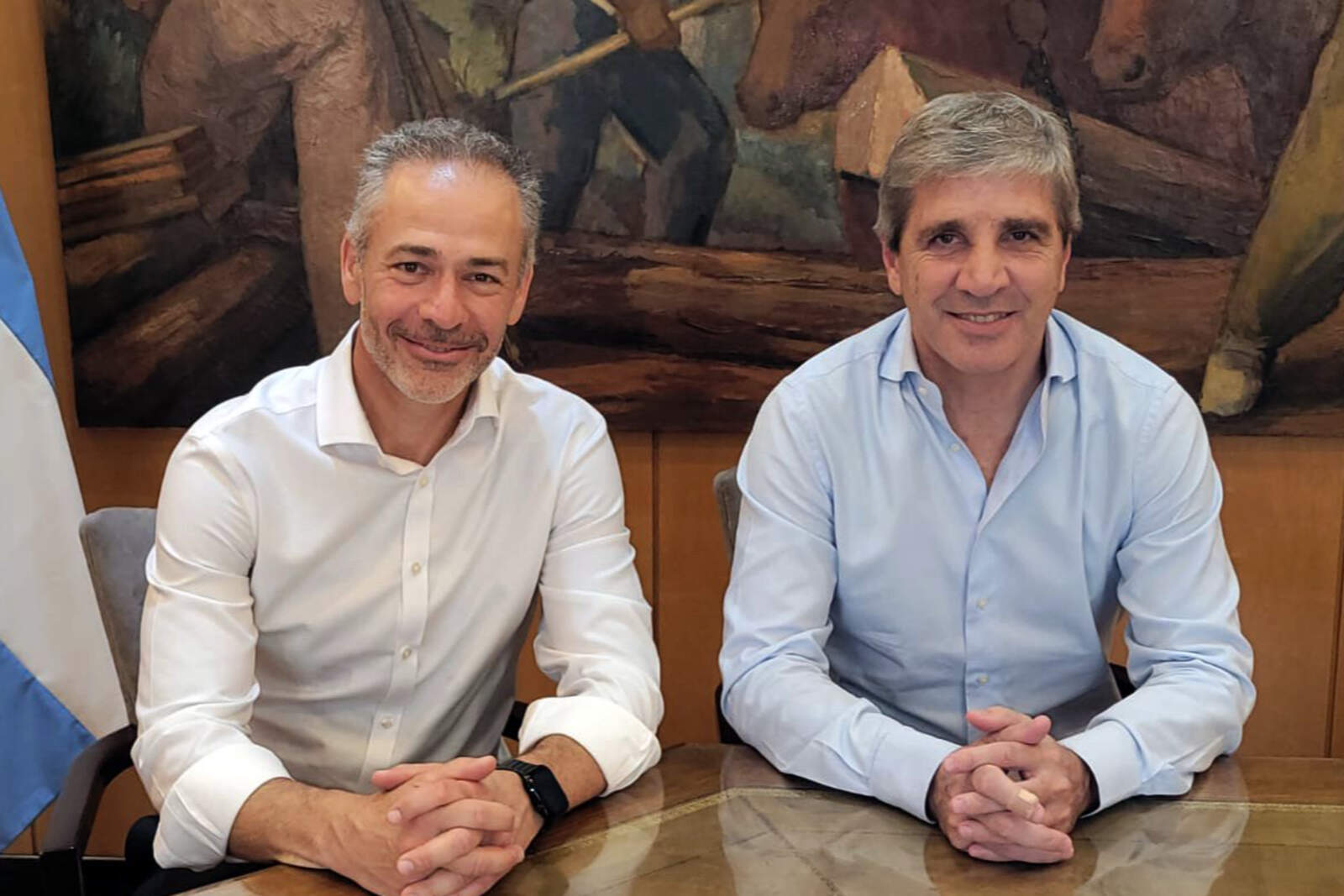
Luis "Toto" Caputo y Alejandro Lew, nuevo secretario de finanzas.
The funds obtained will be used for the payment of a USD 4.2 billion maturity in July, one of the most relevant commitments on the financial calendar. The operation becomes even more significant in a context in which the government ruled out issuing debt again on Wall Street, a decision that was reaffirmed after the recent increase in country risk.
On Monday, together with the announcement of the instruments for the public debt auction in pesos, the Ministry of Economy announced that it will offer this new dollar bond, maturing in October 2027, on a biweekly basis for up to USD 150 million per auction.
The regulations also provide for a second round on the following day, which allows the placement to be expanded by up to an additional USD 100 million, which would bring the potential total to USD 250 million. The security has a 6% nominal annual coupon, payable monthly.
Various analysts highlighted a key technical detail: the bond "was issued above par." This means that, although it pays an annual interest rate of 6%, it was sold with a final yield of 5.9%. In practical terms, investors paid more than its face value to acquire it. That is, the sale price was higher than the amount that the bond will repay at maturity, a concrete sign of confidence in the instrument and in the official economic policy.
The design of the bond aims to attract both large institutional investors and small savers interested in dollarized assets, thereby expanding the hard-currency funding base within the local market.
Javier Milei.
The initiative arises after the recent experience with BONAR 2029, which marked Argentina's return to the voluntary foreign-currency debt market after almost a decade. That placement raised USD 1 billion through market purchases and the issuance of the security.
However, that operation did not fully meet the expectations of the Ministry of Economy: the interest rate exceeded 9% annually and country risk stood at around 569 basis points. Today, with country risk at around 600 basis points, the government is managing to finance itself at 5.89%, a figure that officials at the Treasury Palace interpret as a positive sign amid the macroeconomic normalization process.
The placement of the new bond is part of a demanding agenda of rollovers and payments that the Secretariat of Finance will have to face in the coming months. The USD 4.2 billion maturity in July constitutes one of the greatest financial challenges for the economic team in 2026.
In the face of this scenario, Luis Caputo's strategy prioritizes domestic alternatives and avoids a debt issuance on Wall Street, where the country faces less favorable conditions due to elevated country risk. The minister ruled out moving forward with an immediate placement in international markets and reaffirmed the intention to eliminate dependence on external funds, prioritizing local sources. President Javier Milei backed that stance on his social media accounts, emphasizing the need to strengthen domestic financing.
Gabriel Caamaño, economist at the consulting firm Outlier, stated: "He is proposing to do without something that we have not had for eight years, because since 2018 we have not had a flow from Wall Street, so in reality we no longer have any dependence. What must not be done, in any case, is to become dependent again, but to cut dependence, there is no such dependence, for eight years we have not had financing there."
Meanwhile, Christian Buteler analyzed: "From the very beginning the government had the objective of returning to the credit markets. It expressed this more than once, including in meetings with funds, in which it stated that it would meet maturities in order to roll over the principal of the debt, as the rest of the world does. Two years on, we have country risk at around 600 basis points, even with the backing of the U.S. Treasury."
The debate intensified when analysts in New York mentioned the possibility of a future issuance of up to USD 3 billion, which raised expectations in the market. Javier Casabal, fixed-income strategist at the firm AdCap, explained: "Those reports embolden the market and, if they are not fulfilled, the market becomes disappointed. Caputo's tweet is intended to stop that."
The new issuance reinforces the official decision to avoid international markets in order to guarantee compliance with immediate commitments. Nevertheless, the question about the sustainability of this policy over time persists. The payment of USD 4.2 billion in July represents a significant challenge in 2026. The government is betting on the use of domestic tools and alternative schemes, such as REPO agreements, which make it possible to access funds without lifting foreign-exchange controls or resorting to international markets.