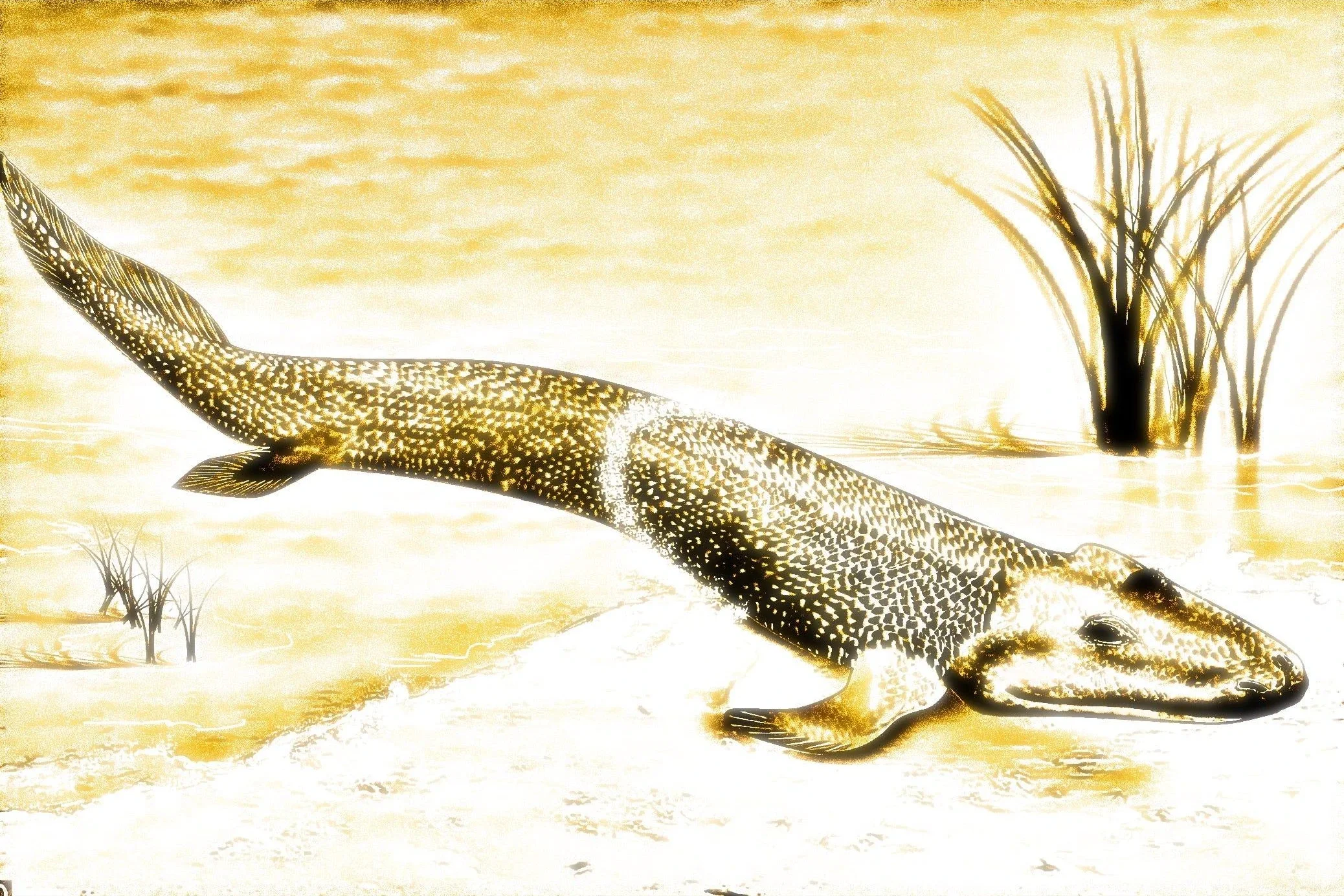
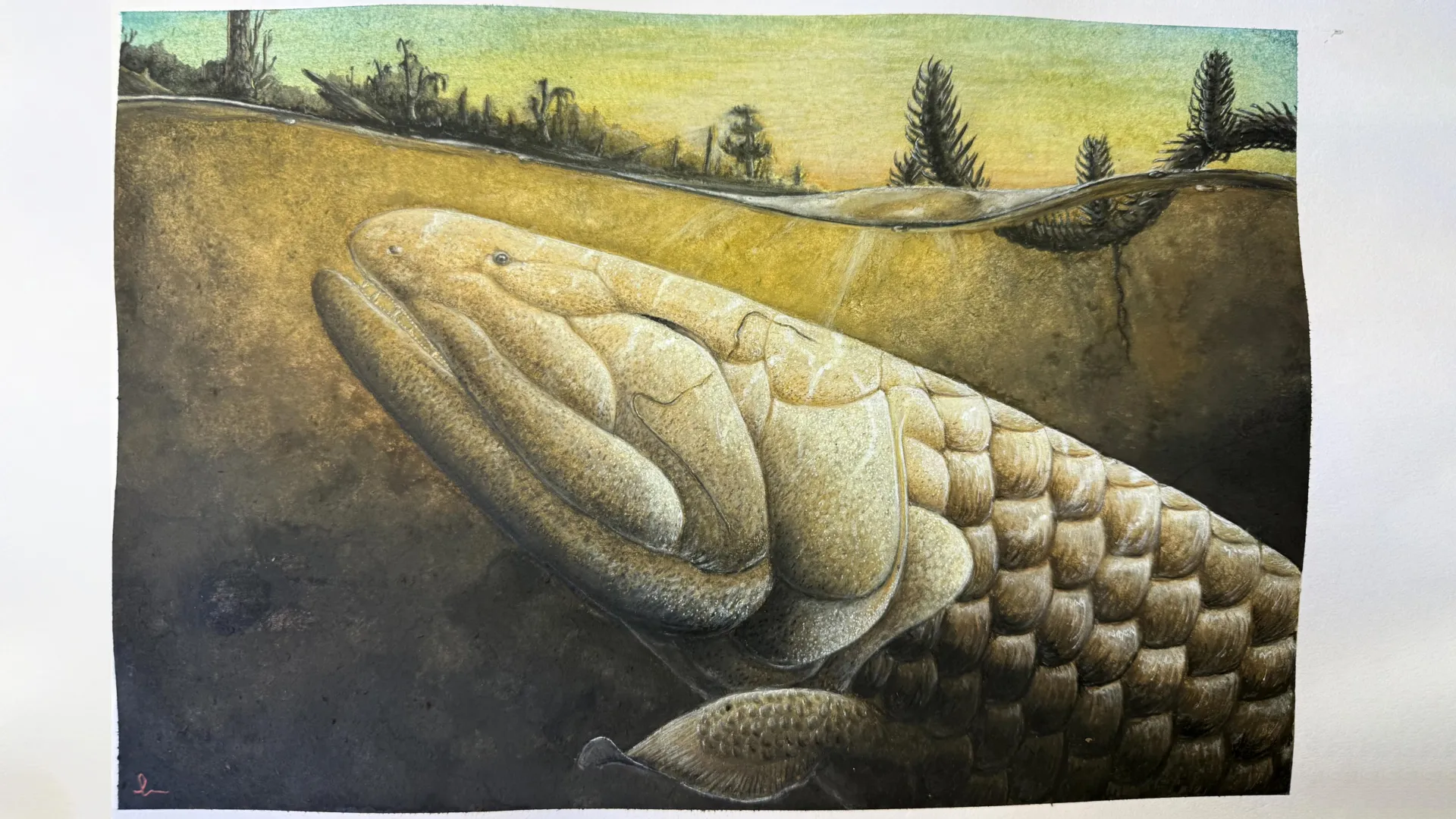
A prehistoric fish from 380 million years ago could provide answers to one of the great questions of evolution: how some animals began to leave the water and live on land. Researchers from Flinders University analyzed the skull and braincase of Koharalepis jarviki, a large predatory fish that lived during the Devonian period, known as the "Age of Fishes." The study revealed anatomical features suggesting a life near the water's surface and possible adaptations related to air breathing.
The fossil was discovered in the Lashly Mountains region of Antarctica and represents the only known specimen of its kind. Its significance lies in the fact that it belongs to a group of fish closely related to the first four-limbed vertebrates, the tetrapods, which later gave rise to land animals. Therefore, every detail of its anatomy can help reconstruct the evolutionary process that allowed life to transition from an aquatic environment to a terrestrial one.
A unique Devonian fossil: the fish that connects Antarctica, Australia, and the first land animals
Koharalepis jarviki belonged to the family Canowindridae, a group of lobed-finned fish that inhabited ancient ecosystems of eastern Gondwana. Fossils of this lineage have been found in both Antarctica and Australia, reinforcing the geological and biological links between the two regions when they were part of the same supercontinent. Dr. Alice Clement, a researcher at Flinders University, explained that this fossil "belongs to a group called Canowindridae, highlighting the ancient connections between Australia and Antarctica."
The relevance of the specimen is also related to its evolutionary moment. The Devonian was a decisive stage in the history of vertebrates because predatory lobed-finned fish closely related to the animals that would later walk on solid ground lived in its seas and rivers. "It is important to study specimens from the Age of Fishes, when the waters were filled with predatory lobed-finned fish like this one, closely related to land animals," Clement noted.
These fish were not land animals, but they shared traits with the lineages that ultimately gave rise to tetrapods. Their fins, skulls, and sensory systems allow us to observe intermediate stages in the evolution of structures that would later be fundamental for moving, breathing, and orienting outside of water. In this sense, Koharalepis jarviki serves as a key piece to understand how adaptations accumulated before vertebrates definitively conquered land.
 Images with neutrons: how they managed to see inside the skull without destroying the fossil
The study was made possible thanks to the use of advanced neutron imaging technology. The researchers applied non-destructive scanning methods to observe the interior of the skull and study structures that remained hidden for hundreds of millions of years. This technique allowed for the reconstruction of details of the braincase and internal bones without cutting or damaging the only known specimen of the species.
Doctoral candidate Corinne Mensforth, the lead author of the work from the Flinders Paleontology Laboratory, emphasized the value of the fossil because it preserves the internal bones of the skull. This type of preservation is especially important in paleontology, as fossils often only show external surfaces or incomplete parts. In this case, the ability to access internal anatomy allowed for the study of signals related to breathing, light perception, and environmental adaptation.
The use of neutron imaging offers advantages over other methods because it allows for the differentiation of materials and structures within complex fossils. In ancient and unique pieces, where physical intervention is not possible, these technologies function as a window into invisible parts of the organism. Thanks to this approach, the team was able to obtain anatomical information that would have previously been impossible or too risky to recover.
Breathing air and living near the surface: the hidden clues in the skull
One of the most striking findings of the study was the presence of openings in the skull that could have helped the fish take in air. The researchers interpret that Koharalepis jarviki had traits suitable for living near the water's surface, where it could better access atmospheric oxygen. This characteristic is relevant because the ability to breathe air was one of the fundamental steps in the evolutionary transition to terrestrial life.
The analysis also revealed a light-sensitive structure linked to day and night rhythms. This organ may have helped the animal regulate behaviors associated with lighting, water depth, or environmental changes. The presence of this sensory system suggests that these fish were not only adapted for moving and hunting but also for better interpreting the conditions of their environment.
In other words, Koharalepis did not "walk" on land, but it does show some important precursor conditions. Living near the surface, detecting changes in light, and possibly taking in air are traits that help imagine how certain fish began to exploit shallow, swampy, or variable environments. These environments may have been the setting where, millions of years later, other vertebrates developed limbs capable of supporting weight outside of water.