Luis 'Toto' Caputo explicitly recommended Banco Nación for depositing foreign currency without extra requirements, aiming to reactivate the economy and strengthen reserves
Compartir:
After the approval of the Fiscal Innocence Law on Friday night, the national government launched a political, communications, and operational offensive to promote massive adherence to the simplified Income Tax regime and to ensure that the so-called "mattress dollars" quickly enter the formal circuit. The objective is twofold:to boost economic activity and increase the circulation of foreign currency, making it easier for the Treasury and the Central Bank (BCRA) to purchase and accumulate international reserves.
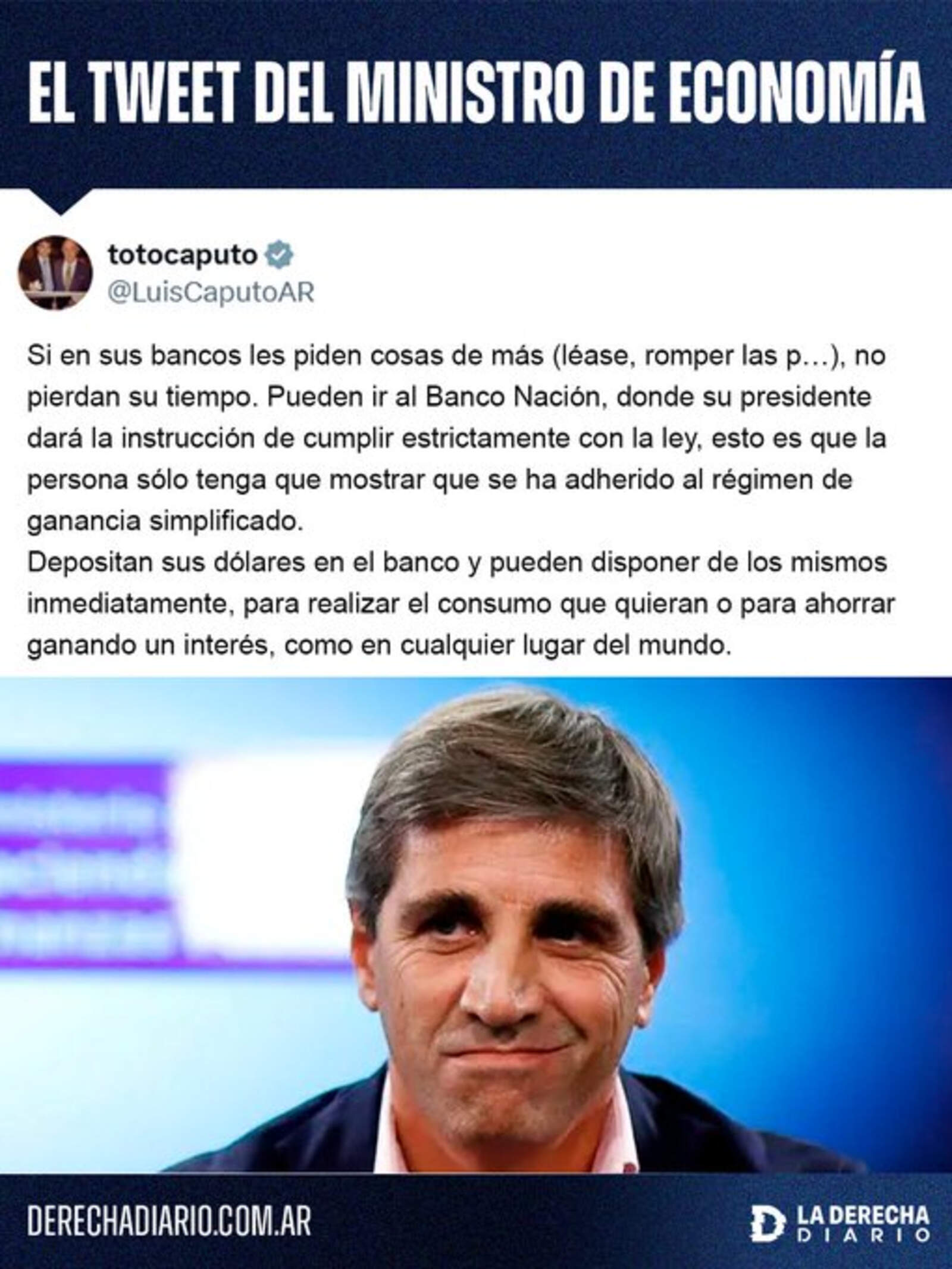
In that context, the Minister of Economy, Luis "Toto" Caputo, was explicit and direct. Through his account on the social network X, he bluntly recommended Banco de la Nación Argentina as the reference institution for those who encounter unjustified obstacles in the private financial system.
Toto Caputo en X:
"If your banks ask you for extra things (meaning, busting your b...), do not waste your time. You can go to Banco Nación, where its president will give the instruction to comply strictly with the law, which means that the person only has to show that he or she has joined the simplified Income Tax regime. You deposit your dollars in the bank and you can use them immediately, to make whatever purchases you want or to save and earn interest, as in any place in the world", Caputo posted.
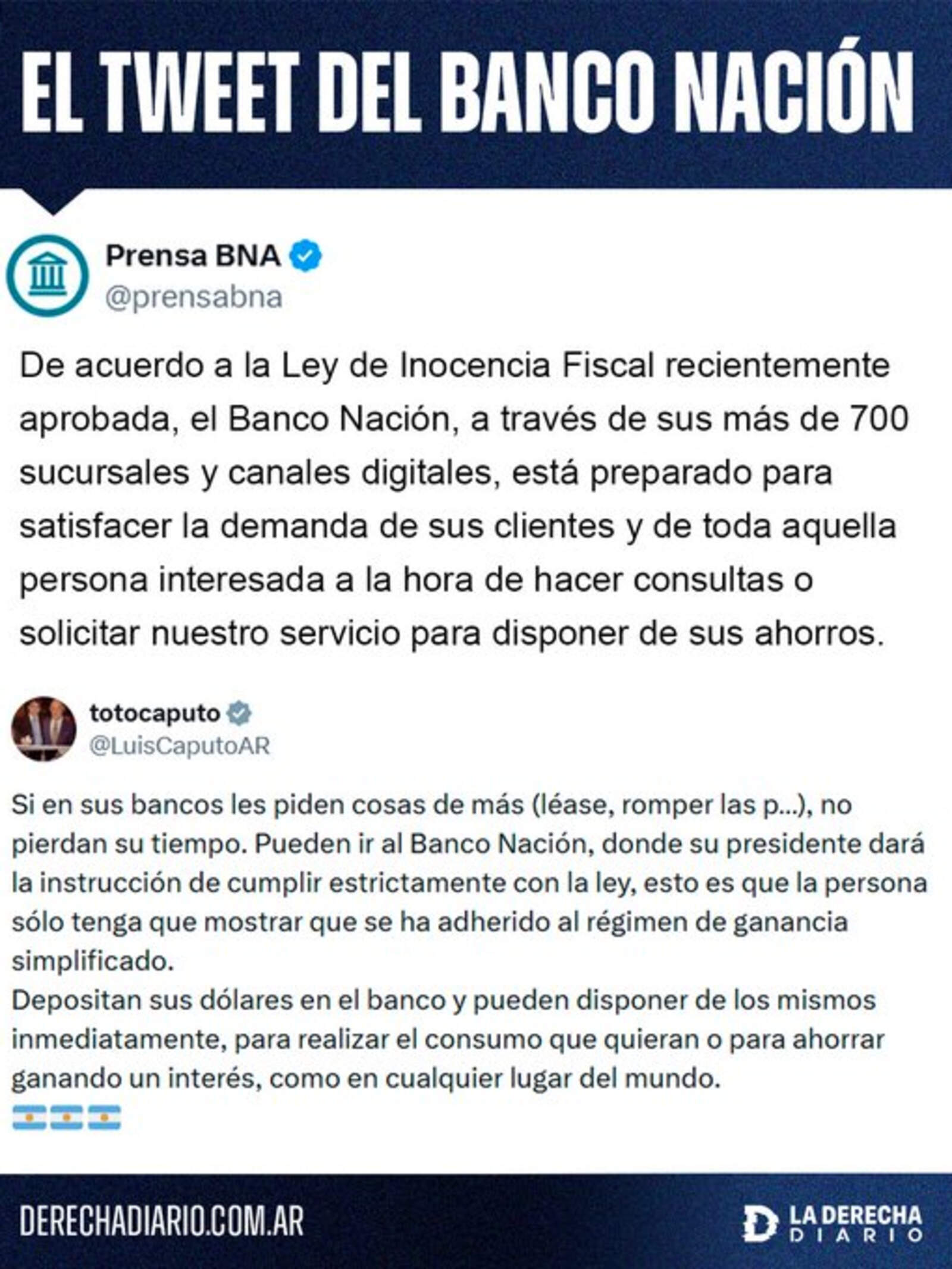
The message was not isolated. From Banco Nación itself, the Press and Communications Department reinforced the concept with an institutional communication, highlighting its operational capacity to absorb the demand caused by the new legal framework.
"In accordance with the recently approved Fiscal Innocence Law, Banco Nación, through its more than 700 branches and digital channels, is prepared to meet the demand of its clients and of any person interested in making inquiries or requesting our service to manage their savings", the institution stated on X.
The official strategy also has the technical and political backing of Juan Pazo, former director of the Revenue Collection and Customs Control Agency (ARCA) and one of Caputo's most trusted associates. Pazo was one of the intellectual authors of the initiative that the Senate turned into law and went out this Saturday to explain the concrete scope of the regime.
The central point, he emphasized, is simplicity. Adherence to the simplified Income Tax regime is the only requirement to enjoy the so-called "fiscal innocence".
"If they even ask you for it, because sometimes compliance officers often have their brains fried and for more than 70 years they have forced us to work in a way that is quite complex, they may end up asking for some type of information, but citizens clearly have to know that there is no obligation whatsoever to submit more documentation than the registration in the simplified Income Tax regime. As I said at the beginning, the asset is yours, use it however you want", Pazo explained in a radio interview.
The former official also specified a key fact:even before the law was passed, some 20,000 people had already joined the simplified regime, anticipating savers' latent interest in normalizing their situation.
El Banco Nación en X:z
When he was asked whether the dollars hoarded outside the system will finally "hit the streets," Pazo was categorical:"Personally, I have no doubts. In every province I visited, every city I went to, the first thing people asked me was: when will the law be passed? I want to change my car, I want to change my tractor, I want to renovate my house. All of that is economic activity."
He added that the formalization process not only reactivates consumption but also opens the door to structural benefits:"Formalization also allows those who do it to obtain benefits. For example, access to long-term credit to buy a house, a car, the same harvester."
In the face of criticism from opposition sectors that describe the regulation as a "law for tax evaders", Pazo replied harshly and targeted what he defined as a hypocritical stance inherited from years of arbitrary controls. "The vast majority of people paid taxes. Employees who paid Income Tax, when they wanted to protect their savings and buy more than 200 dollars, the government persecuted them as if they were criminals. Those people had already paid taxes and the only thing they wanted to do was preserve the value of their savings."
In that regard, he recalled the excesses of the previous system:"They asked you to split the supermarket receipt when you exceeded 100,000 pesos. What we were living through was insane. There is nothing more democratic than this law."