The 1813 document proves that Buenos Aires exercised authority over the Malvinas before the British occupation of 1833
Compartir:
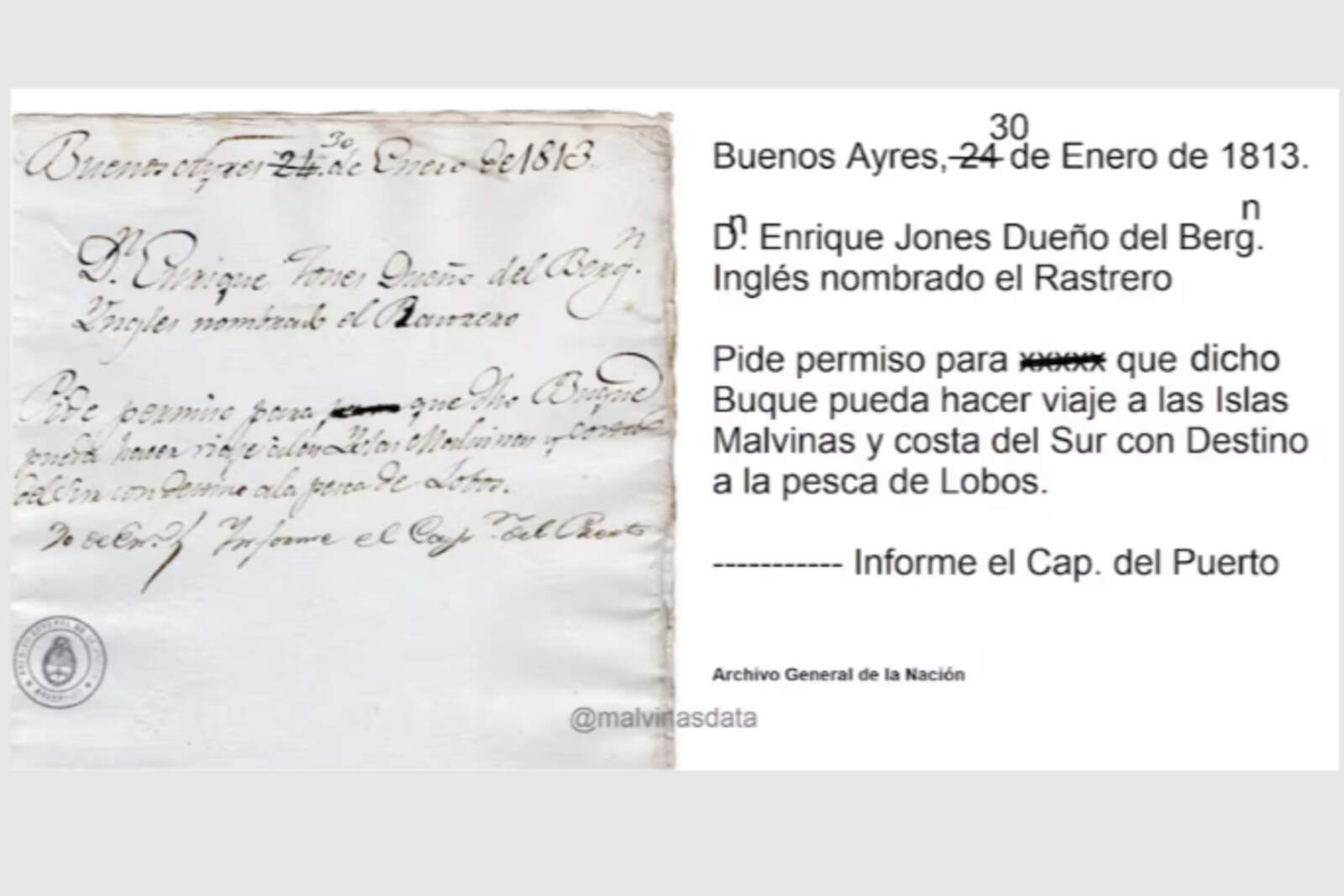
An unpublished document from the early 19th century has once again shaken the historical debate over Argentine sovereignty in the Malvinas Islands. It is a formal request submitted on January 30, 1813 by a British captain to the authorities of Buenos Aires. The letter explicitly recognizes the jurisdiction of the United Provinces of the Río de la Plata over the archipelago.
El hallazgo demuestra que el gobierno patrio ya ejercía administración efectiva y control económico e institucional sobre Malvinas
The discovery, preserved in official archives, constitutes documentary evidence of enormous political and historical weight. It demonstrates that barely three years after the May Revolution, the national government was already exercising effective administration and economic and institutional control over the Malvinas, long before the British occupation of 1833.
A British request that recognizes Argentine authority
The document corresponds to the English captain Henry Jones, commander of the brig El Rastrero.The officer requested authorization from Buenos Aires to hunt sea lions on the coasts of the Malvinas, an economic activity that was key at the time.
La autorización solicitada por Reino Unido para pescar en territorio argentino
The request was submitted to the Director of Customs, Enrique Torres, which shows a regular administrative procedure. It is a foreign vessel requesting permission from a local authority to operate in a territory under its control.
Far from being an isolated event, this act reflects the normal functioning of a sovereign state that regulates, authorizes, and oversees activities in its maritime jurisdiction. The recognition was not symbolic or rhetorical: it was practical, concrete, and formal.
A direct blow to the British narrative
This episode dismantles at its root the historical argument used by the United Kingdom to justify the occupation of 1833. After having been expelled by Spain from Puerto Egmont in 1774, the British abandoned the archipelago for more than half a century. They did not protest or object to the multiple acts of sovereignty exercised from Buenos Aires after 1810.
Jones's request is especially revealing: far from acting as a power with prior rights, he voluntarily submits to Argentine authority, recognizing who exercised the real control of the territory.
Key evidence before the international community
El documento de 1813 se suma a una cadena sólida de antecedentes que refuerzan el derecho argentino
The 1813 document adds to a solid chain of precedents that reinforce Argentina's right. Among them, the jurisdictional continuity from the Spanish viceregal period, the orders executed by the Viceroyalty of the Río de la Plata, and the sustained administration from Buenos Aires after independence.
In terms of international law, the case is clear. There is effective occupation, peaceful exercise of authority, and recognition by third parties. Three elements that the archive confirms in a forceful manner.
This discovery is not an archival curiosity, but a strategic piece of evidence that strengthens Argentina's position before the world. The claim is not a symmetrical dispute, but the restitution of a territory usurped by an act of force in 1833.
The documented history speaks again, and it does so with clarity: the Malvinas were, are, and will remain an integral part of Argentine territory. Above all, under a historical right that time — and the archives — do nothing but reaffirm.