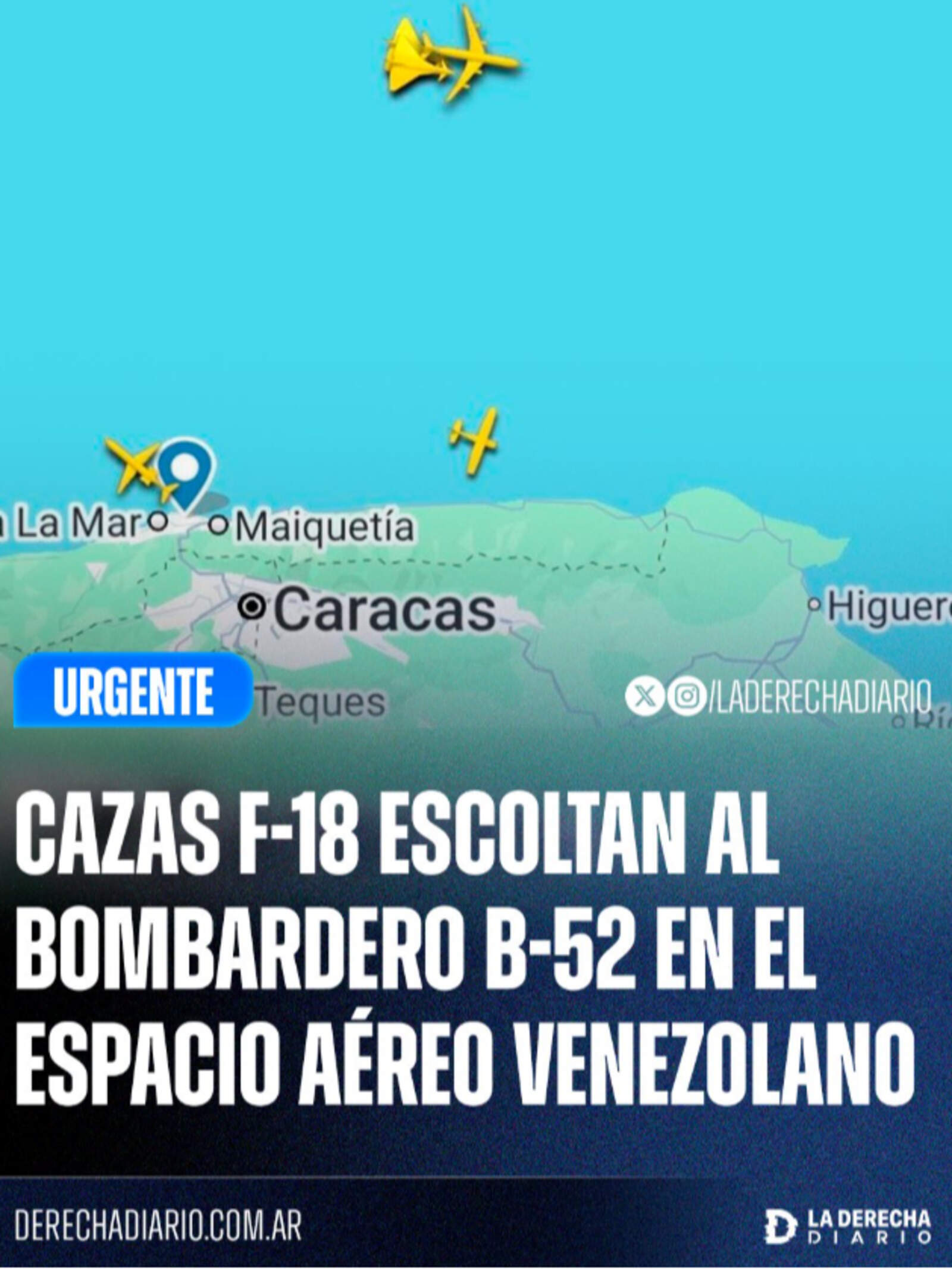
The episode takes place while the aircraft carrier USS Gerald R. Ford, the largest and most modern in the U.S. fleet, sails toward waters near the Caribbean
According to Axios, Washington and Caracas are preparing direct communication between Donald Trump and Nicolás Maduro amid a new escalation of tension, after a B-52 strategic bomber and two F-18 fighter jets crossed Venezuelan airspace. The military movement once again places the U.S. in a position of strength against the Chavista regime and reshapes the regional board.
The revelation caused a strong diplomatic impact: while contact between both leaders is being prepared, the U.S. aerial deployment once again put pressure on Caracas. The overflight of the B-52, an intercontinental-range bomber, together with the F-18s, sends an unequivocal message about the capacity and willingness of the United States to assert military presence in the Caribbean.
Trump's administration, aligned with a firmer foreign policy in the region, is betting on a combination of diplomacy and strategic deterrence.
A Caribbean in tension: the role of USS Gerald R. Ford and the new U.S. military presence
The episode occurs while the aircraft carrier USS Gerald R. Ford, the largest and most modern in the U.S. fleet, sails toward waters near the Caribbean. Its presence is significant: it is a key asset for air operations, deterrence, and strategic control, with the capacity to project power over thousands of kilometers (thousands of miles).
EEUU y Venezuela coordinan una llamada entre Trump y Maduro tras el sobrevuelo de un B-52 y cazas F-18
The deployment of the Ford, together with the entry of the B-52 and the F-18s into Venezuelan airspace, creates a scenario where the United States increases its pressure on Chavismo. For Washington, the region once again becomes a critical point due to Caracas's ties with extra-hemispheric powers and illicit networks that heighten security concerns.
This increase in U.S. military presence also responds to a strategy of reaffirming Western influence in the hemisphere, in line with Trump's doctrine of rebuilding alliances and containing authoritarian projects in the region.
The capabilities of the F-18 fighter jets
The F/A-18 Hornet, one of the most versatile fighter jets in the U.S. arsenal, combines agility, attack capability, and operational robustness. Designed for both air-to-air and air-to-ground missions, it can operate from aircraft carriers and land bases, making it a key element for rapid deployments and shows of force.
EEUU y Venezuela coordinan una llamada entre Trump y Maduro tras el sobrevuelo de un B-52 y cazas F-18
The F-18s used in these operations can carry guided missiles, smart bombs, and electronic countermeasure systems, which allows them to carry out interception, patrol, or tactical support missions in complex scenarios. Their presence alongside the B-52 in Venezuelan airspace sent a clear message of technological superiority and operational capability.
The strategic power of the B-52 bomber
The Boeing B-52 Stratofortress is one of the most iconic strategic bombers of the United States, with the capacity to carry conventional and nuclear weapons, and a range of over 14,000 kilometers (over 8,700 miles) without refueling. Its mere appearance in a tension zone implies a high-impact deterrent message.
In addition to its autonomy, the B-52 stands out for its ability to fly at high altitude and launch precision attacks with long-range missiles. Its deployment near Venezuela represents a clear demonstration of the U.S.'s global reach and its ability to project force rapidly in the face of any threat or provocation.