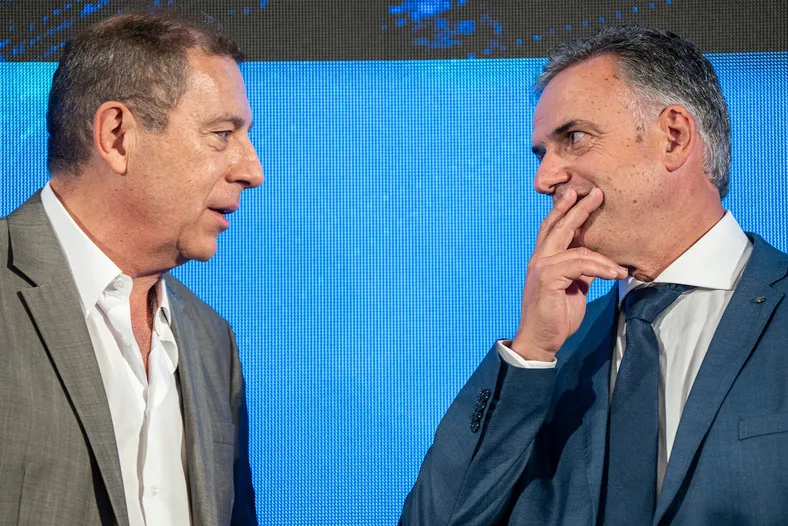
The Minister of Economy, Gabriel Oddone, informed the business chambers that Uruguayan GDP growth in the first quarter of the year will be only 0.3%. With graphic harshness, he summed up the situation: “We are paddling in Dulce de Leche”. At the same time, he announced that the Government is preparing new measures to try to improve the economic outlook
.
This low expansion rate does not arise from an isolated external shock, but rather reflects accumulated structural problems. The State consumes a very large portion of the available resources, which limits the capacity for savings and private investment. Recent data show that consolidated public spending is around 33% of GDP, while tax collection represents about 27.4% of GDP. The fiscal deficit of the Central Government and the Social Security Bank closed 2025 at around 3.7% of GDP (or 4.1% without extraordinary income from the Social Security Trust), and the consolidated result of the public sector exceeded 4.9% of GDP in
some calculations.
These figures imply that almost a third of the wealth generated annually passes first through the hands of the State. Every peso allocated to public spending displaces resources that could have been oriented towards genuine productive projects. High taxes reduce company retained earnings, make it more expensive to hire staff, and discourage innovation and expansion. The costs are then transmitted to the final prices, affecting the purchasing power of families.
Oddone has explicitly recognized that Uruguay “can hardly be a cheap country” due to the size of the State and the model of public provision of services. This statement highlights how structural interventionism increases production costs throughout the chain and reduces international competitiveness
.
The potential growth of the Uruguayan economy has stagnated at around 1.5-2% per year in recent years. After the post-pandemic rebound, expansion has moderated markedly. In 2025, the IMAE registered year-on-year growth of close to 1.8%, below the Government's own initial expectations. This dynamic creates a circle where private investment remains lukewarm, entrepreneurship faces high barriers and progress becomes slow and strenuous
.
The “measures” announced by the minister follow the usual pattern: marginal adjustments, bureaucratic simplifications or selective incentives. However, as long as the excessive size of the State, the high tax burden and regulations that distort price signals are not addressed at the root, these announcements tend to add new layers of intervention rather than freeing up productive capacity
.
Experience shows that economies where the State occupies a smaller space allow for greater voluntary savings, greater capital accumulation and more efficient coordination between producers and consumers. In Uruguay, on the other hand, the State acts as a direct competitor for scarce resources, which explains the constant effort to “row in fudge of
milk”.
The figure of 0.3% in the first trimester is not an isolated cyclical episode. It is the logical manifestation of a model where chronic interventionism displaces productive investment and slows the natural advance of wealth. As long as the idea prevails that economic progress is achieved through official plans rather than arising from the free and coordinated action of individuals in the market, the economy will continue to advance with difficulty, against an artificial current generated by the very weight of the state apparatus.
Only by reducing unnecessary public spending, alleviating tax pressure and eliminating regulatory barriers can savings be transformed into productive capital and for prices to reflect reality without distortions. That way, the paddle would stop sinking into the fudge of milk to move more fluidly over freer waters
.