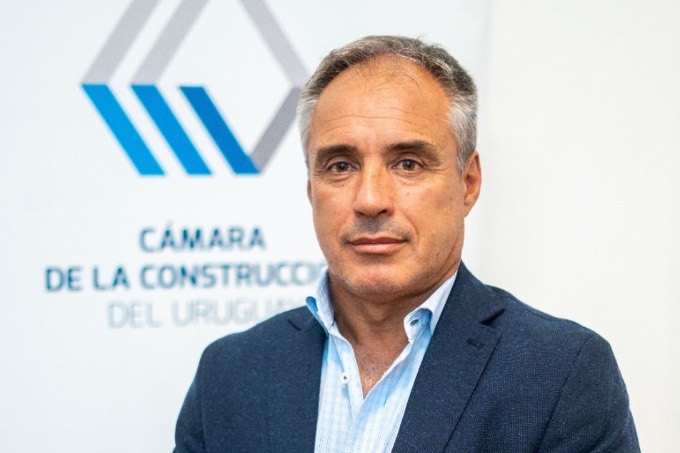
Alejandro Ruibal occupies a unique place on the map of Uruguayan economic power. He is the executive director of Saceem —the construction company that concentrates the most public works in the country— and, at the same time, president of the Chamber of Construction of Uruguay. From this dual position, he leads negotiations with SUNCA aimed at a pre-agreement to gradually reduce the workweek from 44 to 40 hours without loss of salary. The predictable outcome is an increase in the hourly cost of labor close to 9%. This additional cost is not distributed equally: large companies with million-dollar contracts with the State can pass it on to public invoices; medium and small companies, and homebuyers, bear the full brunt.
The map of contracts that consolidated Saceem
Ruibal does not sign contracts in a personal capacity, but few figures are as associated with public works. Saceem, the company he directs, invoices around 350-400 million dollars annually and appears, alone or in consortium, behind the largest state projects of the last decade:
Central Railway (MTOP): the largest PPP contract in the history of the country. Consortium Grupo Vía Central (Sacyr 40%, NGE 27%, Saceem 27%, Berkes 6%). Initial construction around 1.070 million dollars and total project cost estimated above 2.000 million. Saceem's participation is 27%.
Port Rambla Viaduct (ANP, 2018): project of more than 130 million dollars. Saceem was the only bidder and executed the entire project.
East Access Viaduct (MTOP): about 54 million dollars.
Educational PPP II (ANEP, 2019): 42 educational centers for 72 million dollars. Consortium Berkes-Saceem-Stiler.
Historical and minor works for OSE and other agencies.
An approximate floor of identifiable state contracts since 2018 exceeds 440-480 million dollars attributable to Saceem. The company acknowledges a share close to 10% of the public works market. In 2025, it was acquired by the French group NGE for a business value of 45 million dollars; Ruibal continues as general director.
The pre-agreement that raises costs and the transfer mechanism
The pre-agreement that Ruibal negotiates from the Chamber reduces the workday without lowering salaries. The closest international evidence —a Brazilian study by Abrainc/Ecconit on the same change from 44 to 40 hours— estimates a 10% increase in the total cost of projects and a 5.5% increase in the sale price of new homes. Over a ten-year horizon, accounting for delays, lower supply, and rigidities, the additional impact may range between 5% and 10%.
For a company like Saceem, which concentrates hundreds of millions in state contracts, the mechanism is simple: the labor cost increase is incorporated into progress certifications, and the State pays it. The treasury does not operate with the same price discipline as a private client. Medium and small construction companies, which compete in the real market for housing, warehouses, or private renovations, do not have that valve. They absorb the increase in their margins, lose competitiveness, or close.
The final cost is paid by the poorest
Housing is the most significant expense for low-income households. An increase of 5.5% (or more) in new units reduces the number of homes that can be built with the same social housing resources and pushes rents and prices upward. The same Brazilian study calculated that this increase would make financing unviable for 1.6 million low-income families. In Uruguay, the effect is analogous: fewer units per public peso, longer queues, and an even greater proportion of the salary of the lower quintiles allocated to housing.
When costs rise, developers prioritize higher-margin segments. The supply of affordable housing contracts exactly where it is most needed.
A structural pattern
The case of Alejandro Ruibal and Saceem illustrates a deeper phenomenon: a handful of construction companies systematically concentrate large state tenders. “Financial capacity and experience” operate as a barrier to entry. From the presidency of the Chamber, Ruibal negotiates labor conditions that raise the cost of producing infrastructure. From the direction of Saceem, his company is in a position to pass that cost on to the State itself. The result is not neutral: it strengthens those who already dominate public works, weakens companies operating in the private market, and ultimately gets paid in the price of housing for those with the least capacity to absorb it.
What is visible is more free time with the same income for a group of workers. What is not visible is the permanent cost increase on construction, market concentration, and the silent transfer of resources from the pockets of taxpayers and homebuyers to firms with privileged access to the State.