Another key element is the weight of the undecided. Invalid, white votes and those who have not yet defined their position represent 8.7% of the total, a volume sufficient to tilt the result in such a
tight contest.
In alternative runoff scenarios, Lula manages to beat other candidates. He beats Ronaldo Caiado with 45% against 39% and Romeu Zema with 44.7% against 38.7%
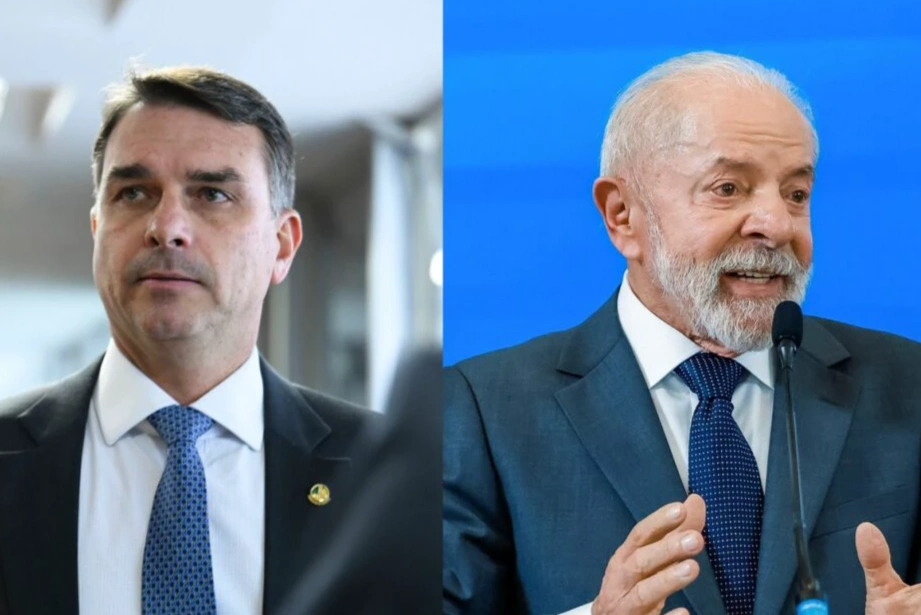
A national poll by Meio Ideia showed that the right-wing candidate Flavio Bolsonaro surpasses the socialist dictator Lula da Silva in voting in a scenario of ballot in Brazil, placing him with an advantage in the context of a technical tie.
The survey, conducted between April 3 and 7 on a sample of 1,500 people, confirms that the electoral dispute is at a point of maximum competitiveness.
Specifically, the son of the former president and political prisoner, Jair Bolsonaro, obtained 45.8% of voting intention compared to 45.5% of Lula, an advantage of 0.3 percentage points.
The difference between the two candidates remains within the margin of error of 2.5 points, but with a slight numerical superiority of the senator, who emerges as one of the most relevant data in the study.
Flavio Bolsonaro and Lula da Silva.
Survey data The
report also exposes a high level of uncertainty in the electorate. 51.4% of respondents said they could change their decision before October, a significant increase from 35.5%
.
It also has an advantage against Renan Santos and Aldo Rebelo, confirming the low competitiveness of the opposition leaders, although without making a difference against Bolsonaro.
Flavio Bolsonaro and Jair Bolsonaro.
The perception of current management also influences the electoral climate. 46.4% of those surveyed rate Lula da Silva's regime as negative or very negative, while 32.2% consider it positive. In the area of security, rejection reached 53.9%, compared to 18.9% of
favorable opinions.
Key voter concerns include the cost of living and indebtedness. 74.7% say that these factors are decisive when deciding their vote, and 70.4% perceive an increase in the cost of living in the last year. In addition, a significant proportion identifies indebtedness as a growing problem
.
With these data, the next elections in Brazil are consolidated as one of the most contested in recent years, with Flávio Bolsonaro showing a slight advantage in voting intention in a context marked by volatility and uncertainty.