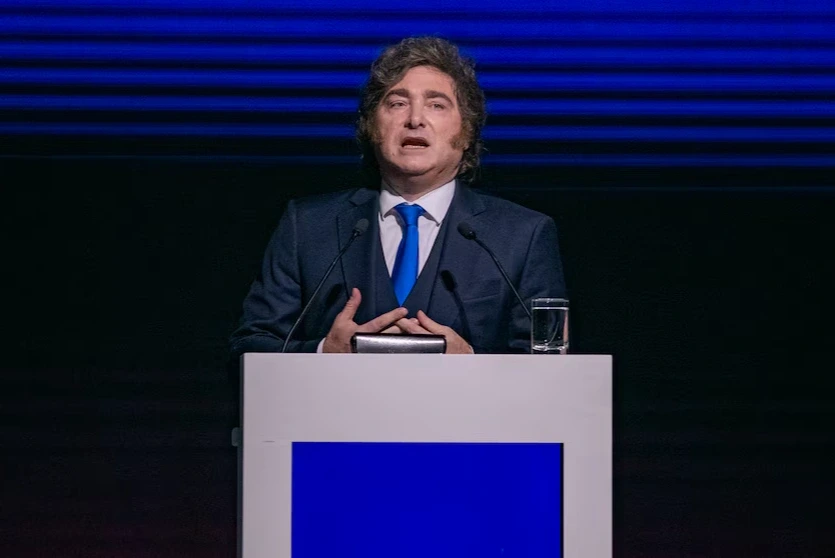

In a context of economic transition and after the release of the latest INDEC data, which marked inflation of 3.4%, President Javier Milei decided to face the scenario without hesitation and with a direct message to the core of the inflation problem. He did this during his presentation to businessmen at the AmCham Summit 2026, where he not only recognized the negative impact of the data, but also explained the structural causes behind the increase and defended the economic direction
adopted by his management.Far from dodging the figure - which represented an increase compared to 2.9% in February - the president made a difference with traditional politics: “Politicians usually pretend to be insane or talk about anything else when they receive bad information. We would have a lot of good things to talk about today, but since I am Milei and I hate the traditional way of doing things, and since I hate inflation, and since I didn't like the fact and it disgusts me, I'm going to
talk about inflation.”From that base, the President raised the need to understand the phenomenon: “One of the important things with this is to explain and be clear about what is happening. It's the first step in finding a solution. In that sense, we have to understand why 3.4%, why inflation has been rising,” and he assured that the Government is clear about the process and is confident in a future slowdown: “I will also explain to you why we are convinced that inflation will go down going forward
.”In his analysis, Milei identified extraordinary factors that conditioned inflationary dynamics. He recalled that the economy faced “two shocks of extraordinary characteristics” in the middle of last year and stressed that, despite this, inflation of 1.5% had been reached in May, “after Manuel made that extraordinary choice in CABA.” However, he denounced a political offensive against his economic program: “From that moment on, a fierce attack by politics began, at the heart of the model. Congress passed more than 40 laws trying to break the fiscal balance. They didn't succeed.”
Along the same lines, he stressed the magnitude of the financial tensions: “Argentina faced a run for the equivalent of 50% of M2. At any time in history, Argentina would have been blown up in the air. Not only did it not fly, but we received strong support at the polls. We got 17% out of Kirchnerism and turned the election around in PBA”, interpreting that result as a clear sign of social support for the change of course: “People don't want to go back to the past”
.The President also provided technical indicators to support his expectation of a slowdown: “If you look at wholesale inflation, which is getting ahead, it is around 10%. We have to finish accommodating relative prices and converge there,” and he called for avoiding hasty answers: “What you have to do is be patient. There is no need to despair. When you get desperate, you make bad decisions. We are not going against economic theory and empirical evidence
.”In a more technical section, he explained that the current phenomenon responds to a previous monetary shock: “What happened in the second half of last year was a monstrous drop in demand for money... by the equivalent of 41 billion dollars.” He explained that, adjusting for adjustments, “the monetary base measured in dollars fell to levels of 20 billion”, that is, “half the average of the previous government with inflation that traveled at 1.5% per









