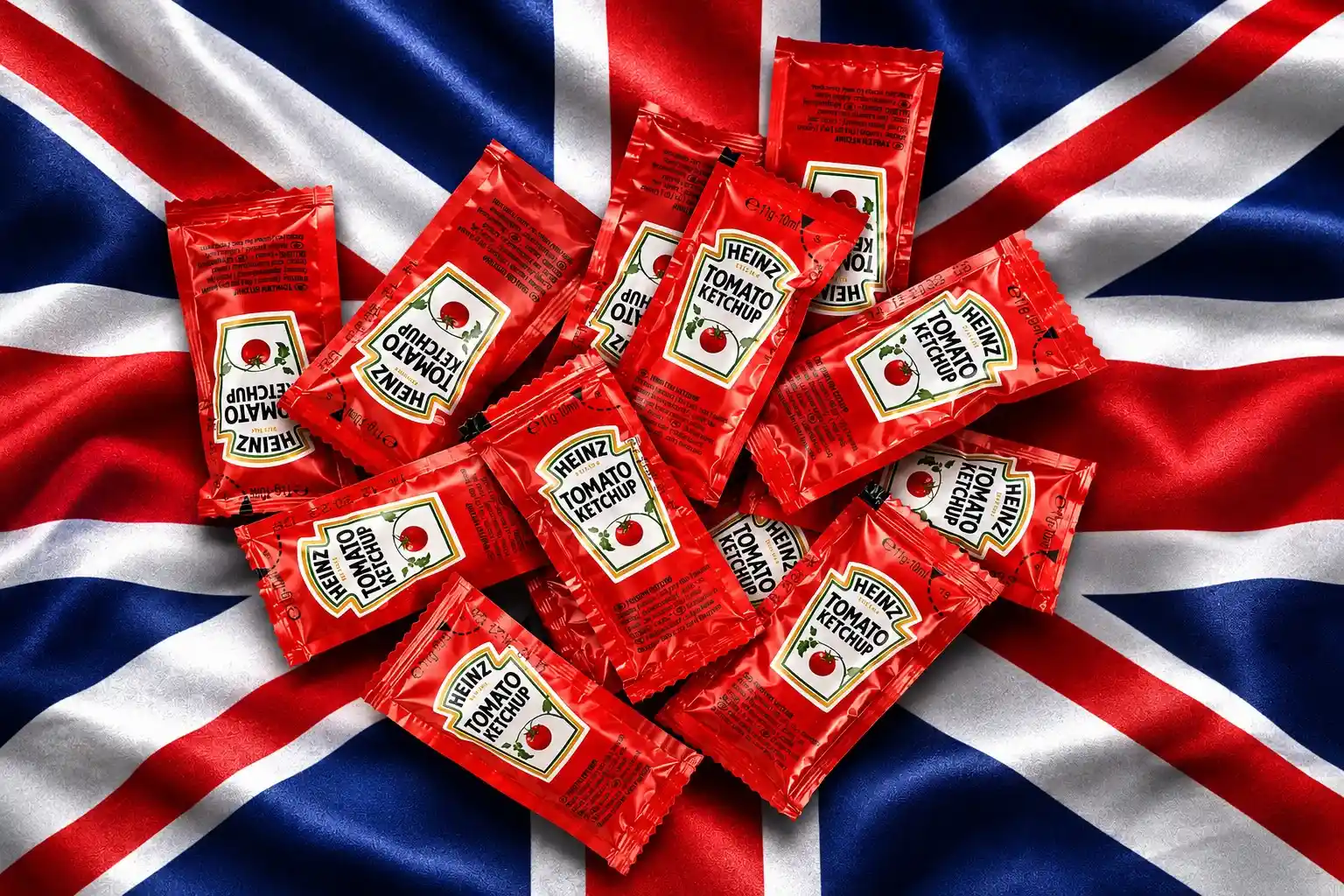
The UK Government clarified that the potential ban on individual packets of ketchup, mayonnaise, and other condiments is not part of the new agreement with the European Union (EU). Downing Street insisted that any such restriction would be a sovereign decision of the British Executive and not an obligation imposed by Brussels.
The clarification came after it was revealed that the Government was considering moving forward with a consultation to assess the ban on individual condiment packaging commonly used in restaurants, bars, cafes, and fast food outlets. The initiative had raised concerns about the possibility of the UK starting to incorporate new European restrictions as part of its trade approach with the bloc.
From the Prime Minister's office, they maintained that the ban on individual packets is not included in any agreement with European partners nor is it part of the so-called reset of relations between the UK and the EU. However, the official spokesperson avoided completely ruling out the possibility of moving forward with national regulation.
"If any consultation on single-use packets is carried out, it will be solely as a result of a decision from the UK," was the message conveyed from Downing Street.
The European ban on ketchup packets will begin in 2030
The origin of the controversy lies in the new EU Regulation on Packaging and Packaging Waste, which establishes progressive restrictions on the use of certain disposable products. The regulation began to apply on August 12, 2026, and stipulates that, starting January 1, 2030, the marketing of certain formats of single-use packaging will be prohibited when reusable or more sustainable alternatives exist.
Among the products affected are small individual packets of ketchup, mayonnaise, mustard, sugar, salt, oil, and vinegar that are usually provided in dining establishments. Other small containers, such as individual shampoo bottles offered by some hotels, are also included.
Brussels' justification is to reduce packaging waste and the consumption of disposable plastics. The European Commission argues that these products generate large amounts of waste and that, in many cases, alternatives exist that allow for a reduction of their environmental impact.
The regulation does not imply a general ban on all single-use packaging. It includes exceptions for certain uses related to food safety, public health, and other specific needs.
Northern Ireland will have to apply European restrictions
The situation is different depending on the British territory. Northern Ireland will have to comply with the European ban under the Windsor Framework, the mechanism established after Brexit to regulate certain trade and regulatory aspects between that region and the European Union.
In contrast, the restriction will not automatically extend to the rest of the UK. This was confirmed by the Minister of State for the Department for Environment, Food and Rural Affairs, Emma Hardy, in response to a parliamentary question from Conservative MP Mike Wood.
The official explained that the European regulation will apply to Northern Ireland, but not to Great Britain as a result of the new trade agreement with Brussels. She also confirmed that the British Government is preparing a consultation to assess a potential alignment of national standards with European ones.
The distinction is important because it demonstrates that the trade approach between London and Brussels does not necessarily imply that all European regulations must be transferred to the entire British territory.
The UK's approach to Brussels reopens the Brexit debate
The controversy over ketchup packets occurs amid a process of rapprochement between the British Government and the European Union, which seeks to reduce trade barriers that arose after Brexit.
Prime Minister Andy Burnham is preparing a new understanding with Brussels that will be presented during a summit scheduled for November 20, 2026. Among the main objectives are to facilitate the trade of food and beverages, reduce border controls, and simplify sanitary and phytosanitary requirements for exports.
The agreement also includes advancing issues related to youth mobility and cooperation between both parties. One of the central points is to facilitate British exports of products such as fresh meat, fish, seafood, and certain varieties of agricultural products.
However, the process also raises questions about how far the UK is willing to regain European regulatory standards after having formally left the bloc in 2020.
In this context, Downing Street sought to separate the potential ban on ketchup packets from negotiations with Brussels, to avoid presenting any eventual environmental restriction as a direct consequence of the new trade agreement. For now, British consumers in England, Scotland, and Wales do not have a confirmed ban, although the Government keeps the possibility of discussing it open.