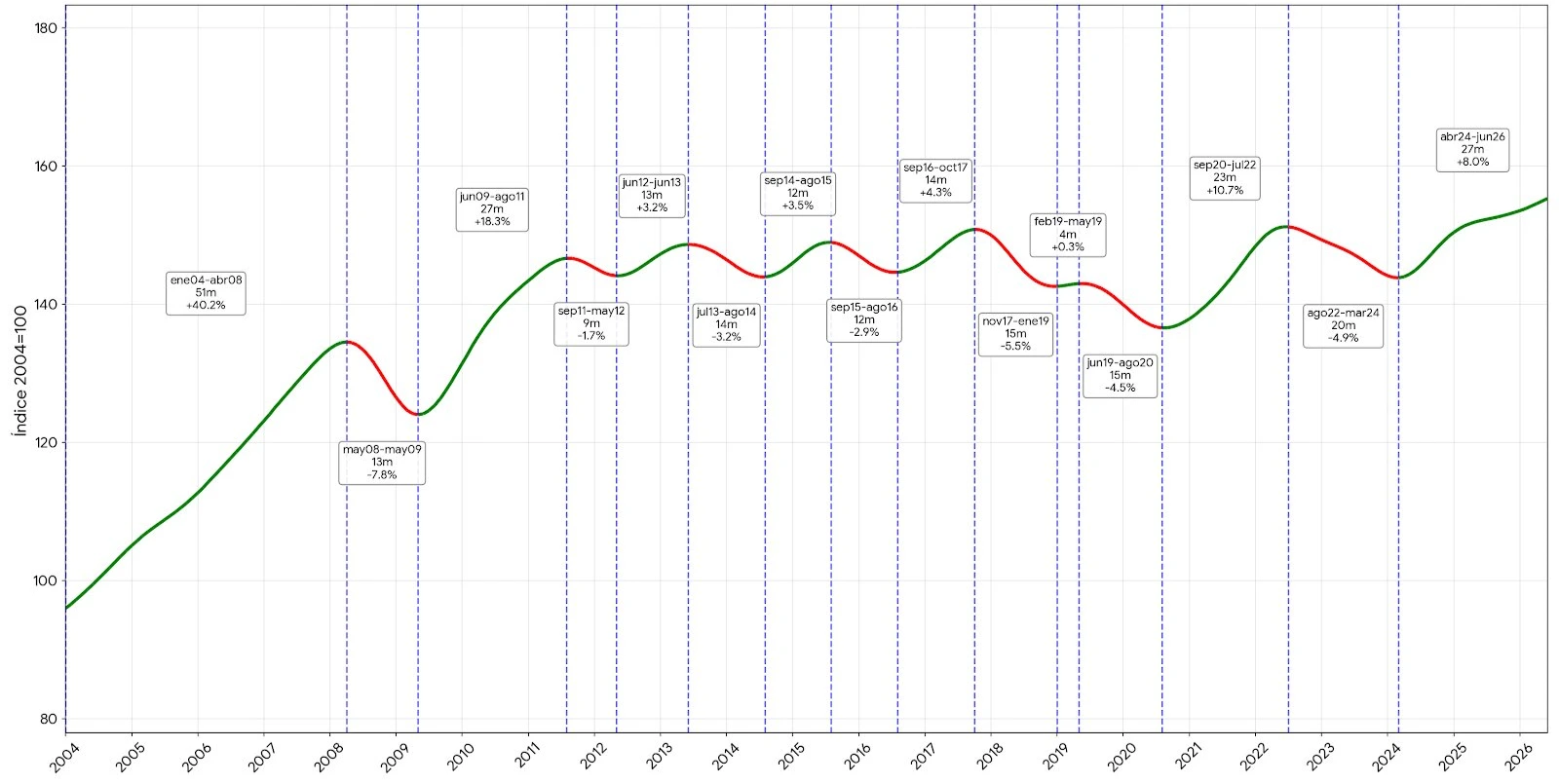
The Argentine economy reached a new milestone during the administration of Javier Milei and achieved, for the first time since 2011, 27 consecutive months of growth in the trend-cycle indicator of economic activity.
This data comes from the official records of the National Institute of Statistics and Censuses (INDEC) regarding the Monthly Economic Activity Estimator (EMAE).
According to the official series, the trend-cycle component recorded positive monthly variations for 27 consecutive months up to June 2026. This is the longest continuous expansion period since the cycle between June 2009 and August 2011.
The performance recorded in June also showed continuity in this dynamic. In that month, the trend-cycle advanced 0.2% monthly, while the EMAE showed a year-on-year improvement of 2.7%.
Cycle trend indicator of the EMAE
A historic change
This data is significant because it marks a change in the dynamics that characterized the Argentine economy over the last few decades.
Since 2011, the country has gone through periods of growth that failed to consolidate and were followed by new crises. The result was an economy with a trajectory marked by strong fluctuations, in a dynamic that can be represented as a "sawtooth": phases of expansion followed by new declines.
The current streak of 27 consecutive months of trend growth breaks with that dynamic. The extension of the cycle constitutes a signal that the recovery is not limited to a one-time rebound, but that there is a underlying expansion that persists over time.
Prolonged trend-cycle cycles are also relevant for the economy, as an activity that manages to maintain an upward trajectory over an extended period creates conditions for planning investments with a longer-term horizon.
Javier Milei and Luis Caputo
Although the growth rate is slower than that observed in other expansion episodes, this slower pace also represents one of the strengths of the current cycle, precisely because it aims for a more sustained dynamic rather than rapid and short-lived growth.
The difference is central compared to previous cycles. Expansion periods driven by short-term populist policies can generate a quick boom, but subsequently lead to strong imbalances in exchange rates and inflation that destroy the growth achieved.
In this sense, the current trajectory of the indicator shows a different behavior: 27 consecutive months of trend-cycle expansion, completely natural and without artificial stimulus, a streak not seen since 2011 that breaks with years of intermittent growth.
The INDEC data thus constitutes one of the main indicators to assess the evolution of economic activity during Milei's administration and the process of structural reforms to lay the foundations for sustained growth in Argentina.