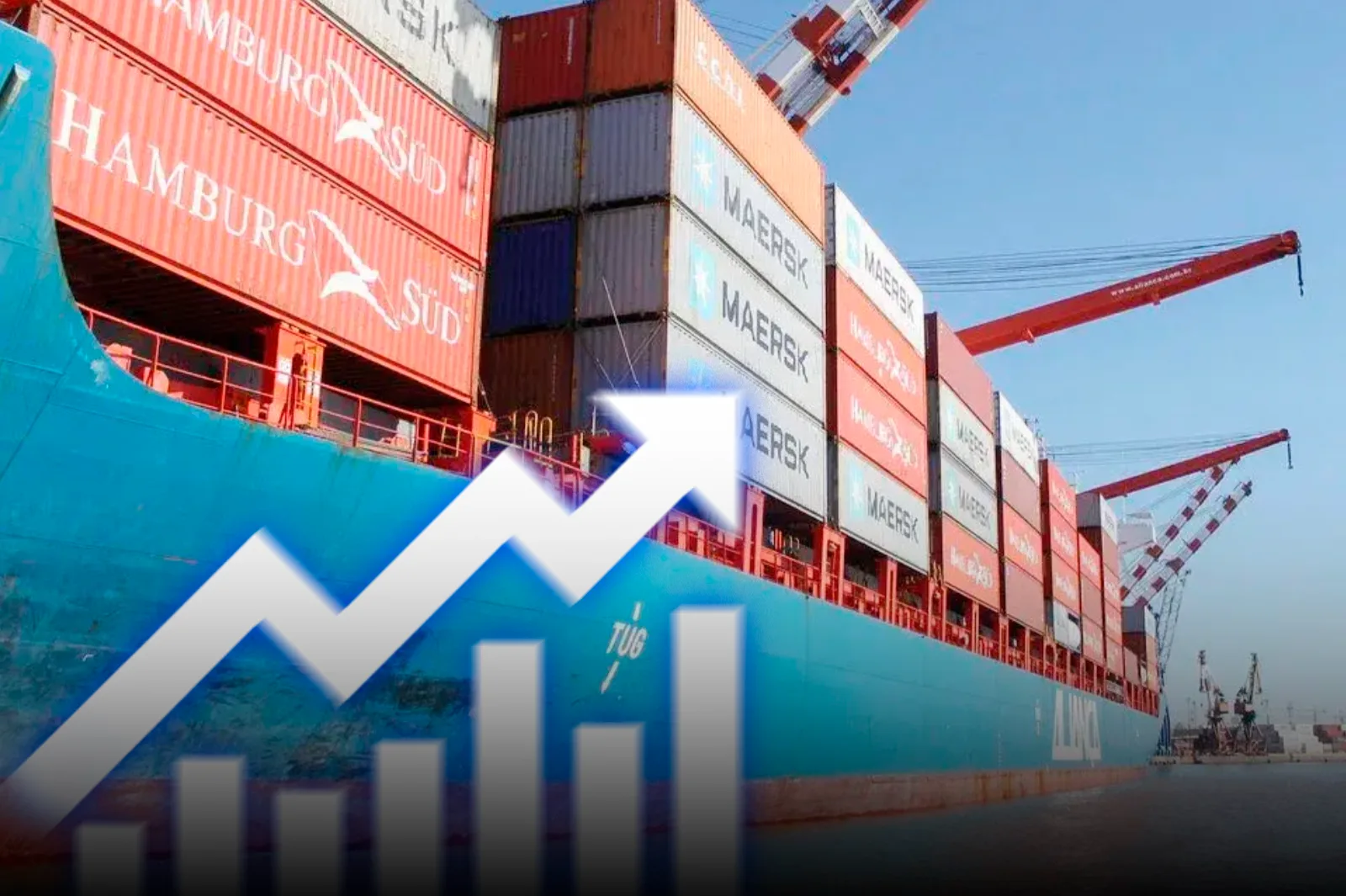
As of May 1, 2026, the Interim Trade Agreement between Mercosur and the European Union is in effect, and the numbers already show a concrete impact. According to a report from the Rosario Stock Exchange, Argentine exports to the European bloc totaled US$ 5.191 billion in the first seven months of the year, 19% more than the US$ 4.365 billion in the same period of 2025.
This value represents the third highest export level in 14 years and the highest since 2022. Additionally, it exceeds the average of the last decade by nearly 12.5%. The recovery is consolidating after the low point of 2023, although it still remains below the peaks of 2021 and 2022, when international prices were very high.
In the May-July quarter, now with the agreement in effect, shipments reached US$ 2.476 billion, 13.1% above the same period last year. This is the best quarterly record since 2022. The European Union remains the second destination for Argentine exports, accounting for 9.3% of total shipments in 2025.
The agreement frees 100% of industrial goods and 82% of agricultural goods to the European market. However, the real benefit depends on each sector: the design of quotas, the pace of tariff reductions, and the positioning of brands of origin create clear differences between sectors.
 Quotas with strong Argentine presence
Local exporters have already taken the entire quota of eggs and almost all of the egg albumin quota as of July 29. They also covered more than 70% of the honey quota, more than half of the ethanol quota, and over a third of the rice quota. In meats, Argentina contributes nearly a third of the fresh beef quota and 7% of the frozen meat quota.
The most notable case is that of honey. Exports exceeded the average of the last five years by 88.4%. The European Union granted Mercosur a new quota that will gradually reach 45,000 tons with an intra-quota tariff of 0%. In the initial year, 7,500 tons were authorized, of which 5,000 correspond to the May-December 2026 period. The sector quickly exhausted the available volume for this first stage.
Beef also felt the change from day one. The Hilton quota went from paying a 20% tariff to entering duty-free. Additionally, new quotas for fresh and frozen meat were added with an intra-quota tariff of 7.5%. For May-December 2026, the agreement included 6,050 tons of fresh meat and 4,950 tons of frozen meat for all of Mercosur.
In the fishing sector, hake received an immediate improvement: tariffs ranging from 8% to 15% were eliminated. Shrimp, on the other hand, faces a more gradual tariff reduction, with a 20% cut in the base tariff in 2026 and the prospect of reaching zero in the next five years.
Other products and the return of biodiesel
Lemons and tobacco started with moderate preference, as they follow gradual tariff reduction schemes. Combed wool, for its part, achieved immediate reductions in some positions, although it started from relatively low tariffs. The BCR report, prepared by Ana Inés Rubicondi, Guido D’Angelo, and Emilce Terré, emphasizes that the new tariff preferences already reinforce a more favorable export dynamic.
In June and July, shipments of biodiesel to the European Union resumed, with business exceeding US$ 110 million. The cancellation of the proposal to classify soybeans as a high-risk land-use change crop (ILUC) opens the door to new growth for this biofuel and also benefits soybean meal, the main product Argentina sends to the bloc. Crude oil and the peanut complex complete the list of relevant players in bilateral trade.
The agreement is the most significant in the history of Mercosur and creates the largest free trade area in the world, with 31 countries and nearly 20% of global GDP. For the South American bloc, it represents a signal of commercial maturity and an opportunity to regain prominence on the integration agenda, after years in which European participation in Argentine exports had lost ground to the rest of the world.