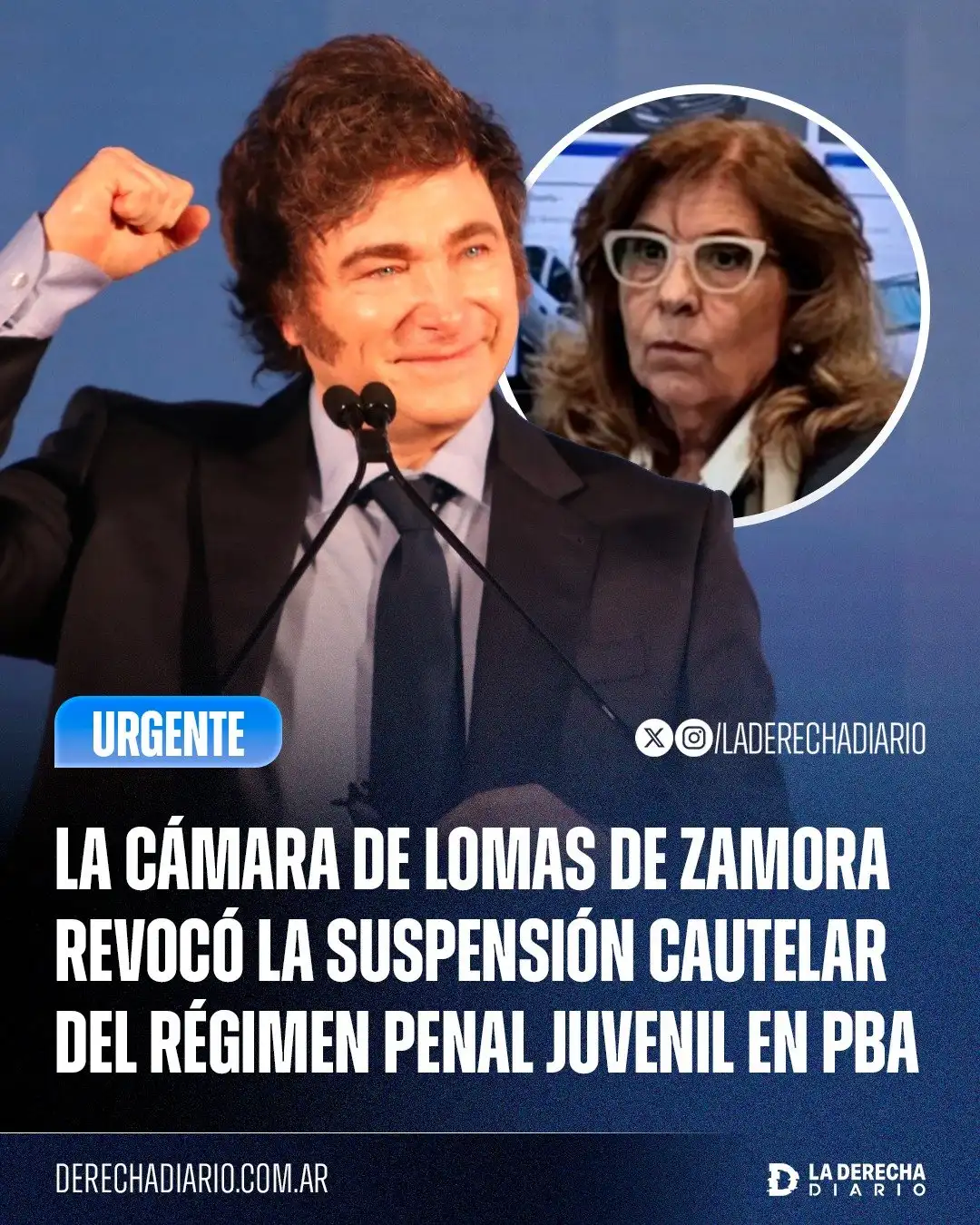
The Appeals and Guarantees Chamber in Criminal Matters of Lomas de Zamora revoked the precautionary measure that had suspended for 60 days the application of the new Juvenile Criminal Regime and the lowering of the age of criminal responsibility throughout the province of Buenos Aires.
The suspension had been ordered on September 7 by the Kirchnerist judge Marta Pascual, head of the Juvenile Criminal Responsibility Court No. 2 of Lomas de Zamora, following a habeas corpus filed by the Civil Association “No Seas Pavote”, part of the Federation Family Grande Hogar de Cristo.
The action aimed to halt the application of the regulation, which lowers the age of criminal responsibility from 16 to 14 years, for at least two months, which generated a strong rejection in society.
The Justice revoked the suspension of the new Juvenile Criminal Regime
To justify the measure, Pascual had claimed that the inclusion of offenders aged 14 and 15 could cause a serious and imminent injury to "fundamental rights" if there were no adequate material, institutional, and professional conditions.
The decision was appealed by the Public Prosecutor's Office, which questioned whether a precautionary measure could suspend a law enacted by Congress and promulgated by the Executive Power.
The Attorney General also argued that preventive habeas corpus requires a concrete threat to personal freedom or the conditions under which it is exercised, and that a potential future impact did not justify suspending a national law for all affected individuals.
The Kirchnerist judge Marta Pascual
The setback for the Kirchnerist judge
In their ruling, judges Miguel Carlos Navascués and Miguel María Alberdi recalled that laws regularly enacted enjoy a presumption of legitimacy and that their potential inapplicability requires a control of constitutionality or conventionality in a specific case.
The Chamber focused on the principle of separation of powers and stated that courts cannot refrain from applying a valid norm simply because they consider its consequences inconvenient or misguided, especially when it comes to decisions related to criminal policy, a matter primarily reserved for the Legislative Power.
To support their decision, the court cited the precedent “Thomas, Enrique c/ E.N.A. s/ amparo” from the Supreme Court, issued in 2010. It established that the Argentine system adopts a diffuse model of constitutional control, allowing judges to analyze the validity of a norm in specific cases, but not to cease its validity in a general manner.
With this reasoning, the Chamber considered that temporarily suspending a law enacted by Congress throughout the provincial territory is incompatible with the republican system of government. Therefore, it upheld the appeal and annulled the 60-day suspension.
Finally, the Chamber ordered the first-instance judge to urgently review her competence to continue intervening, considering that the subject of this habeas corpus was different from another action related to the detention conditions at the Reception Center of Lomas de Zamora.