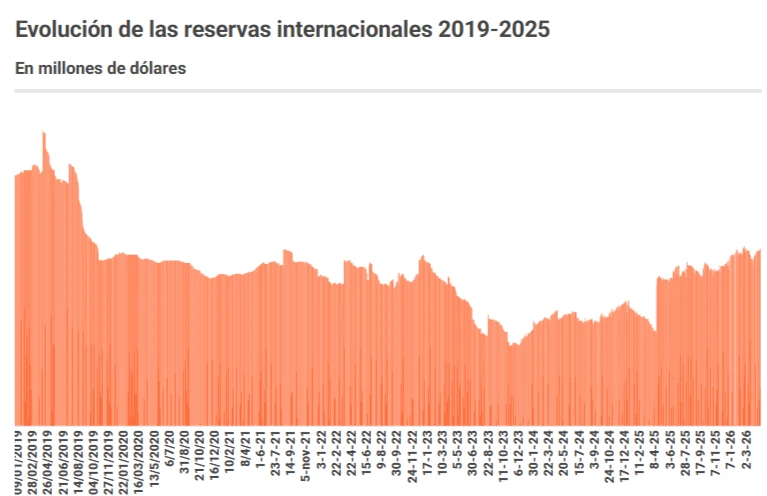

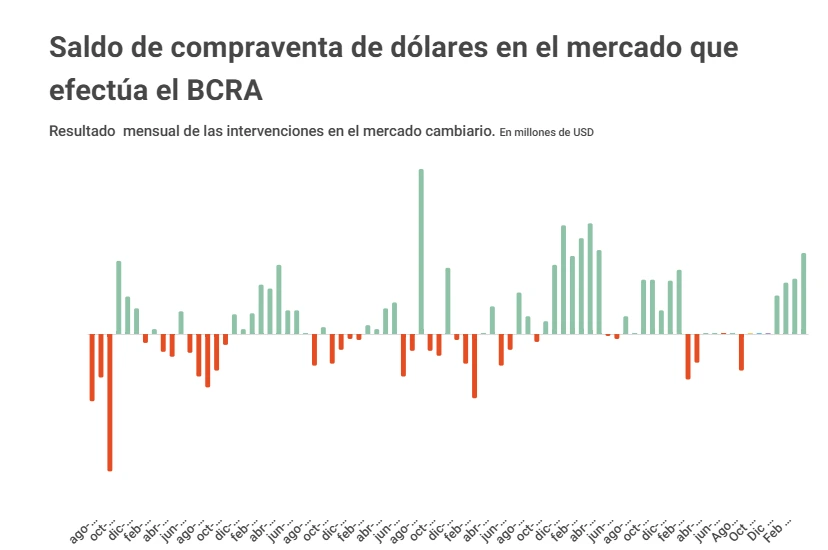
The Central Bank of the Argentine Republic continues to deepen its foreign exchange accumulation policy in 2026, in a clear sign of a strengthening of the external front. Despite the rise in the exchange rate, the monetary authority managed to sustain its buying intervention and is approaching a significant milestone in terms of reserves. In this context, the BCRA acquired USD 54 million this Monday, reaching 75 consecutive days with a buying balance, a streak that reflects consistency in the exchange rate strategy. In this way, cumulative purchases so far this year already exceed USD 6.8 billion, consolidating a performance that far exceeds
initial expectations.Since the implementation of the new monetary scheme in January, the Central Bank has added USD 6.819 million, a figure that represents more than half of the expected annual goal. In April, in addition, the pace accelerated significantly, with acquisitions of USD 2,433 million, while in the last week alone, USD 745 million was absorbed. In terms of objectives, the monetary authority has already reached 68% of the annual target, although the impact of Treasury debt payments — partly made with currencies provided by the Central Bank itself — moderated the net growth of international reserves
.
To sustain this process, the BCRA chose to increase the emission of weights without resorting to traditional sterilization mechanisms. In parallel, the Treasury complemented the strategy by placing debt in local currency, absorbing liquidity and avoiding additional pressures on the exchange rate and inflation, in line with the monetary discipline approach promoted by
current management.Official projections predict that the net purchase balance could be between $10 billion and $17 billion by the end of the year. In this regard, the head of the BCRA, Santiago Bausili, warned that the availability of foreign exchange and the demand for pesos will be determining factors in achieving this objective
.At the close of the last round, gross international reserves stood at USD 46,088 million, after recording a daily drop of USD 96 million. The recent peak was reached in February, when the stock reached USD 46,905 million, the highest value since 2018 and the highest record under current management. The subsequent decline is explained by debt payments in foreign currency and by the variation of international assets such as gold and bonds, in an unstable global scenario