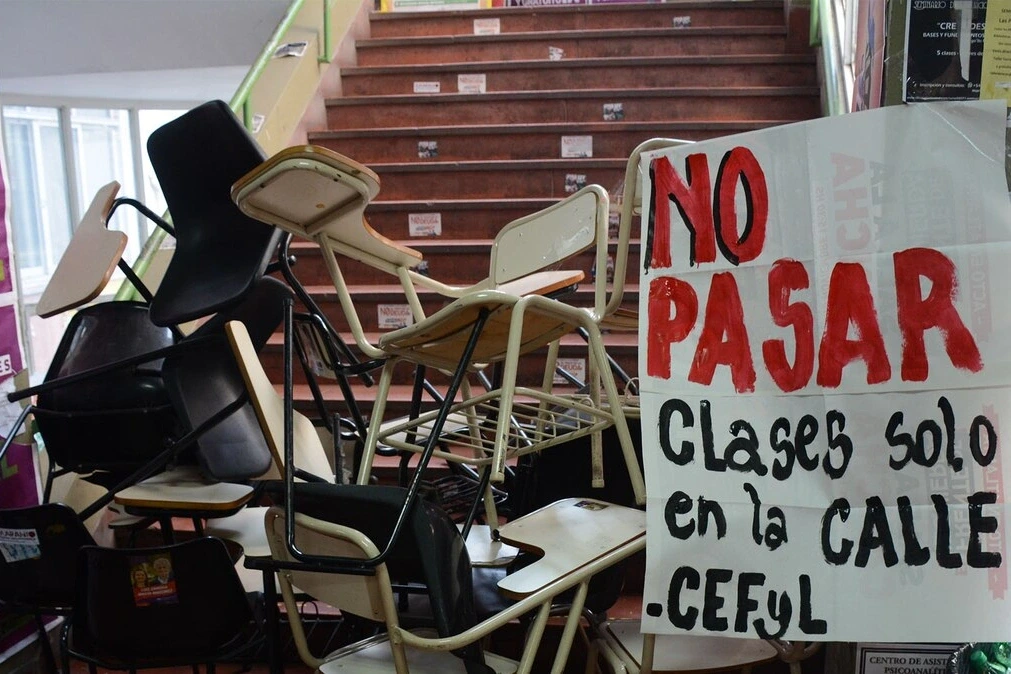
The national government gave National Universities 48 hours to explain how they would guarantee classes despite teaching stoppages and to present a plan to ensure academic continuity, with concrete measures to avoid the total paralysis of the school year and to sustain both teaching and evaluation.
The decision was announced by the Ministry of Human Capital, through the Undersecretary for University Policies, headed by Alejandro “El Profe” Álvarez, in the midst of a growing conflict over the measures of force promoted by teaching and non-teaching unions in different universities in the country.
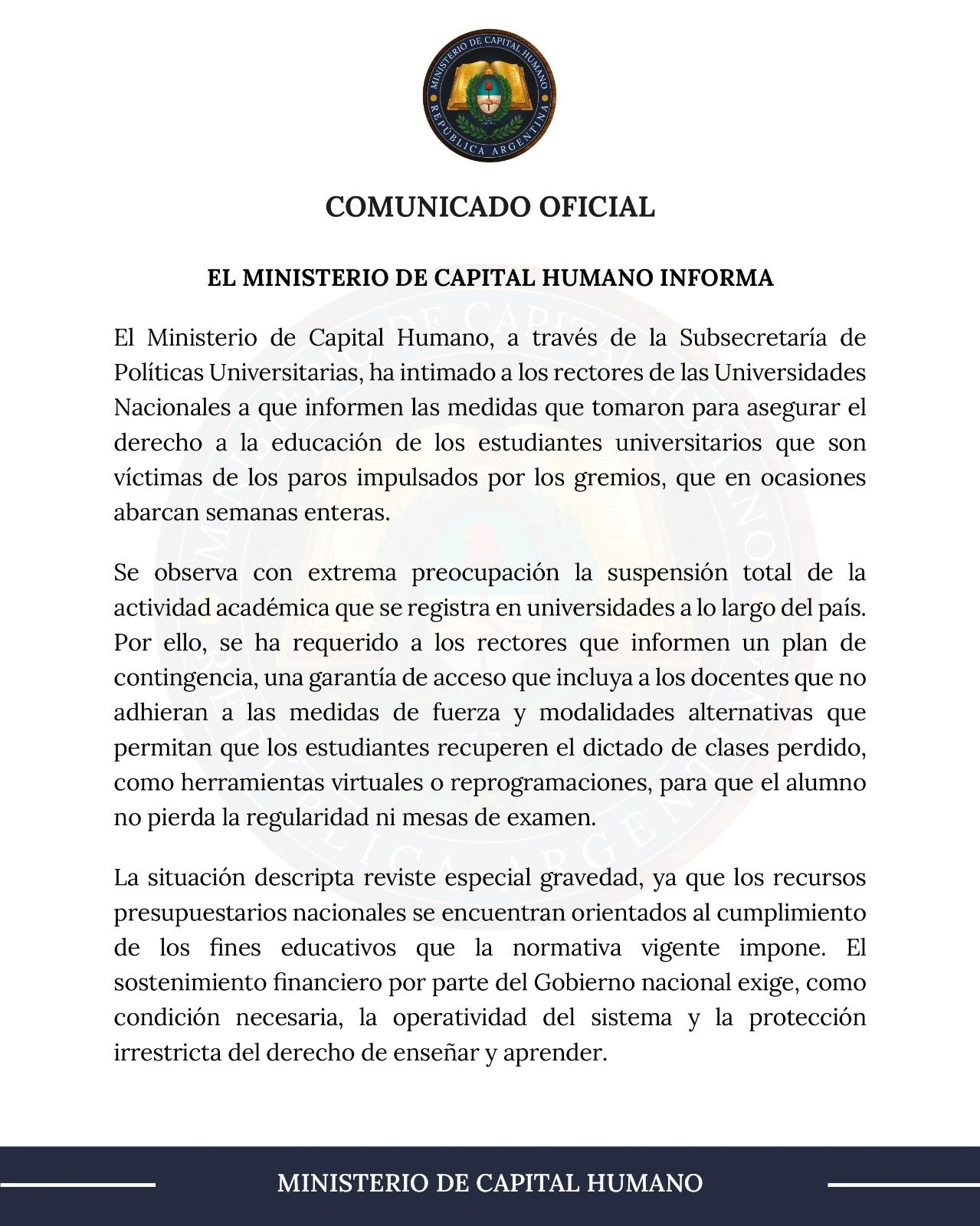
The release from Human Capital.
According to the official document, the national administration expressed extreme concern about the suspension of academic activity, which, in some cases, extends for weeks. Within this framework, schools were required to implement contingency plans to sustain the teaching of classes and guarantee the students' right to education
.
The requirement includes three central points: ensuring access to establishments for teachers who do not adhere to stoppages, implementing alternative modalities —such as virtual tools or reprogramming— and ensuring that students do not lose their regularity or their exam shifts.
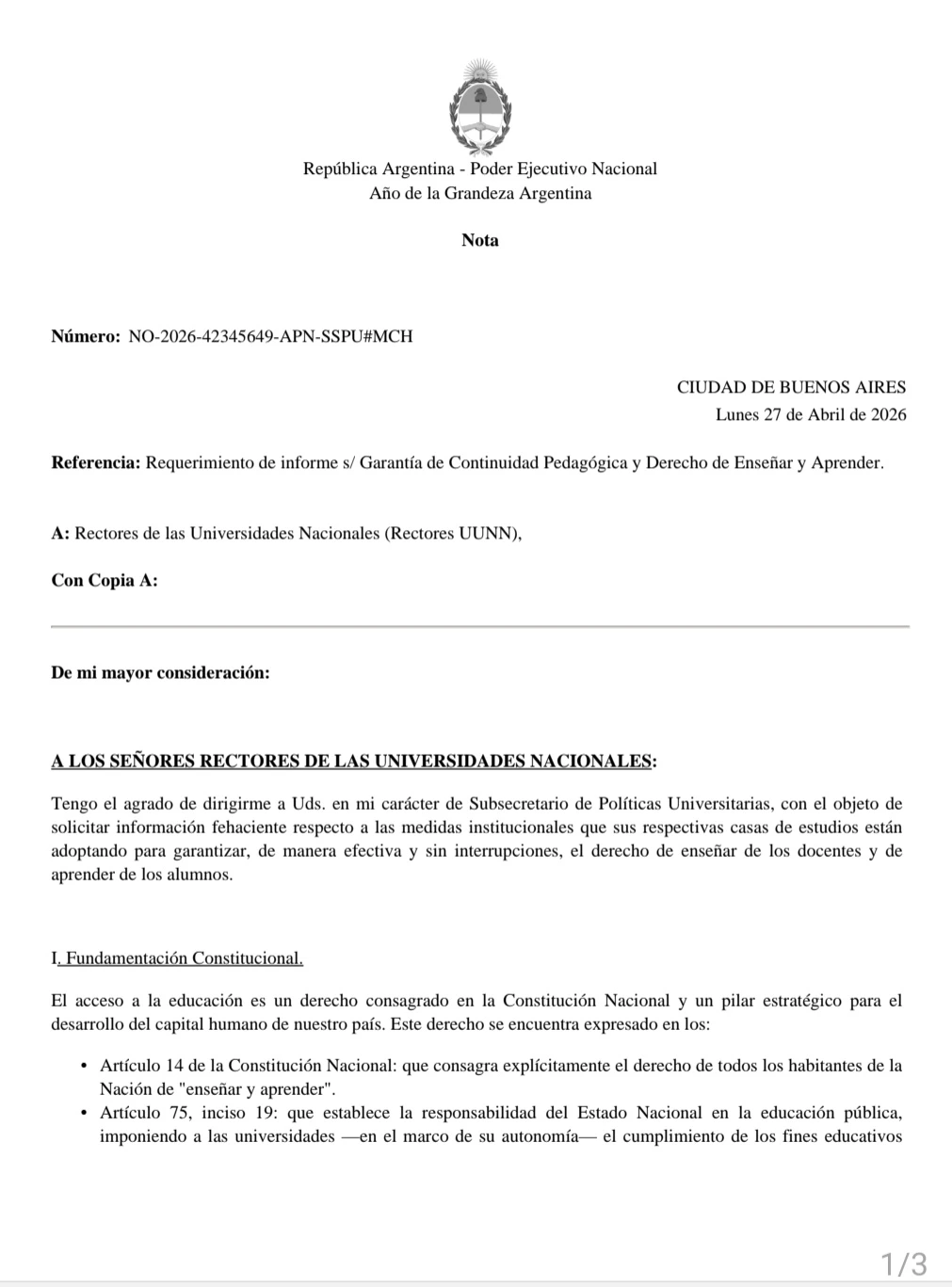
Excerpt from the statement issued by the Undersecretary for University Policies.
The Government's approach is based on constitutional foundations. The text recalls that the right to teach and learn is enshrined in the National Constitution and that its fulfillment cannot be subordinated to trade union conflicts. Along these lines, it should be noted that the exercise of the right to strike cannot cancel access to education
.
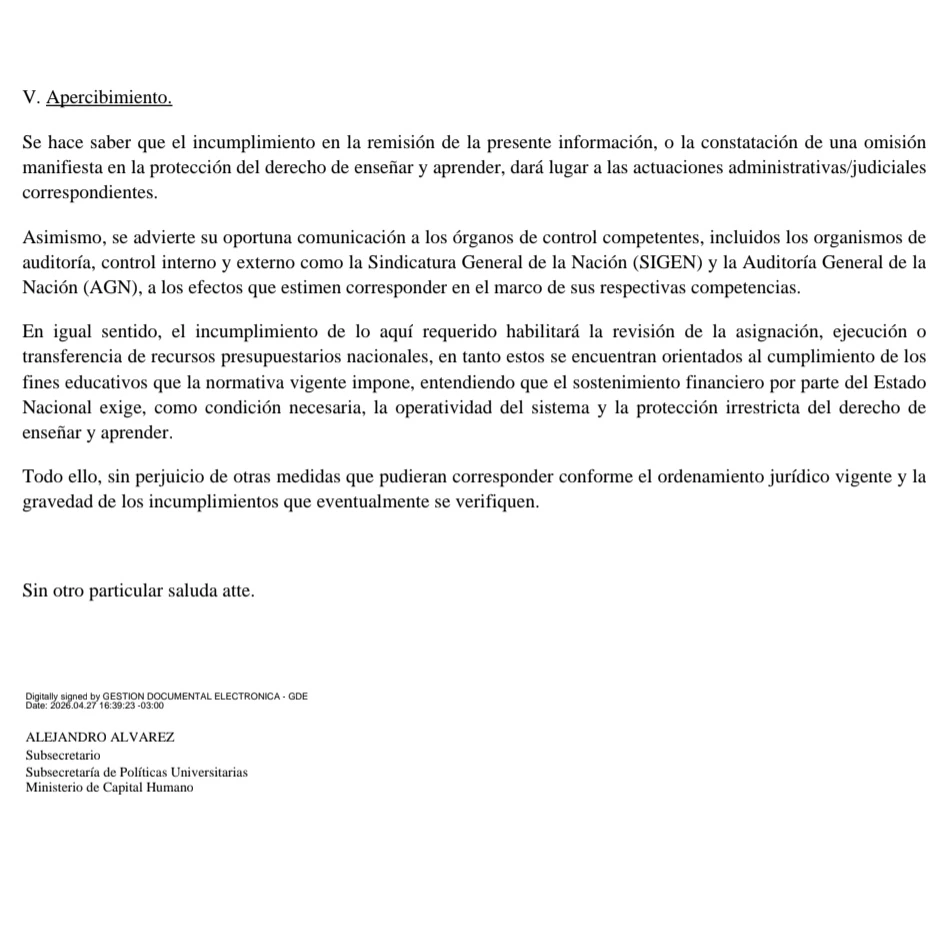
In addition, the document introduces a key point in the discussion: funding. From the Casa Rosada, they made it clear that the economic support of the university system by the national State requires, as a necessary condition, the operation of the educational service
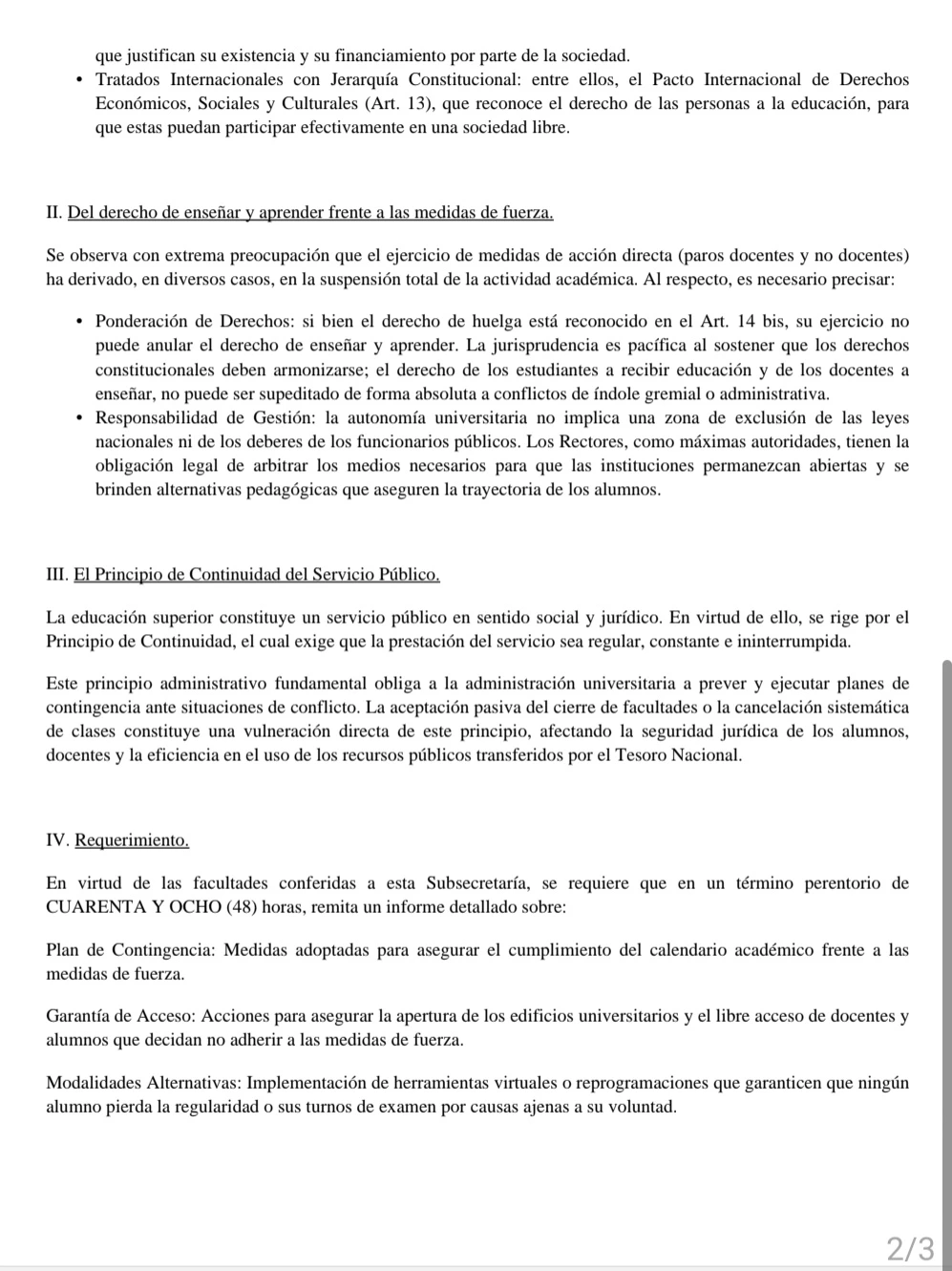
. Excerpt from the statement issued by the Undersecretary for University Policies.
In this regard, Álvarez himself publicly warned that non-compliance with these obligations could result in the revision of the allocation, execution or transfer of national budgetary resources. In other words, it opens the door to possible measures on funding in case universities do not guarantee the basic functioning of the system
.
The text also invokes the principle of continuity of public service, pointing out that higher education must be provided on a regular, constant and uninterrupted basis. Under this criterion, the systematic cancellation of classes or the closure of powers could constitute a direct violation of
that principle. Excerpt from the statement issued by the Undersecretary for University Policies.
Finally, the Government stated that, in the event of non-compliance, control bodies such as the General Office of the Nation (SIGEN) and the General Audit Office (AGN) will be intervened, in addition
to allowing possible administrative or judicial actions.
With this movement, Javier Milei's administration tightens its position in the face of trade union conflicts in the university environment and seeks to transfer the responsibility for ensuring the functioning of the system to the authorities of each institution.