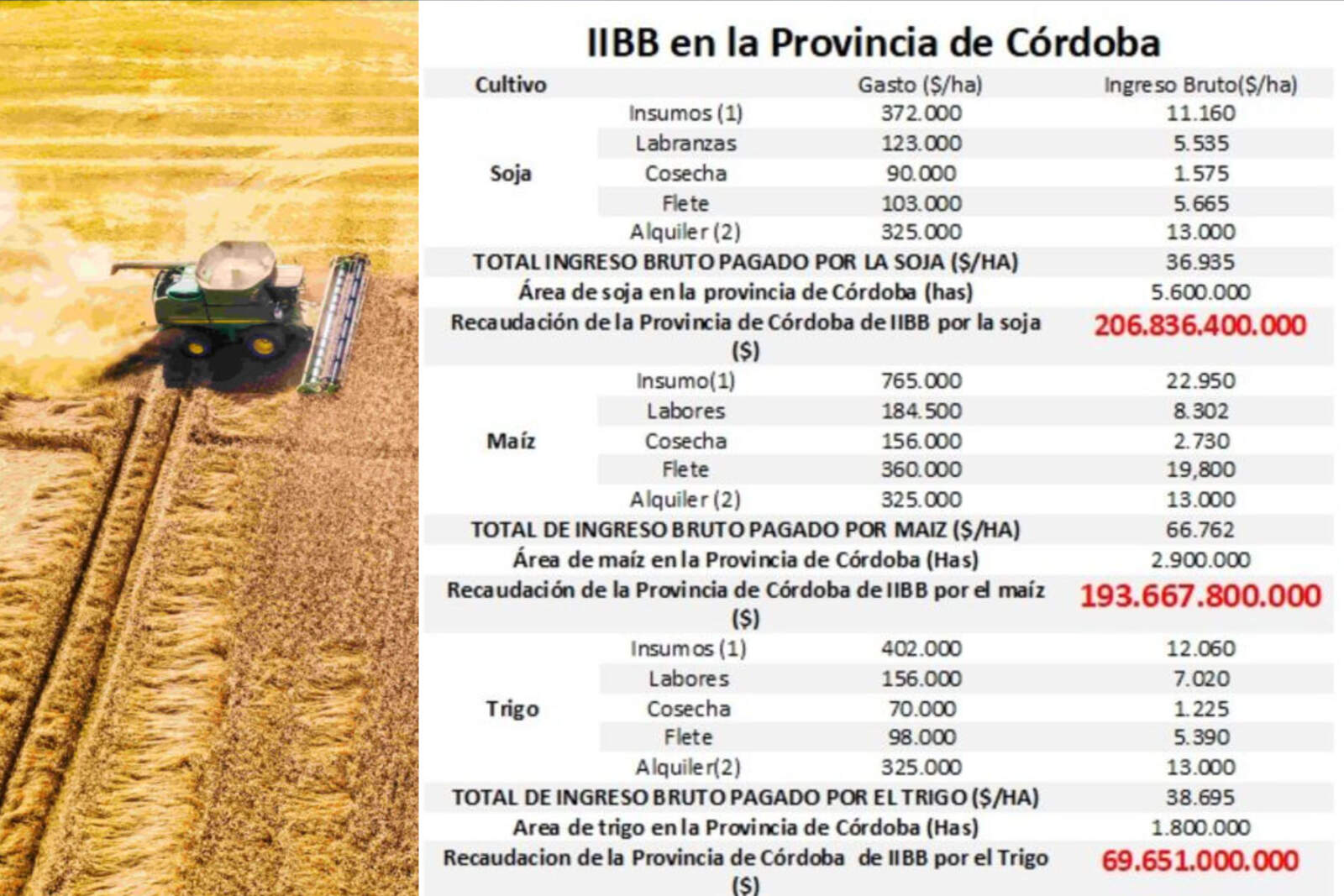
While the sector awaits the 2026 Budget, concern is growing about the future of the Rural Property Tax. Although agriculture is exempt from the Gross Income Tax (IIBB), a report by former leader Néstor Roulet showed its indirect impact. According to the study, producers end up financing a large part of provincial revenue through the consumption of goods and services.
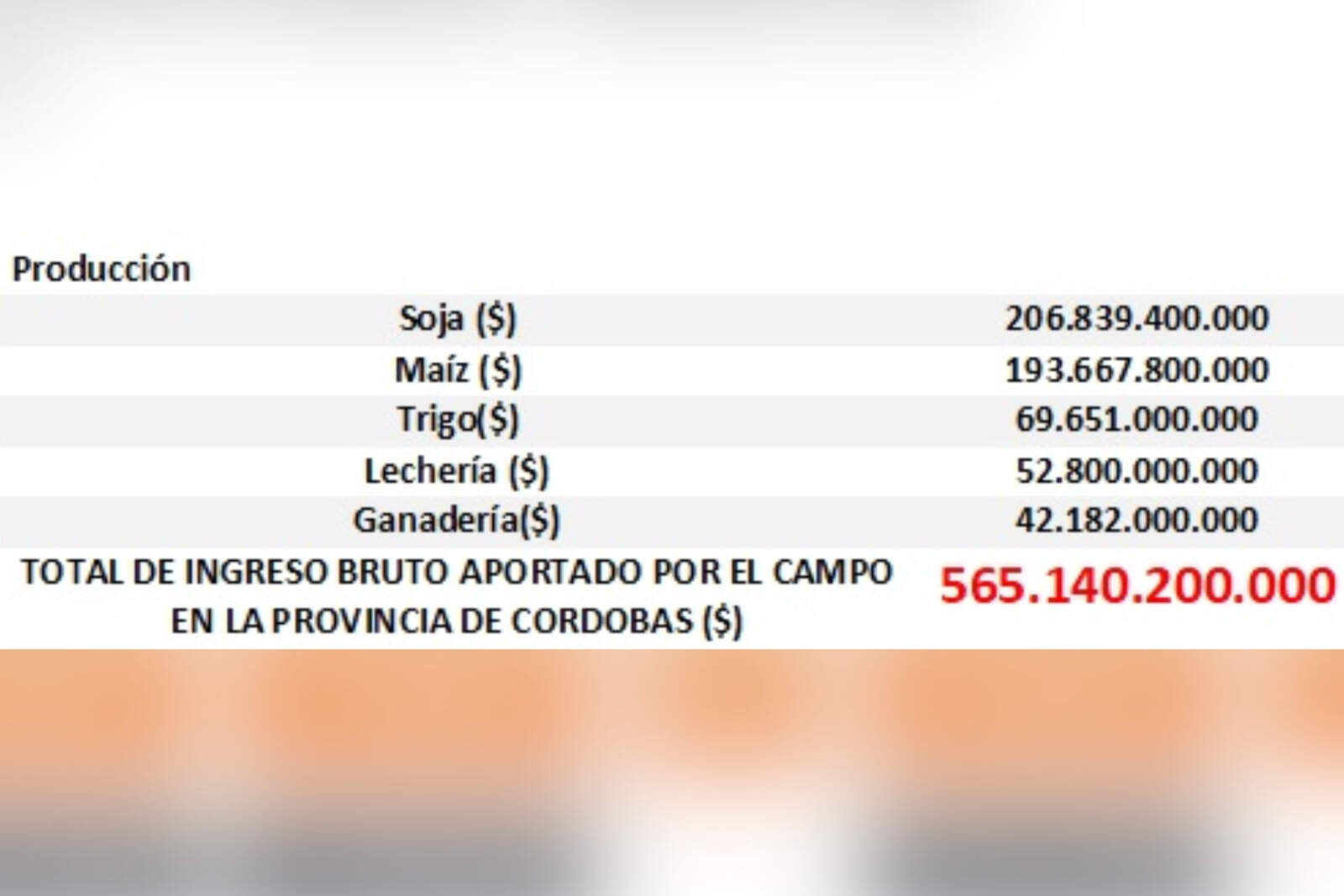
En total, el campo cordobés genera $ 565.140 millones por Ingresos Brutos al campo.
The hidden tax in agricultural production
Roulet explained that IIBB is applied to the supply chains of inputs and services that supply the sector. Although it doesn't appear on invoices, its cost is passed on to the final price paid by producers. Unlike VAT, this tax is multi-phase and cumulative, which increases costs at each stage of the chain.
For example, agrochemicals are taxed at 3.5% in wholesale sales and 3% in retail, significantly raising the final price. The impact multiplies when considering all the inputs and services needed to plant, produce, and market. According to the study, the indirect tax burden erodes the sector's competitiveness.
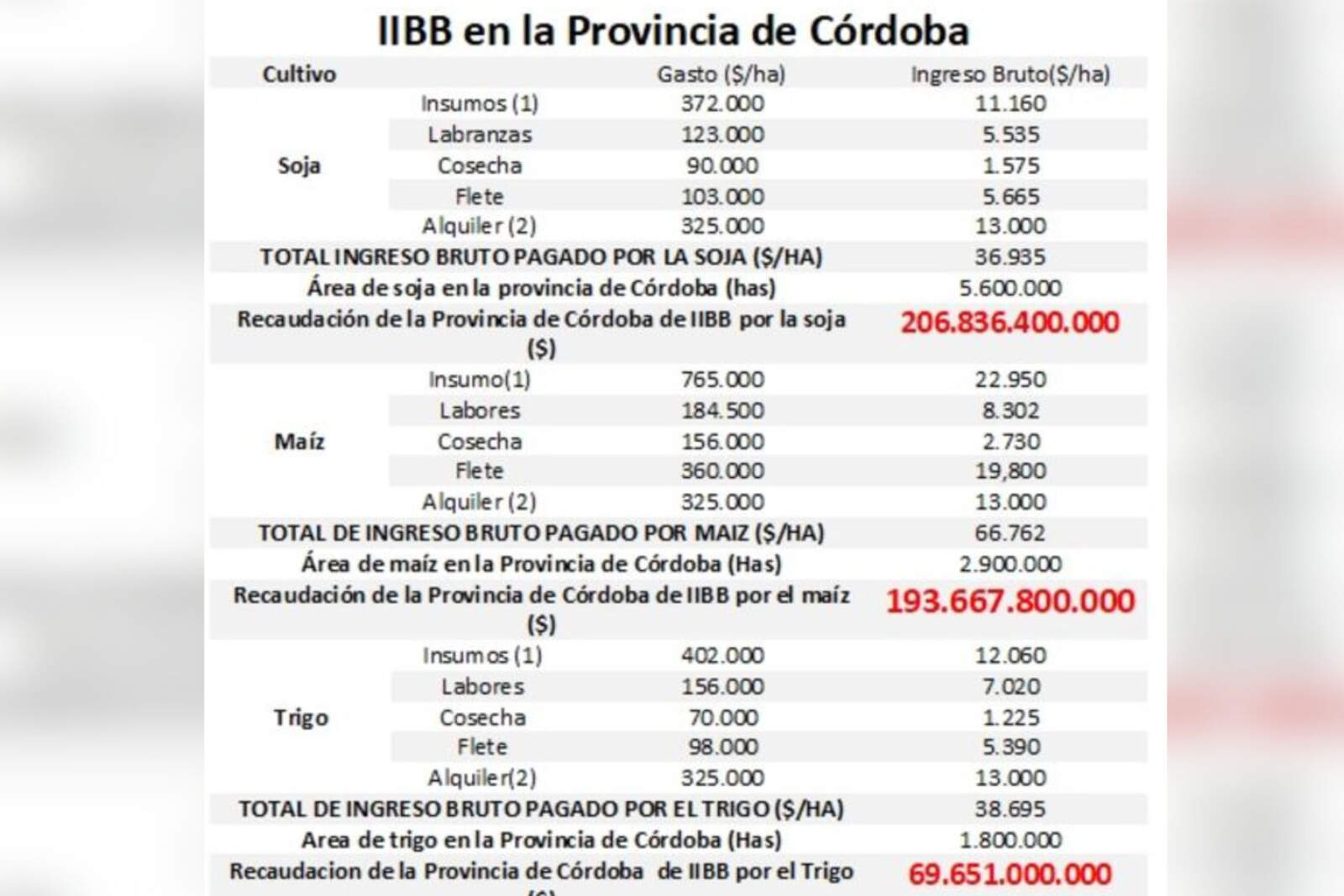
El informe estimó que solo en los tres principales cultivos —soja, maíz y trigo— el agro aporta $ 470.000 millones en IIBB.
The multimillion-dollar impact of agriculture on provincial revenue
The report estimated that only in the three main crops—soybean, corn, and wheat—agriculture contributes $470,000 million in IIBB. To this are added $52,800 million from the dairy sector and $42,182 million from the livestock sector. In total, the Córdoba agricultural sector generates $565,140 million from this tax.
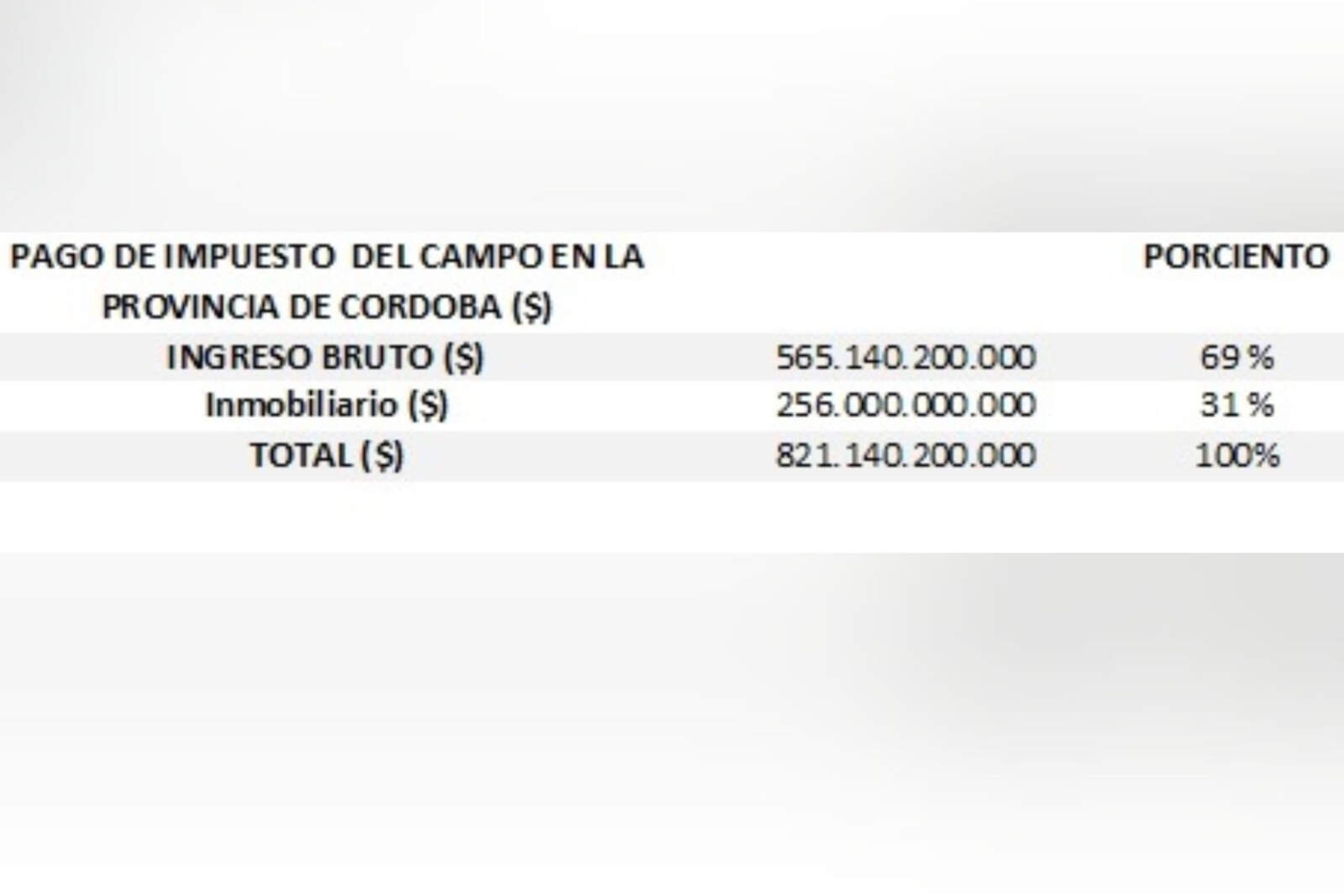
When compared to the Rural Property Tax, whose revenue in 2024 was $256,000 million, the indirect contribution from IIBB is more than double. In total, agriculture contributes more than $821,000 million to provincial coffers, according to the study. The figure is equivalent to 21% of the revenue collected from Gross Income Tax in Córdoba.
Si se compara con el Inmobiliario Rural, cuya recaudación en 2024 fue de $ 256.000 millones
A call to review the agricultural tax structure
Roulet argues that, given the magnitude of the indirect contribution, the distribution of these funds should be reconsidered. He proposes that part of the IIBB caused by rural activity be allocated to the Agricultural Development Fund. Currently, that fund is financed almost exclusively with 98% of the Rural Property Tax.
The analysis exposes a recurring contradiction: the provincial government indirectly taxes the sector that most drives the economy. The current tax scheme discourages investment and reduces the competitiveness of Córdoba's agricultural sector. A fiscal review would be key to balancing equity and tax efficiency.