Driven by trade liberalization and deregulation, clothing reached its lowest relative value since 2016
Compartir:
Since the inauguration of the government of Javier Milei, the price of clothing in Argentina has recorded a sharp drop in relative terms and has reached its lowest level in almost a decade.
Driven by trade liberalization and deregulation, clothing has become 30.6% cheaper compared with the average of the economy and has reached its lowest relative value since 2016, according to a report by consulting firm Analytica. The phenomenon has become one of the most visible changes in everyday consumption under the libertarian administration.
Bajó el precio de la ropa en términos relativos.
The report indicates that, since November 2023, while overall inflation has accumulated an increase of 259.4% due to the economic crisis caused by Kirchnerism, clothing and footwear prices have risen 149.4%, a difference that explains the marked relative reduction in prices in the sector. In that context, clothing has ceased to be among the most expensive goods in the country compared with the rest of the economy and has begun to align with international values.
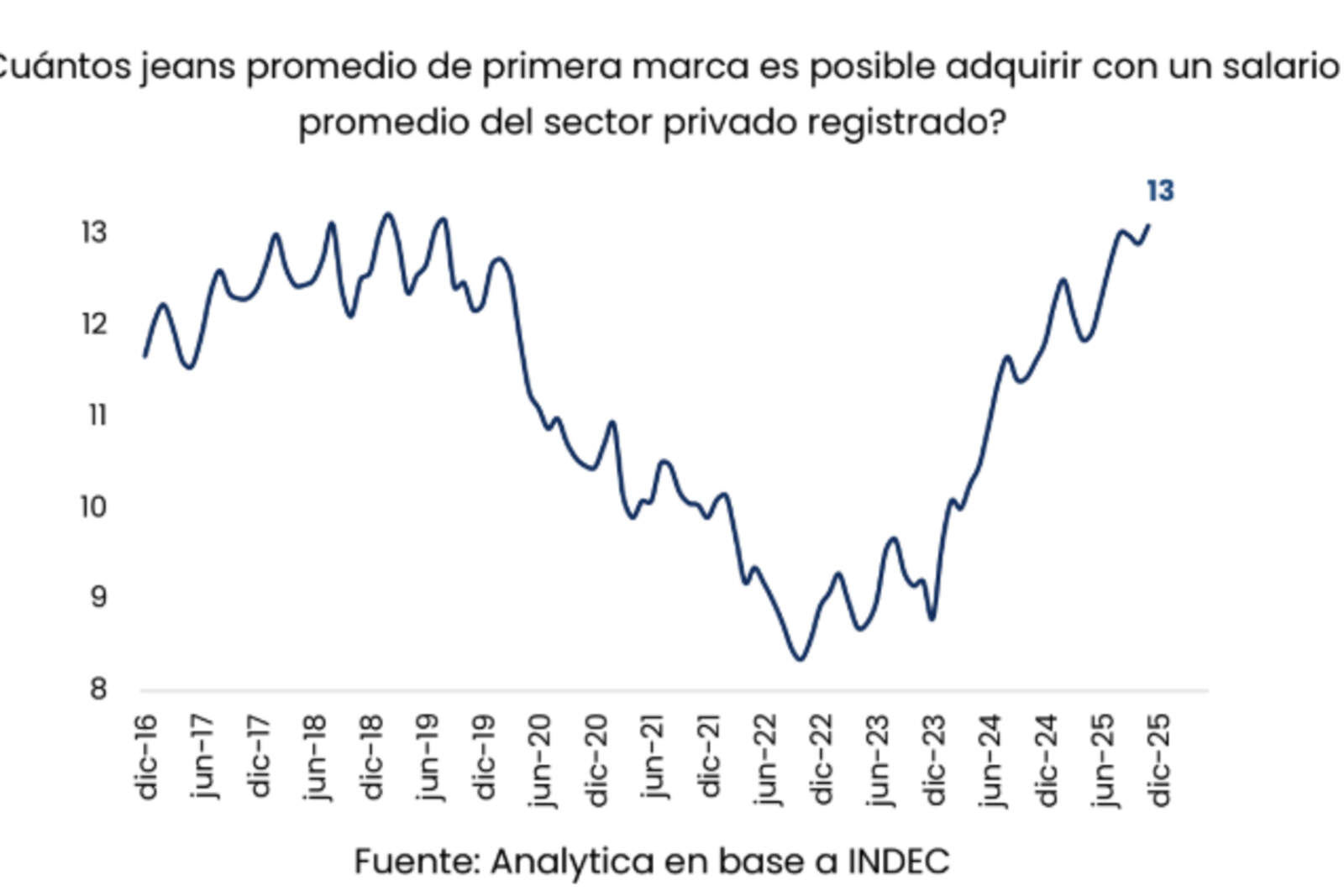
The impact is also evident in official dollars. A top-brand pair of jeans has dropped 39% and, with the average formal salary, people can now buy 13 pairs of jeans, compared with the 9 that people could purchase in 2023, which demonstrates the increase in purchasing power.
El informe de Analytica.
The drop in prices has been accompanied by strong growth in imports. According to Analytica, external purchases of clothing grew 97.3% year-on-year, which represents about an additional USD 336 million. In the case of other textile products, the increase was 121.2%, with an additional USD 94 million, while the footwear and parts segment showed a rise of 25.2%, equivalent to an additional USD 166 million compared with the previous year.
In aggregate terms, clothing imports totaled USD 681 million in 2025, the highest value in the historical series measured at constant prices. In parallel, imports of footwear and parts reached USD 825 million, just below the 2017 record, when they stood at USD 857 million. These data reinforce the idea of greater external competition as a key factor in the reduction of prices.
El presidente Javier Milei.
Toto Caputo's statements
In this context, the Minister of Economy, Luis "Toto" Caputo, recently questioned the disastrous protectionist scheme that had been in force for decades. “The textile sector is also an emblematic case of a sector that has been protected for many years, with the story that there are 150,000 families who work in this. But there are 47 million Argentines who have had to pay for textiles and footwear two, three, four, or even ten times what they are worth in the world,” he stated.
Caputo described protectionism as “a foolish measure that harms those who have the least” and added: “I never bought clothes in Argentina in my life because it was a rip-off. So those of us who had the possibility of traveling bought abroad.”
Along those lines, he maintained that the drop in prices generates a positive effect on the entire economy: “If you pay five dollars for a T-jersey instead of 50, you now have 45 dollars to spend on something else. So you'll go out to eat, you'll have an ice cream, and those resources will be allocated to other industries.”