A discovery at the Lingjing site reveals that Homo juluensis developed complex technology during a harsh glacial period, challenging the idea that creativity only arises in favorable times.
Researchers in China found evidence that 146,000 years ago, during a harsh ice age, a group of ancient humans crafted stone tools with surprisingly advanced technology. The finding comes from the archaeological site of Lingjing, in the central part of the country, and belongs to Homo juluensis, an extinct relative of modern humans.
For more than ten years, scientists excavated animal bones and sophisticated stone tools. The new study, published in the Journal of Human Evolution, determined that the site dates back to about 146,000 years ago, during a cold glacial period, and not during a warm stage as previously thought.
This information completely changes the traditional view. For a long time, it was believed that creativity and technological advancements primarily emerged during times of stability and abundance. However, the discovery shows that environmental difficulties can drive innovation and adaptation.
Tools that demonstrate planning
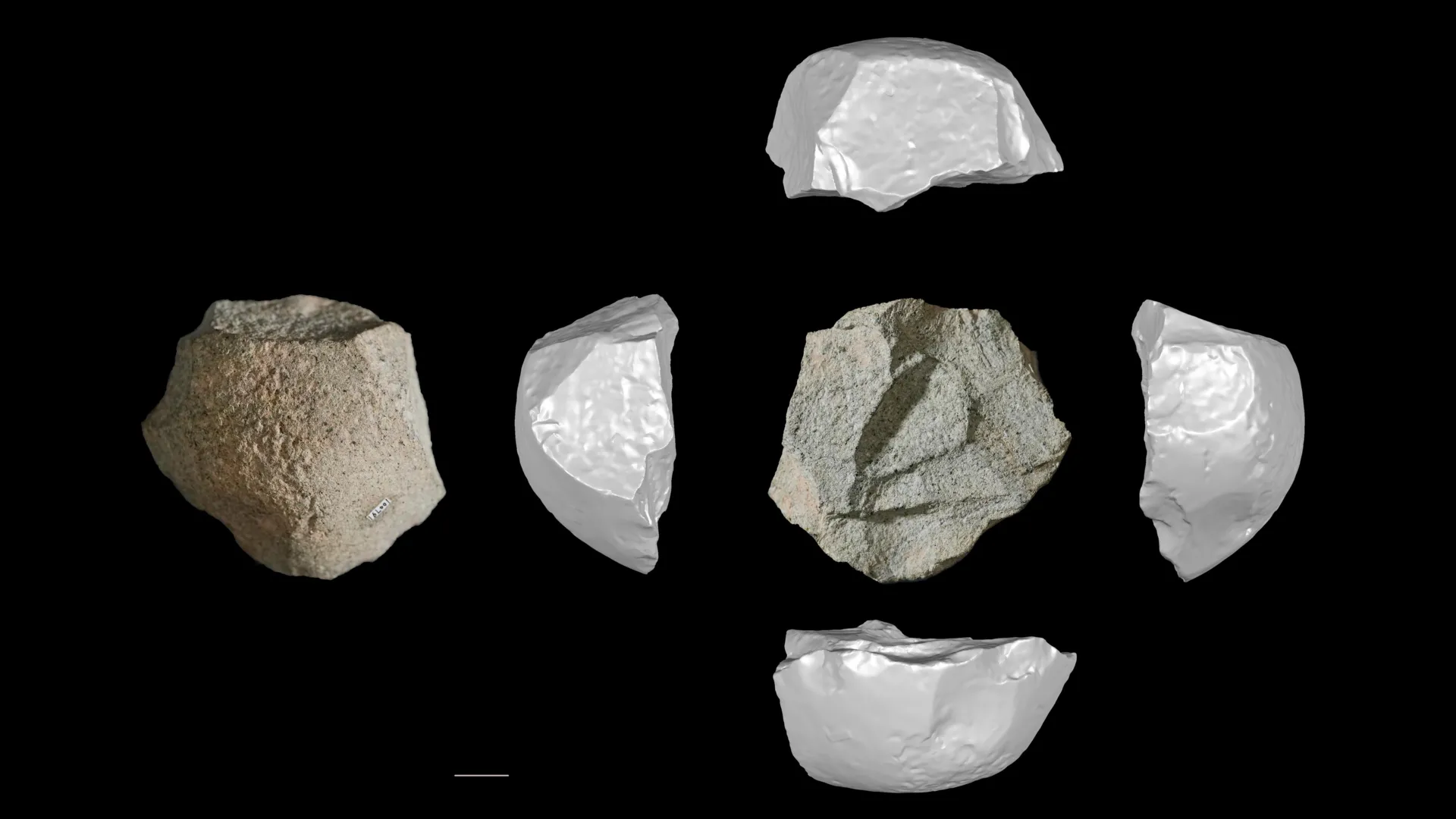
At first glance, the disc-shaped stone cores do not seem extraordinary. But a detailed analysis revealed a highly organized manufacturing process. The Homo juluensis struck smaller stones against larger cores to obtain useful sharp flakes.
Some cores were worked evenly on both sides, while others followed a more intentional design: one side served as a striking platform and the opposite was prepared to produce sharp flakes. This asymmetric technique indicates that the makers understood the stones as three-dimensional objects and did not just strike them randomly.
“It was not a casual production of flakes, but a technology that required planning, precision, and a deep understanding of the properties of the stone and its fracture mechanics,” explained the lead researcher. These cognitive skills show similarities with Middle Paleolithic technologies associated with Neanderthals in Europe and human ancestors in Africa.
A more precise dating thanks to crystals
The team also refined the age of the site by analyzing calcite crystals within a rib bone of a deer-like animal. These crystals contain uranium that over time transforms into thorium, functioning as a natural clock.
Previous estimates placed the tools at around 126,000 years, but the new analysis pushed them back about 20,000 years. This change places human activity in a much more hostile environmental context, during a severe glacial period of the Pleistocene.
The researchers highlight that the site functioned as a butchering place where animals were processed. The findings force a reevaluation of technological development in East Asia during the late Middle Pleistocene, a region that was previously considered to have more limited advancements compared to Africa and Europe.
Creativity born from adversity
“People often imagine creativity as something that flourishes in good times. Discovering that these tools were made during a harsh ice age tells a different story,” noted Yuchao Zhao from the Field Museum in Chicago. The study suggests that extreme conditions may have forced these humans to develop more complex solutions.
Homo juluensis had very large brains and combined traits from different ancient human groups. They likely interacted with ancestors of Homo sapiens. This finding enriches the narrative of human evolution in East Asia and highlights the intelligence and innovative capacity of these populations.
Ultimately, the oldest known centripetal technology in East Eurasia demonstrates a level of behavioral complexity that is surprising for that time and region. Researchers continue to analyze the material to better understand how these ancient inhabitants lived and adapted.