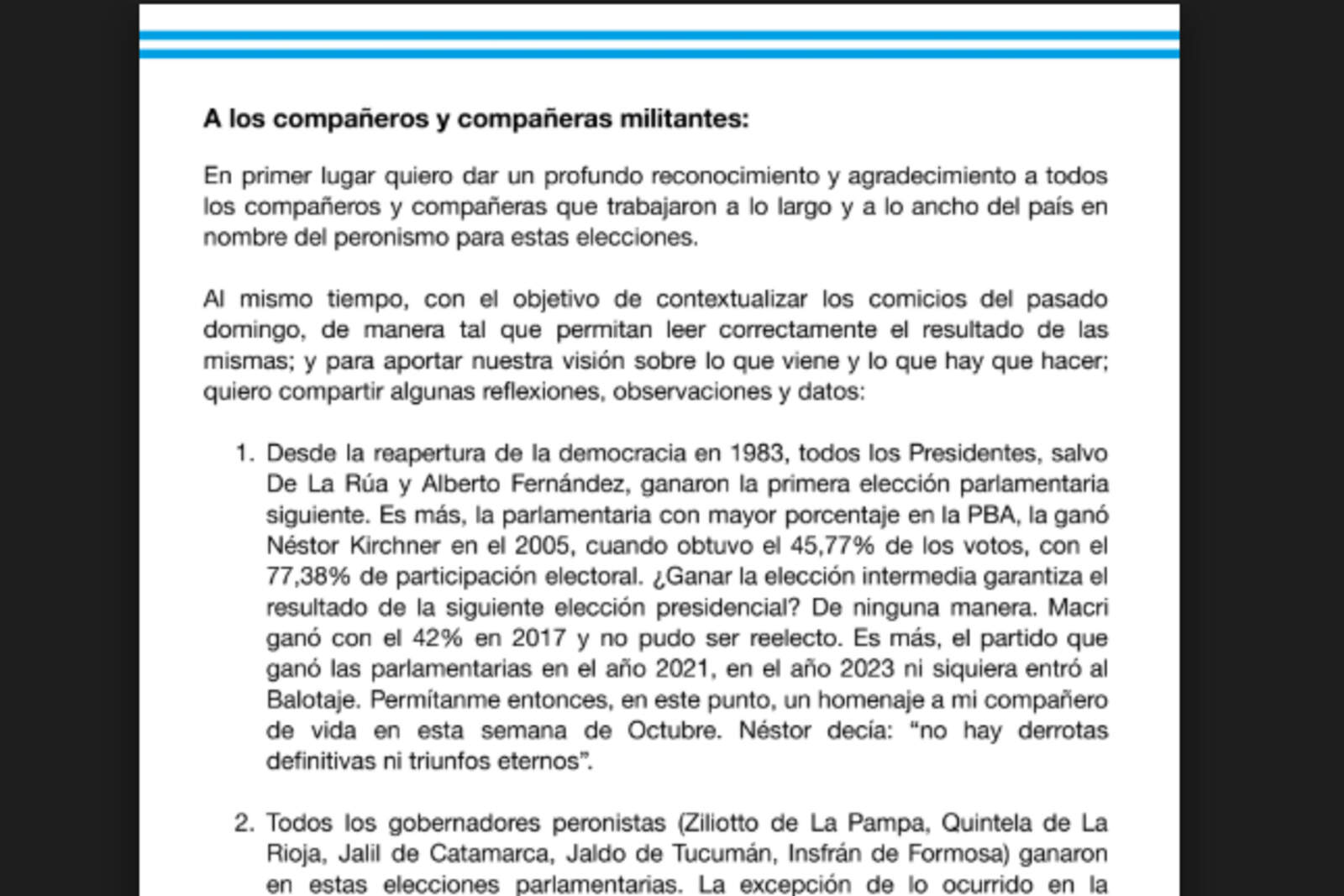
The internal conflict within Peronism remains heated, and it seems it will continue for some time. Former president Cristina Fernández de Kirchner reappeared this Friday with a letter addressed to her supporters, in which she blamed Governor Axel Kicillof for the electoral defeat and described the decision to split the Buenos Aires elections as a "political mistake."
Así inicia el documento dirigido a su militacia.
The text, titled "October 26 Election," was released from her apartment at San José 1111—where she is serving a sentence for corruption cases—and contains an extensive attempt at political, economic, and judicial analysis of the electoral result. Clearly too late for them, since it failed to prevent Milei from winning the national elections by more than 11 points.
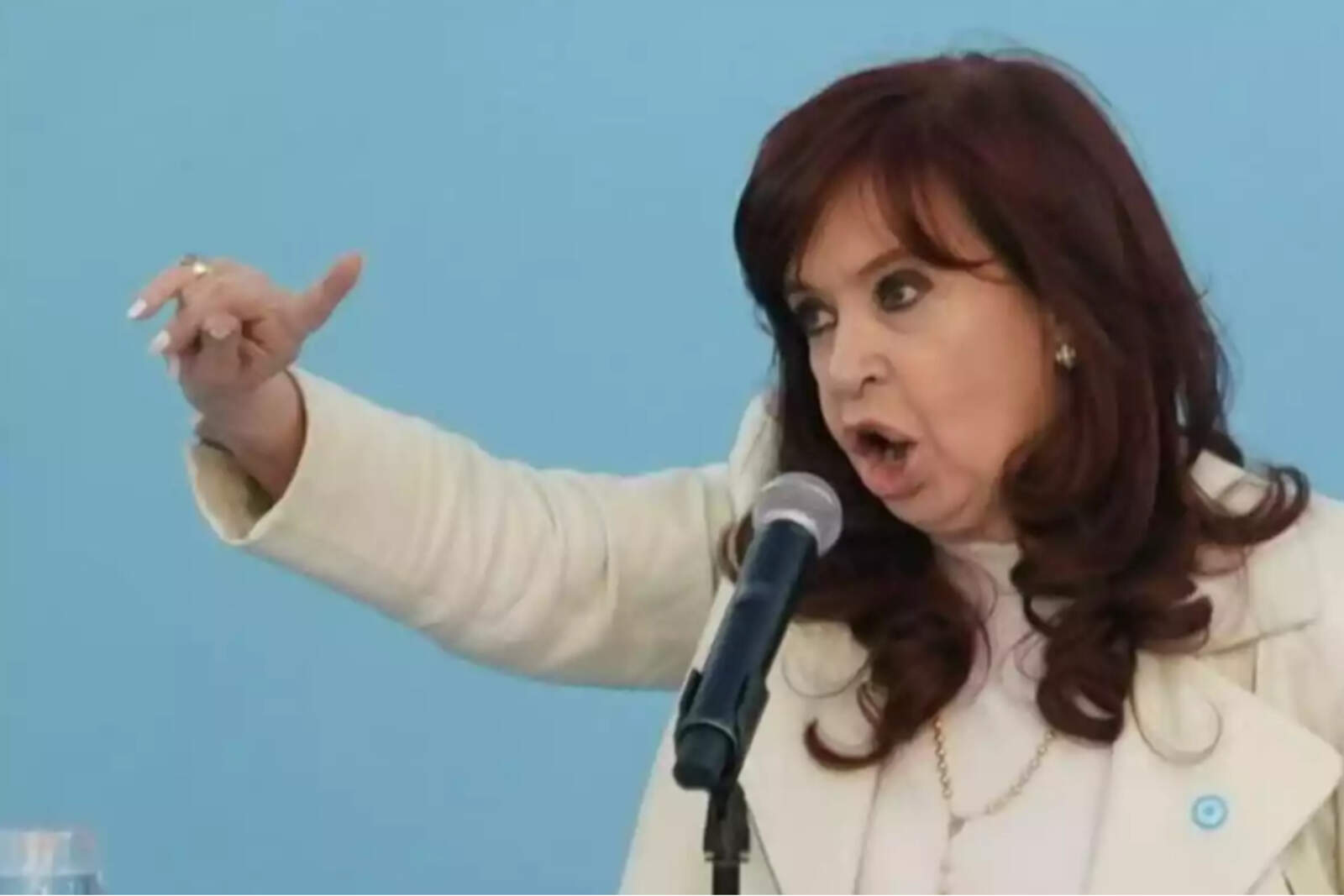
Cristina desde su prisión domiciliaria
"The exception of what happened in Buenos Aires Province is due to a political mistake in choosing the electoral strategy, deciding to split the elections," wrote the former president, pointing directly at Axel Kicillof.
According to her interpretation, moving the provincial elections forward acted as an "early runoff," which allowed the anti-Peronist vote to regroup and influenced the result on October 26. This reading avoids acknowledging a host of other factors that affected the province, such as, for example, the use of the Single Paper Ballot (BUP), which enabled transparent elections free from the pressure of mayors.
In her letter, Cristina warned that moving the elections forward in the province "was very risky due to its symbolic and electoral weight," since a defeat in that territory could have a "devastating effect" for Peronism at the national level. In this regard, she was not mistaken, because without a doubt the movement is completely weakened, but this is more due to the lack of popular vote than to the splitting of the elections she points to.
Cristina vs. Kicillof
Internal conflict and leadership breakdown
The document, which contains more than ten sections, deepens the internal crisis of Peronism. The leader, convicted of stealing money from Argentinians through corruption schemes involving public works, tries to maintain her role as a political reference, but her authority is in decline.
Cristina Kirchner, ex vicepresidente, se niega a perder su poder partidario
Peronism is broken because its leadership is extinct. No matter how hard she tries, it is impossible to lead such a movement from her apartment.
The letter, filled with historical references and self-referential quotes, confirms that Cristina Kirchner feels increasingly distant from national leadership. She tries to influence the party's decisions, without realizing that Peronism is in the midst of an internal conflict where it is uncertain who will emerge victorious.
The inevitable complaint about her conviction
In one of the passages, the former vice president tried to combine self-criticism with judicial victimization. She denounced an alleged "offensive to break Peronism," alluding to her "imprisonment and disqualification" as part of a political, media, and judicial disciplining strategy.
However, society recognizes that the reality is that she was convicted for proven acts of corruption and today is serving her sentence while she continues to intervene in the political scene.
Despite the criticism of Kicillof and the harsh tone of the document, the former president ended with a call for unity. "I continue to uphold the value of unity as a political instrument for national, popular, and democratic construction," she wrote.
From confinement, Cristina Kirchner seems to have plenty of time to write and read, although her words actually reflect what seems to be more desperation than strategy.