There are changes in the update of the floating bands and a plan to strengthen international reserves
Nuevo
Agregar La Derecha Diario en
Compartir:
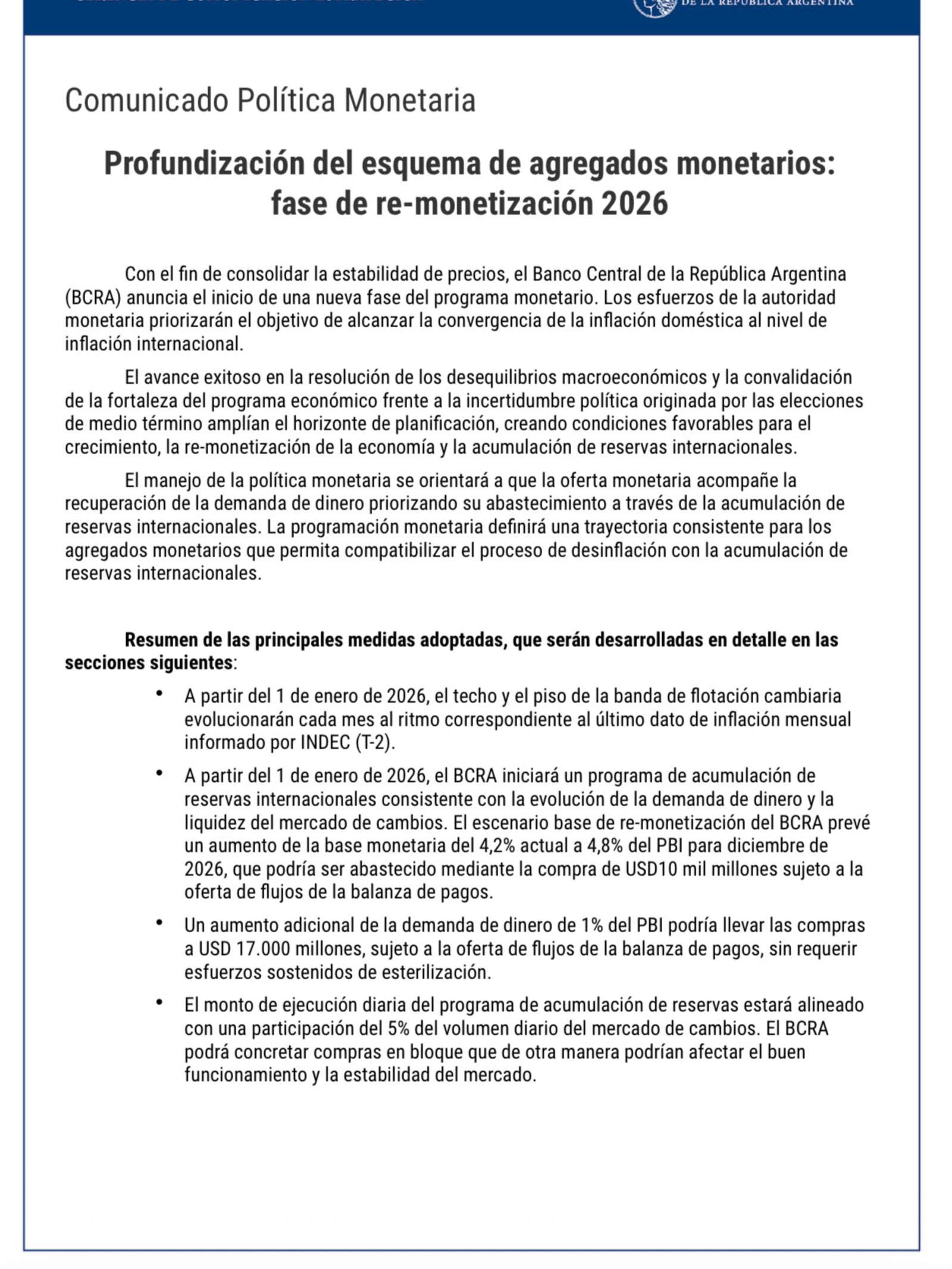
The Government of Javier Milei, through the Central Bank of the Argentine Republic (BCRA), announced a change in exchange rate and monetary policy that will take effect starting in January 2026, marking the beginning of the "re-monetization" phase of the economy.
The monetary authority reported that the dollar floating bands will be updated monthly based on inflation, while outlining a plan to strengthen international reserves through foreign currency purchases that could reach up to USD 17,000 million, provided that a higher level of money demand in the economy is consolidated.
According to the official statement, the new framework provides that the floor and ceiling of the exchange rate band will be automatically adjusted following the consumer price index.
"Starting January 1, 2026, the ceiling and floor of the exchange rate floating band will evolve each month at the pace corresponding to the latest monthly inflation data reported by Indec," stated the agency headed by Santiago Bausili.
El comunicado del BCRA.
The purchase of reserves
Meanwhile, the BCRA presented the guidelines of a reserve accumulation strategy that will be closely linked to the process of remonetizing the economy.
The agency's central projection contemplates an expansion of the monetary base from the current 4.2% of Gross Domestic Product (GDP) to 4.8% by the end of 2026. To achieve this objective, the Central Bank estimates that it will be necessary to purchase around USD 10,000 million, provided that the balance of payments shows compatible flows.
However, the framework contemplates a more ambitious scenario. If money demand increases by one additional percentage point of GDP, foreign currency purchases could scale up to USD 17,000 million. The institution clarified that this process would be carried out based on the availability of dollars in the balance of payments and without permanently resorting to monetary sterilization mechanisms.
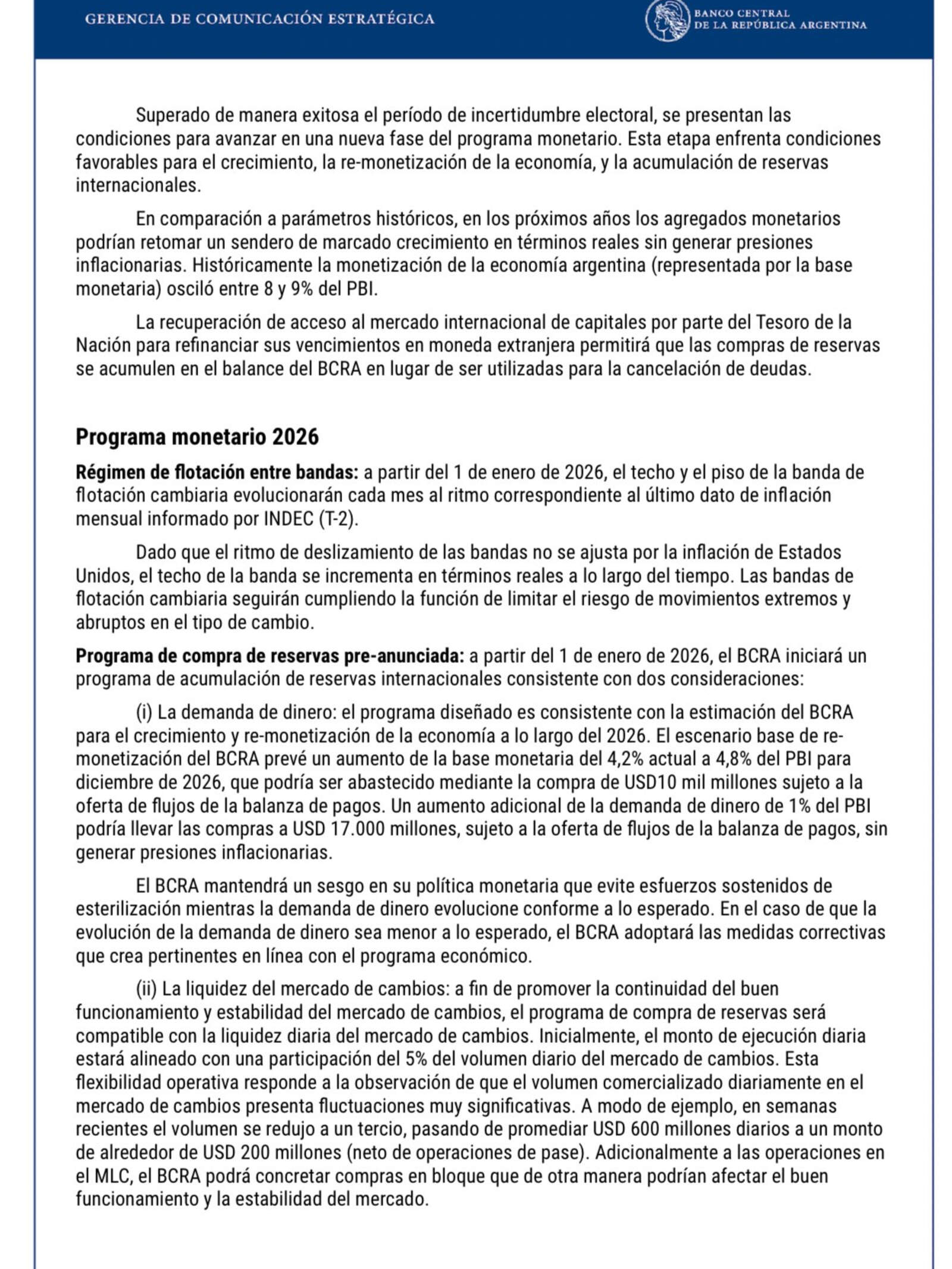
Another central aspect of the announcement is the way in which the Central Bank will intervene in the foreign exchange market. In an initial stage, daily reserve purchases will be limited to 5% of the volume traded in the market, with the aim of avoiding distortions in operations. In addition, the monetary authority reserved the possibility of making large block acquisitions when necessary to preserve market stability.
El comunicado del BCRA.
In the statement, the agency highlighted the political and macroeconomic context as a key factor for moving forward with these changes. "Having successfully overcome the period of electoral uncertainty, conditions are in place to move forward with a new phase of the monetary program. This stage faces favorable conditions for growth, the re-monetization of the economy, and the accumulation of international reserves," stated the Central Bank.
In terms of monetary policy, the BCRA anticipated that it will closely monitor the evolution of inflation, its relationship with the level of activity, and the financial conditions that influence money demand. If local inflation remains above international levels, the institution will adopt a contractionary stance regarding its baseline projection of money demand.
To manage the issuance associated with reserve purchases, the Central Bank will continue to use traditional instruments. Among them are open market operations, with the purchase and sale of LECAPs in pesos, and LECAP repos with financial institutions, tools that will seek to correct potential imbalances in the money supply and sustain system stability.
"The BCRA anticipates a cycle of expansion in economic activity and credit to the private sector, driven by market incentives that favor investment, exports, and consumption. Free from stocks of remunerated liabilities, the BCRA will supply money demand through its international reserve purchase program. With the aim of continuing to reduce inflation, the BCRA will maintain a contractionary bias in monetary policy, ensuring that the money supply evolves at a slower pace than demand," concluded the BCRA.